








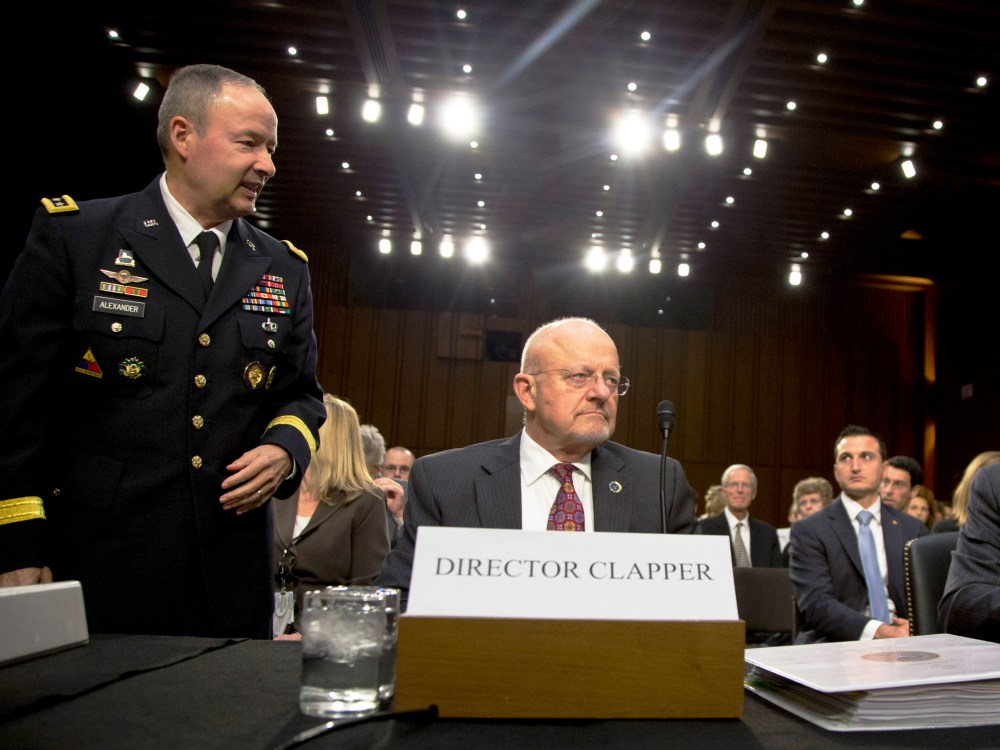
American intelligence officials and their supporters in Congress agree: the controversy over the National Security Agency’s surveillance program is the media’s fault.
“In the last few months, the manner in which our activities have been characterized has often been incomplete, inaccurate, or misleading,” James Clapper, director of national intelligence told the Senate intelligence committee Thursday. “This public discussion should be based on an accurate understanding of the intelligence community: who we are, what we do, and how we’re overseen.” General Keith Alexander, Director of the National Security Agency, likewise slammed “sensational” reporting on government surveillance powers. Republican Senator Dan Coats of Indiana complained of a “non-trusting public” fired up by a press that’s eager to “throw raw meat out there.”
California Democratic Senator Dianne Feinstein, the intel committee chair, said that the NSA’s surveillance program wasn’t even a surveillance program at all. “Much of the press has called this a surveillance program. It is not, and the general belief out there is that everyone is being surveilled, and they are not,” Feinstein said. Clapper expressed his willingness to work with Congress on reforming surveillance law, but warned that “if it’s transparent for the American people, it’s transparent for our adversaries too.”
The intelligence community leaders’ complaints essentially amount to a dispute over language. A secret court order leaked by former NSA contractor Edward Snowden in June showed that the NSA had sought and been granted access to the communications data of all the customers of a Verizon subsidiary. Similar orders are in place for other telecommunications providers. During Thursday’s hearing, Alexander insisted that collecting so many records is necessary to create a “haystack” through which to search for the needles of terrorist communications. When Colorado Democratic Senator Mark Udall asked Alexander if the NSA sought all Americans’ communications records, Alexander said the NSA should “put all the phone records into a lockbox that we can search when the nation needs to do it.”
So there’s little dispute that Americans’ communications data are being collected—or that the NSA is interested in collecting as much as possible. The intelligence leadership and its Congressional backers argue that the NSA doesn’t actually look through the massive database except when the agency has “reasonable articulable suspicion” to justify doing so, and therefore, Americans’ privacy is protected.
Critics of the law counter that Americans’ rights are violated when the government collects the data in the first place. During the hearing, they pointed out that, contrary to the intel chiefs’ complaints about misleading press coverage, the intelligence leadership had mislead the public about the nature of government surveillance prior to the leaks.
The American people “were told one thing in a public forum, while intelligence agencies did something else in private,” Oregon Democratic Senator Ron Wyden said Thursday. During a Senate hearing in March, Wyden asked Clapper if the NSA “collected any type of data at all” on Americans. Clapper gave a firm “no,” an answer he later admitted was “cute.” During Thursday’s hearing, Clapper said, “I think we have erred on the side of being transparent,” although recent government disclosures on surveillance occurred only because of the unauthorized leaks that he called “extremely damaging.” Subsequent official disclosures have revealed “thousands” of instances of the NSA mistakenly violating the law, which Alexander framed Thursday as an understandable rate of error in programs this size. The few instances of deliberate violations of the law, he said, had been referred to the Justice Department for investigation. Wyden and several of his Senate colleagues introduced a bipartisan proposal Wednesday to rein in the NSA’s surveillance authorities and place new civil liberties safeguards into the secret court process for approving requests for surveillance of suspected foreign agents. Feinstein and her Republican counterpart on the intelligence committee, Saxby Chambliss of Georgia, have promised to put forth an alternative proposal. Even as senators defended the NSA, however, they acknowledged that public opinion on the issue had shifted. That Feinstein and Chambliss, who have both vocally defended the NSA’s activities, felt they had to propose an alternative reform bill is itself a sign that legislators feel pressure to at least appear to be constraining government spying. “A lot of Americans have lost trust in what you’re doing,” said Democratic Senator Mark Warner of Virginia, who said he nevertheless supported the surveillance programs. “A bunch of senators saying ‘it’s okay’ is not gonna regain that trust.”
Adam Serwer Recommended


