









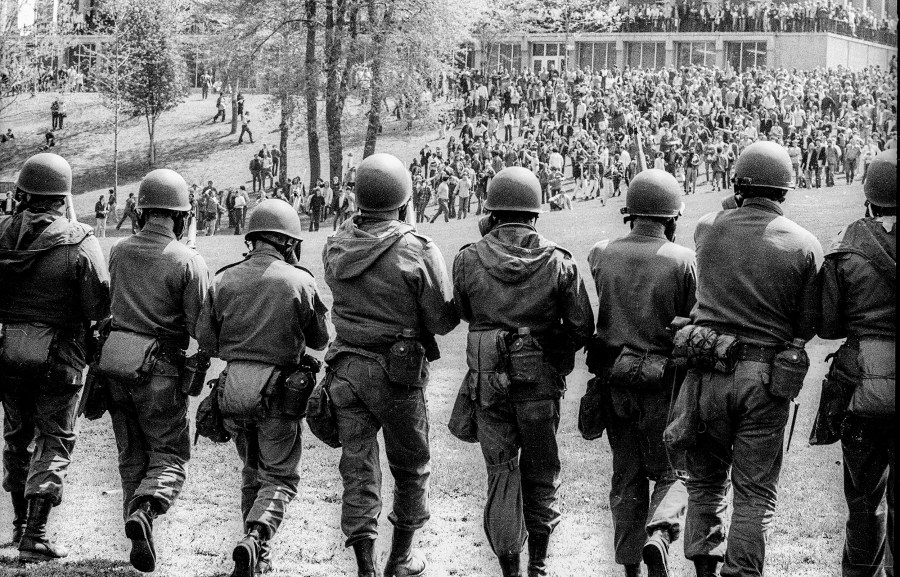
In an alternate universe, the chilling images that emerged from the 1970 shooting at Kent State University in Ohio might have inspired change. A contrite president might have helped — but Richard Nixon wasn’t fit for the task.
We’re now more than 50 years removed (to the day) from the deadly, state-sanctioned crackdown on student antiwar protesters that left four dead. And it’s clear old habits are tough to break.
In hindsight, we now know Nixon didn’t feel all that regretful. An unearthed recording of a conversation between Nixon and H.R. Haldeman, his chief of staff, found the two boasting about the deadly shooting’s ability to deter uprisings. It’s remarkable how popular that brutal view of policing has become in the conservative movement.
As president, Donald Trump fantasized about maiming protesters, and new reporting has only brought those desires into clearer view. According to Axios, former Defense Secretary Mark Esper, whom Trump fired days after the 2020 election, claims in his forthcoming book that Trump floated the idea of shooting demonstrators as they filled the streets of Washington to protest the murder of George Floyd.
“Can’t you just shoot them? Just shoot them in the legs or something?” Trump had asked, according to Esper.
It was around that time, in the summer of 2020, that Esper publicly broke with Trump and said he did not believe active-duty military troops should be deployed against protesters. Days earlier, Trump infamously warned protesters that “when the looting starts, the shooting starts,” a phrase first used by a racist Miami police chief in the 1960s about policing Black neighborhoods.
And surely you remember the time federal forces used tear gas to clear protesters from Lafayette Square in Washington moments before Trump staged a photo-op nearby.
Trump deployed thousands of National Guard troops to quell protests in 2020, which inevitably led to many allegations of misconduct and abuse.
But he’s not the only official to endorse violent state-sanctioned crackdowns on protesters. In fact, it became a rote Republican talking point to decry alleged lawlessness during the 2020 protests and encourage law enforcement to bring demonstrators to heel.
In Florida last year, we saw Gov. Ron DeSantis sign a so-called anti-riot law that would make it a felony for people to protest in allegedly violent protests. It would have also allowed authorities to detain arrested protesters until their first trial. A judge blocked the law months later, arguing its definition of “riot” was too vague and that the rationale for the law has previously been used to crack down on anti-segregation protests.
DeSantis has also proposed a volunteer, civilian military force that would answer to him and, according to state law, “assist the civil authorities in maintaining law and order.” In Kentucky, conservative lawmakers responded to the 2020 protests with a bill that would have outlawed insulting an officer, making an unkind gesture or doing anything that might “provoke a violent response” (whatever that means). Republicans in several other states have also pushed for laws meant to deter protests. And there’s evidence these ideas are encouraging brutality in the Republican base. The Dallas Morning News and the University of Texas at Tyler released a poll in 2020 that showed about 70 percent of Republicans — but only 15 percent of Democrats — supported deploying the military against protesters. Fifty years after one of the most disturbing acts of state-sanctioned, antidemocratic violence, the bloodlust for more continues. Related:
Ja’han Jones is an MS NOW opinion blogger. He previously wrote The ReidOut Blog. Recommended


