








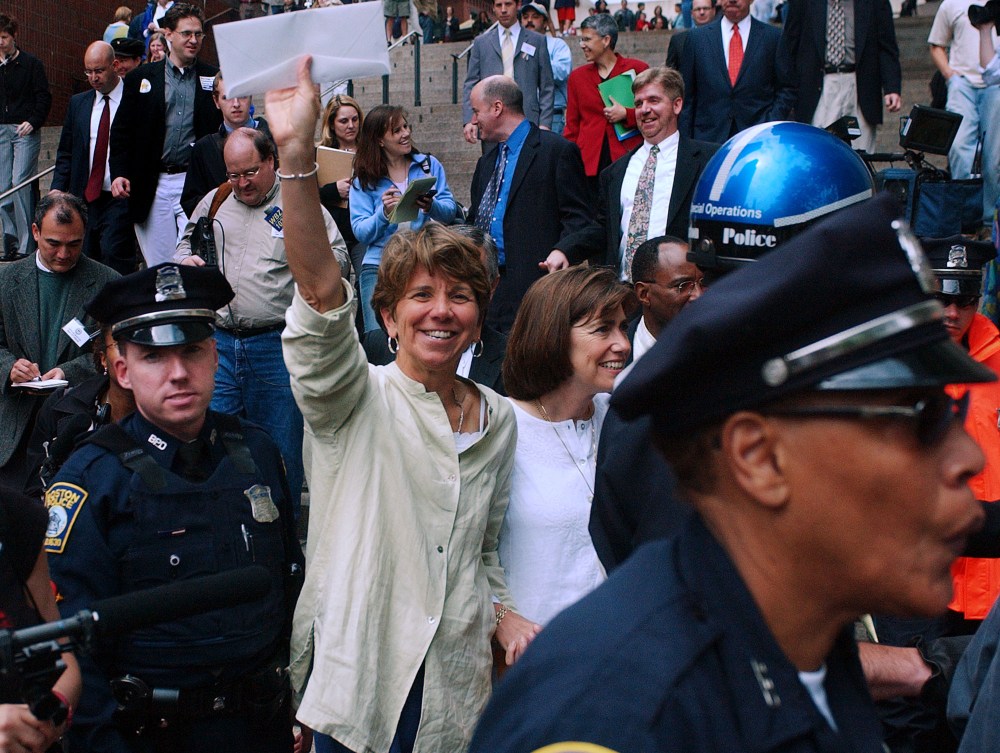
This weekend marks 10 years since same-sex marriages began in the United States. The first unions began in the early morning hours of May 17, 2004 in Massachusetts. Thousands of couples camped outside the city clerk’s office in Cambridge for a chance to be first ones legally wed. The Boston suburb was one a handful of jurisdictions to open city offices at midnight to offer marriage licenses to couples.
The marriages were made possible after a narrow decision by the Massachusetts Supreme Judicial Court. The case, Goodridge v. Department of Public Health, was brought by the organization Gay and Lesbian Advocates and Defenders on behalf of seven couples who had been denied marriage licenses in early 2001. The 4-3 ruling was issued Nov. 18, 2003, and went into effect 180 days later.
The case is considered by many LGBT advocates to be a major turning point – one that will eventually make its way into every history book in the nation.
Massachusetts, like the nation, has changed over the past decade – new laws, new lawmakers, new judges – and many of those who were instrumental in the marriage-legalization process are now retired or have moved on from the public spotlight they were cast into 10 years ago.
The Goodridge ruling was the first of its kind in the U.S. and included wording that gays and lesbians had seldom heard before from a court. In her ruling, Chief Justice Marshall, who is now the senior fellow at Yale University, wrote denying same-sex couples marriage rights created “second-class citizens” and violated the Massachusetts Constitution.
“My task was to decide in front of the court,“ Marshall told msnbc Friday. “Frankly, I don’t follow what happens in one state or another. Of course I read decisions by the U.S. Supreme Court, but I’ve written hundreds and hundreds of decisions that were all terribly important, and this was no different.”
The Supreme Judicial Court’s opinion was written in November 2003 and went into effect six months later. Some same-sex couples feared the state legislature would water down the ruling and enact some kind of similar civil unions bill, similar to the one in Vermont, but it never happened after legal analysts said civil unions would not survive a court challenge.
“I had no idea what [the outcome] would be,” Marshall said. “The job of a judge or justice is to decide the case at hand and move on to the next.”
A “wonderful feeling”
Officiates across Massachusetts had six months to prepare for a rush of same-sex weddings. Many city offices were equipped with extra judges who could waive the customary three-day waiting period between the time a couple applies for a marriage license and the time that license can be signed.
D. Margaret Drury was the Cambridge city clerk in 2004. She retired in 2012 after 20 years on the job and presided over the first legal marriage of a same-sex couple in the U.S.
“We didn’t know what to expect,“ Drury told msnbc Wednesday. “We knew there were going to be a lot of people so we had set up the lower level of City Hall as a temporary clerk’s office. We saw the line outside grow from hundreds to thousands and by the end of the night there were 10,000 people outside City Hall.”
Gay couples in San Francisco had been able to marry for a one-month period between February and March 2004. Gavin Newsom, then the city’s mayor, was quickly rebuffed by California’s attorney general and the marriages were later invalidated. But in Massachusetts, the opinion was written so narrowly that it was virtually impossible for opponents to take any quick, decisive action. Justices wrote the majority opinion saying the denial of marriage rights to same-sex couples violated the Massachusetts Constitution – virtually preventing any state or federal appeal.
Then-Gov. Mitt Romney, along with fellow Republicans and many Democrats in the state legislature supported an amendment to the state Constitution to define marriage as a union between one man and one woman, but the proposal eventually went nowhere. The U.S. Supreme Court finally rejected a last-minute appeal to the Massachusetts ruling just 48 hours before the first marriages.
“There was no way marriages were going to stop or [the ruling] was going to be able to be overturned,” Drury said. “It was a wonderful feeling that the Court provided such a sense of security in its ruling.”
Before the Massachusetts decision, Vermont had the only statewide recognition of any kind for gay and lesbian couples with the state’s civil union law passed in 2001.
“[The ruling] meant a world of change to same-sex couples,” said Jeremy Pittman, the deputy field director for the Human Rights Campaign. Pittman is the former deputy campaign director for MassEquality, the statewide group that successfully defended same-sex marriage rights in the Bay State. “It was the first significant recognition of the common humanity of gay and lesbian people.” Cautious optimism Proponents of same-sex marriage wouldn’t see another victory for another four years in Connecticut. But since Massachusetts in 2004, 16 other states and the District of Columbia have legalized same-sex marriage, either legislatively or by court decisions. This month of May has been filled with activity for LGBT activists with a recent spate of legal victories. Earlier this month, a judge struck down Arkansas’ voter-approved ban on same-sex marriage. Unions began taking place there May 10, making Arkansas the first state of the Old Confederacy to issue marriage licenses to same-sex couples, but Friday afternoon the Arkansas Supreme Court stayed the ruling discontinuing same-sex weddings. On Tuesday, a U.S. chief magistrate judge ordered Idaho to begin same-sex marriages, but the 9th U.S. Circuit Court of Appeals put those marriages on hold pending an appeal by the state’s Republican governor. “The attitude toward same-sex couples and families [in 2004] was one characterized by a lack of understanding,” Pittman told msnbc Wednesday. “[The ruling] didn’t bring full equality under the law and it certainly didn’t bring social equality.” An evolving public In the decade since same-sex couples were first seen marrying on TV, activists in the so-called “Marriage Equality” movement have been aided by a relatively new supporter on their side – the American public. Views on LGBT rights have shifted dramatically over the past decade. Forty-two percent of Americans supported the right of same-sex couples to marry back in 2004, compared to 54% now according to polling data from Gallup. “We have a lot of work to do to create safe environments for LGBT people,” Pittman said. “In 2004, we were surprised by the events in Massachusetts and I think at that time, people looking out 10 years into the future might have guessed that we would have marriage equality in a handful of states, but not necessarily in a third of U.S. states and more than a third of the population living in those states – that would have pressed the bounds of credulity.” Activists say they’re optimistic of what the next decade could bring, with many conceding the fight over same-sex marriage will most likely be decided by the Supreme Court. “I think [the marriage equality movement] has really snowballed,” Drury said. “Momentum has picked up and I think it’s great. [Same-sex marriage] is going to be legal in all the states of the nation within the foreseeable future.”
David Ingram Recommended


