








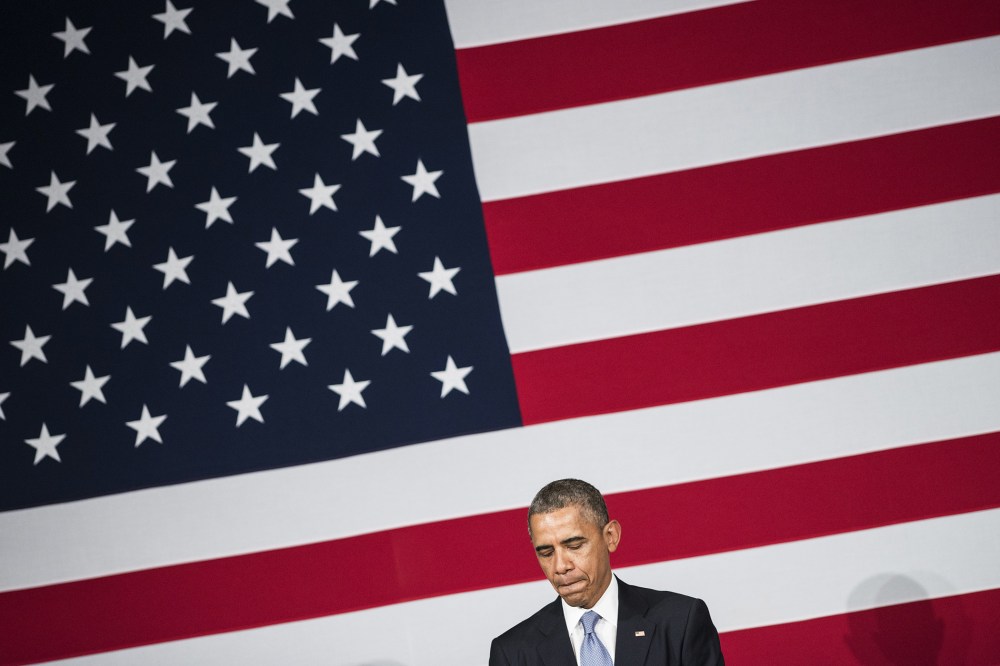
One year ago today, President Obama promised to “engage Congress about the existing Authorization to Use Military Force, or AUMF, to determine how we can continue to fight terrorism without keeping America on a perpetual wartime footing.”
Enacted one week after Sept. 11, 2001 and targeted specifically at those groups responsible for the attacks, the AUMF has become increasingly outdated, the president explained, as a result of the decimation of Al Qaeda’s “core” and fewer threats coming from groups with a connection to 9/11.
“I look forward to engaging Congress and the American people in efforts to refine, and ultimately repeal, the AUMF’s mandate,” the president concluded. Although “[o]ur systematic effort to dismantle terrorist organizations must continue … this war, like all wars, must end. That’s what history advises. That’s what our democracy demands.”
Unfortunately, like the president’s pledge to close Guantánamo, or to provide far greater transparency about drone strikes, or to support aggressive reforms of National Security Agency surveillance programs, the administration has utterly failed to follow through on the president’s commitments.
Not only has the administration introduced no legislation of its own that would bring about the AUMF’s demise; it has also not supported efforts currently underway by various members of Congress to scale back the AUMF—even the more modest proposals to gradually sunset the statute once ground troops are withdrawn from Afghanistan.
%22The%20administration%20has%20utterly%20failed%20to%20follow%20through%20on%20the%20president%E2%80%99s%20commitments.%22′
Just last week, in a long-overdue report Congress had mandated with regard to the legal consequences of transferring the remaining Guantánamo detainees into the United States, the Justice Department relied upon the AUMF’s continuing force as a basis for long-term detention authority to explain why transferring the detainees would not, by itself, result in their release. But that argument only holds if the AUMF is going to remain on the books for the foreseeable future. And earlier this week, administration witnesses could not answer when asked at a Senate hearing whether the president supports “refining or repealing” the AUMF right now.
To be sure, these statements, like last year’s speech, were as much about mollifying particular political constituencies as they were about setting policy priorities. But the policy issues surrounding the AUMF’s repeal are actually far simpler than the politics, especially once U.S. ground troops are removed from Afghanistan. At that point, the United States will simply no longer need forward-looking and open-ended authority to use military force against those groups responsible for the Sept. 11 attacks.
Instead, the government can rely upon ordinary law enforcement tools to incapacitate terrorism suspects — as it has in hundreds of cases since Sept 11. Simply put, we don’t need to send terrorism suspects to Guantánamo anymore (and haven’t since 2008); we prosecute them in civilian court, thanks to evolutions in U.S. criminal law over the past decade.
For example, the federal statute most often invoked in terrorism prosecutions—which makes it a crime to provide “material support” to a “foreign terrorist organization”—now applies to conduct anywhere in the world (it didn’t on 9/11). And Congress also recognized in 2004 a new crime of “receiving military-type training from a foreign terrorist organization.”
These developments have helped facilitate the civilian prosecutions in U.S. courts of terrorism suspects arrested all over the world, including Ahmed Warsame, who was captured off the coast of Yemen in 2011; Ibrahim Suleiman Adnan Adam Harun, who was captured in Italy in 2012; Abu Ghaith, Osama bin Laden’s son-in-law, who was taken into custody in Jordan in February 2013; and Abu Anas al Libi, who was captured in Libya in October 2013. None of these prosecutions depended in any way upon the AUMF.
And where individuals or groups pose an imminent threat to our national security that cannot be neutralized through their arrest or capture, such as the threat allegedly posed by U.S. citizen Anwar al-Awlaki in the days and weeks leading up to his targeted killing in a drone strike, the president has the constitutional authority to use military force to defend the nation whether or not Congress has provided statutory authorization. In that regard, it is more than a little ironic that some of the most vocal opponents to repealing the AUMF have also been staunch supporters of broad, inherent executive power (power that renders the AUMF unnecessary). Of course, it’s possible that groups will pose threats to U.S. interests in the future comparable to those posed by Al Qaeda in the weeks and months before and after Sept. 11 — threats that cannot adequately be remedied through existing law enforcement and self-defense authorities. But if such threats exist, the burden should be on the executive branch to identify them, and on Congress to specifically authorize forward-looking military force to quell them. More often than not, such a debate will only underscore how unnecessary such an authorization is, as with Congressman Hunter’s ill-conceived proposal to expand the AUMF to encompass those responsible for the Benghazi attacks. Indeed, the only truly thorny policy issue raised by repeal of the AUMF is the fate of the Guantánamo detainees. But even for those who believe that at least some of those detainees should continue to be held without trial in perpetuity, there are existing grounds on which such detention could be predicated that have nothing to do with the AUMF. And in any event, it hardly needs saying that perpetuating Guantánamo cannot be the sole reason for leaving the AUMF on the books. Ultimately, President Obama was entirely correct last May that “this war, like all wars, must end.” But democracy demands actual leadership on that front, and not just another speech full of empty platitudes. Stephen I. Vladeck is Professor of Law and Associate Dean for Scholarship at American University.
Stephen Vladeck Recommended


