








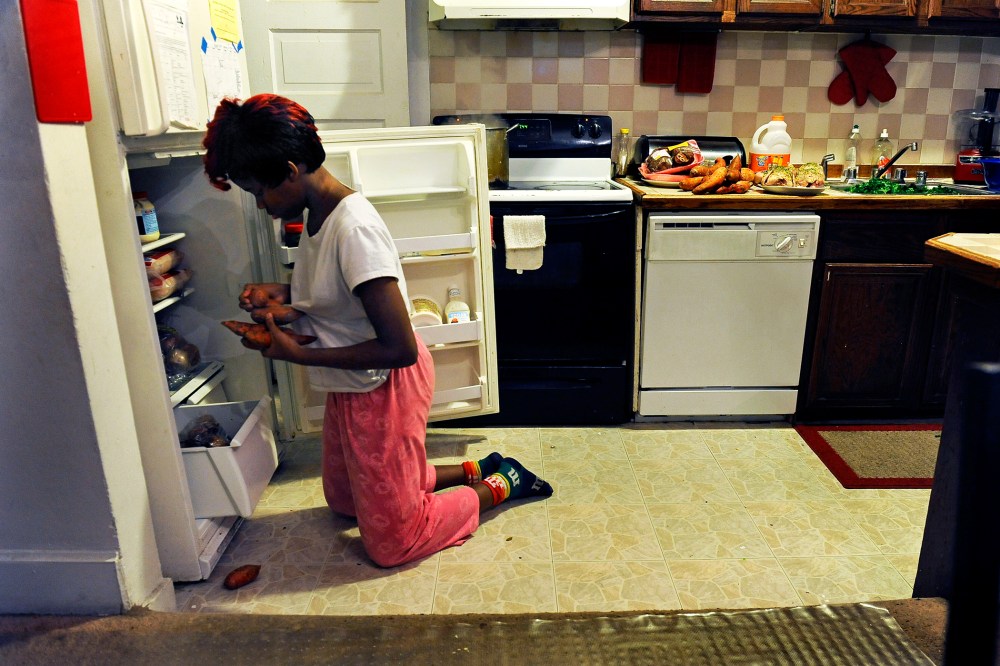
There’s the 99% and the 1%, and then there’s the 16%. The latter number is the proportion of Americans who don’t have enough food to eat, according to the most recent figures on food insecurity.
In absolute numbers, nearly 50 million people in this country—including 16 million children—currently lack sufficient food to live a healthy life.
The numbers are striking on their own, but what’s even more striking is how little attention the problem has received in Washington. When the food stamp program received an automatic $5 billion cut, reducing benefit levels across the board, there was little response from either the White House or Congress. And when Congress did turn to address the food stamp program, it was a only to pass a bipartisan piece of legislation which cut benefit levels further. President Obama praised that bill and signed it at a public event in February.
This is the same President Obama who recently described economic inequality as “the defining challenge of our time.” Elsewhere in the Democratic Party, various members have decided to make inequality the main theme of their 2014 midterm campaigns. And yet, despite the current vogue in Washington for talking about inequality, political leaders have paid little attention to the hunger crisis which is now ravaging America’s poor communities.

“I can’t quite understand why there’s this reluctance to take the issue on,” said Rep. Jim McGovern, D-Mass. McGovern is one of a handful of legislators who have tried to raise the alarm about hunger. Yet even among his fellow Democrats, the issue has gained very little traction. While plenty of them are willing to talk about inequality, McGovern suggested the party as a whole is not yet willing to tackle issues of direct importance to the poor.
“There’s timidity on the part of a lot of Democrats to be champions of the poor,” he said. “I think people think that it’s not a political winner.”
Instead, leading Democrats tend to frame inequality as either an abstract issue or a division between the rich and the middle class. With regards to the poor, the president and other Democrats have tended to focus on ways to increase “opportunity.” In his most recent State of the Union Address, President Obama depicted his anti-inequality agenda as a plan to “speed up growth, strengthen the middle class, and build new ladders of opportunity into the middle class.”
New York City Coalition Against Hunger executive director Joel Berg said that the most important issue to the poor is something more fundamental than opportunity and upward mobility.
“It’s about how people can’t have their basic needs met,” he said.
At least one high-profile Republican has proven himself a lot more eager to tackle poverty head-on. Rep. Paul Ryan, R-Wis. has spent the last several months recasting himself as a “champion of the poor,” in the words of one upbeat Buzzfeed profile. Yet when Ryan invokes hunger, it is mainly to suggest that public food assistance programs erode the “dignity” of those they’re meant to help. “It doesn’t surprise that there’s this huge disconnect, because the people most affected aren’t part of the conversation,” said Berg. “We’re having a national conversation on poverty without poor people.” Recent political science research has aimed to demonstrate related claims empirically. Earlier this month, a new paper from scholars Martin Gilens and Benjamin I. Page argued that “policymaking is dominated by powerful business organizations and a small number of affluent Americans.” Even the middle class is largely powerless according to the report. Berg attributed that lack of power in part to the social isolation of political elites and said the inequality debate had become about “this anger among, frankly, the upper middle class towards the mega wealthy.” The result being that the poor are treated as if they’re invisible. “Before the recession there were 35 million people who were food insecure,” said Berg. “People would say it’s a hidden problem, and I’d say, Really? Thirty-five million is the population of California. They know they exist.”
Ned Resnikoff is an urban policy analyst, researcher, writer, and editor. His byline has appeared in a variety of publications, including the New York Times, San Francisco Chronicle, Dissent, and The Nation. He writes the newsletter Public Comment, which can be found at publiccomment.blog. Recommended


