








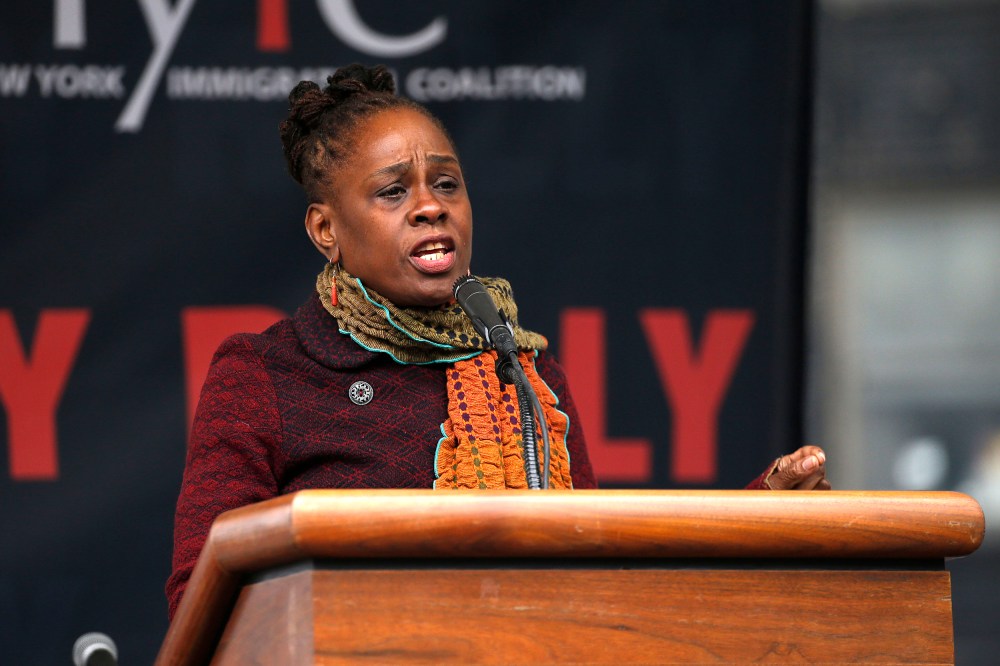
When Chirlane McCray became the first lady of New York City five years ago, she knew she wanted to make correcting racial and gender inequity a cornerstone of her work.
She had a lot of plans — and at first, none of them involved She Built NYC, a new initiative to install more statues of notable women in history across the cityscape.
“There are so many other things to think about besides statues when you’re trying to make major change. You take office, you move to Gracie [Mansion] and you want to tackle all of these big issues,” McCray told Know Your Value.
But McCray, who is married to Mayor Bill de Blasio, had heard that of New York City’s 150 public statues, only five are of historic women. She couldn’t get the lopsided statistic out of her mind.
“I thought, ‘Oh my God, we have to do something about this,’” McCray recalled. “Growing up as an African-American woman, I didn’t see anyone who represented me in media or popular culture, even though women make incredible contributions. Erecting statues of women is an easy way to correct that historical record.”
McCray and Deputy Mayor Alicia Glen talked at length about creating multiple initiatives to help women succeed, and they concluded that such projects must include visibility in the public sphere.
“That vision led to She Built NYC,” McCray said. “We thought, what better way to encourage women than to celebrate those who helped build our city?”
She Built NYC officially launched in June 2018 with the goal of ensuring at least half of New York’s public monuments honor women. The effort began with an open call for nominations, and the public proposed more than 2,000 women, groups of women and events in the city.
Growing%20up%20as%20an%20African-American%20woman,%20I%20didn%E2%80%99t%20see%20anyone%20who%20represented%20me%20in%20media%20or%20popular%20culture,%20even%20though%20women%20make%20incredible%20contributions.%20Erecting%20statues%20of%20women%20is%20an%20easy%20to%20correct%20that%20historical%20record.
The program selected Shirley Chisholm for the first monument. In 1968, Chisholm became the first black woman elected to U.S. Congress. Four years later, she notched another two places in history: the first black candidate for a major-party nomination for president, as well as the first woman of any race to run for the Democratic party’s presidential nomination.
“Chisholm paved the way for the record number of trailblazing women elected to Congress in 2018,” says She Built NYC’s website. “Her rise to national prominence in the early 1970s was a monumental step forward in making America more inclusive and ensuring that everyone had a voice at the highest levels of government.”
Chisholm will receive a permanent monument in Brooklyn’s Prospect Park and will be completed by an artist who will be announced sometime in early 2019. Hers will be the first of many women monuments to come, McCray said.
While many agree with the long-term goal of combating gender inequity, not everyone is convinced statues are the best medium to do so. That group includes Michele Bogart, professor of art history at Stony Brook University and author of the 2018 book “Sculpture in Gotham: Art and Urban Renewal in New York City.”
“The philosophy here is righting the wrong by commissioning a bunch of women statues alongside all of these men,” Bogart said. “But there’s a question as to whether, in the 21st century, a statue is the best way to do that. Why do the same approach, one that recapitulates the older attitudes and forms that were indeed primarily dominated by men?” Instead, Bogart said, she “would prefer to see shorter-term exhibits of public art, where you can celebrate different types of women — and the power of groups of women – in multiple formats and mediums. It’s a fresh approach instead of an add-on to the existing setup.” Several U.S. cities beyond New York are grappling with the gender inequity in their cityscapes. San Francisco takes a broader public art approach a la Bogart’s suggestion: In October the city approved an ordinance requiring that “at least 30 percent of nonfictional figures depicted or commemorated in statues and other works of art on city-owned property, public building names, and street names, be women,” as KQED reported. Other cities’ initiatives are more similar to that of She Built NYC, with a focus on statues. In Washington, D.C., the city council is considering legislation proposed by Councilmember Kenyan McDuffie to erect a statue of women and/or minorities in each of the city’s eight wards. And in Pittsburgh, a Task Force on Women in Public Art is collecting feedback in selecting an African-American women to be honored with a statue in the city’s North Oakland neighborhood. It’s McCray’s view that statues are different from other types of public art, which she said is an important distinction: “They’re powerful and long-lasting ways to honor an individual. A lot of decisions and process go into a statue or monument, and they’re maintained. They tend to be around for a very long time.” That’s McCray’s hope for the forthcoming Chisholm statue and future She Built NYC monuments. Other women nominated by the public with many votes include Eleanor Roosevelt, Margaret Sanger and Emma Lazarus. But McCray notes there are women who may not be as well known, yet have powerful stories that deserve to be shared. If McCray could submit her own personal wish list for future She Built NYC monuments, it would include writer Audre Lorde, ACLU co-founder Crystal Eastman and prima ballerina Maria Tallchief, the first Native American to achieve that rank. “The list is very long, and the gap is wide, but we will do all we can,” McCray said. “I believe there is a thread running through all of my work: to right wrongs and correct inequity. She Built NYC fits right into what we do.”
Julianne Pepitone
Julianne is the senior technology writer for NBC News Digital, covering large consumer tech companies' (Apple, Google, Facebook, etc.) news and trends, as well as cybersecurity. She also writes and appears in original videos for NBCNews.com, and speaks as an expert guest on live shows across the NBC and MSNBC networks.
She previously worked at CNNMoney.com where she covered large techs from a business angle, as well as the intersection of the tech and media industries.
In addition to NBC and CNN online properties, Julianne has written for several national magazines and online publications including Esquire, Self, Popular Mechanics and Cosmopolitan. Recommended


