








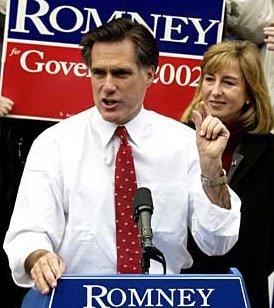
Major-party presidential candidates tend to win their home state, even if they’re losing the election, but in 2012, the race for Mitt Romney’s home state is apparently over before it starts.
Don’t bet on Mitt Romney winning his home state. Or even trying.
“That’s not been a topic of discussion,” Romney campaign adviser Kevin Madden said when asked if the Republican former Massachusetts governor would compete in the heavily Democratic state.
Romney was never a hero in the liberal bastion, and aides say there are other ways he can win the White House and deny President Barack Obama a second term without the 11 electoral votes Massachusetts offers.
According to the Boston Globe’s analysis, if Romney wins, he’ll be the “first presidential candidate elected without carrying his home state since before the Civil War. James K. Polk lost Tennessee en route to the White House — 168 years ago.”
In case you’re thinking it’s unfair to characterize Massachusetts as Romney’s home state — he also owns mansions in New Hampshire and California — the Republican is expected to lose all three of his home states.
And while Romney will probably be the first major-party candidate in generations who won’t even try to win his home state, I continue to marvel at the fact that Romney’s unpopularity among Massachusetts voters — the folks who got to see his governing up close for four years — is a total non-issue in the presidential race.
I’ve heard Romney’s stump speech many times, and it includes exactly zero references to his term as governor — his only experience in public office at any level. I watched his speech on his economic plan, his speech on debt reduction, and even his commencement address at Liberty University, and not one included so much as a passing reference to Massachusetts or his background as the chief executive of a major state.
Am I the only one who finds this odd?
Following up on a report from a month ago, when I was doing research for this recent piece on presidential candidates and their pre-campaign experience in public service — Romney’s the least experienced nominee in 72 years — I found plenty of governors and former governors who tried (and succeeded) to parlay their background as the chief executive of a state into becoming the chief executive of the nation.
But I could find no example of a major-party nominee whose only experience in government was serving as a governor, but who then made no effort to talk about this experience as part of his appeal to voters for national office. Nor could I find any examples of a governor quitting after one term, knowing he’d lose if he sought re-election, and then running for president.
And why is it, exactly, that Romney is avoiding the subject of his only background in public service? Perhaps because, during his 2003-to-2007 tenure, Romney failed to impress much of anyone.
“His favorability was basically a straight line down from his honeymoon,” said David Paleologos, director of Suffolk University’s Political Research Center and a longtime Massachusetts pollster. “Sometimes familiarity breeds contempt.” […] Romney entered the Massachusetts State House in January 2003 with a flashy favorability rating of 61 percent…. By November 2004, voters were souring, and a Suffolk poll found his favorable rating had dropped to 47 percent… By November 2006, as he closed out his increasingly absentee term, his overall job approval rating had cratered to 36 percent. Thomas Whalen, a Boston University political science professor, put it this way: “To know Mitt Romney is to dislike him. That is the moral of the story.” Maybe he looks better in hindsight? No, Romney’s former constituents still don’t like him and still don’t want him to be president. Maybe it’s because he was a GOP governor in a reliably “blue” state? No, Massachusetts has had plenty of modern Republican governors — Weld, Cellucci, Swift — and all were more popular with their Bay State constituents than Romney. This is all generally overlooked, which is a shame because it seems like it ought to be more relevant in a presidential campaign. Here’s the sample question reporters can ask Romney: why were you so woefully unpopular with your own constituents when voters gave you a chance to lead?
The place for in-depth analysis, commentary and informed perspectives. Recommended


