








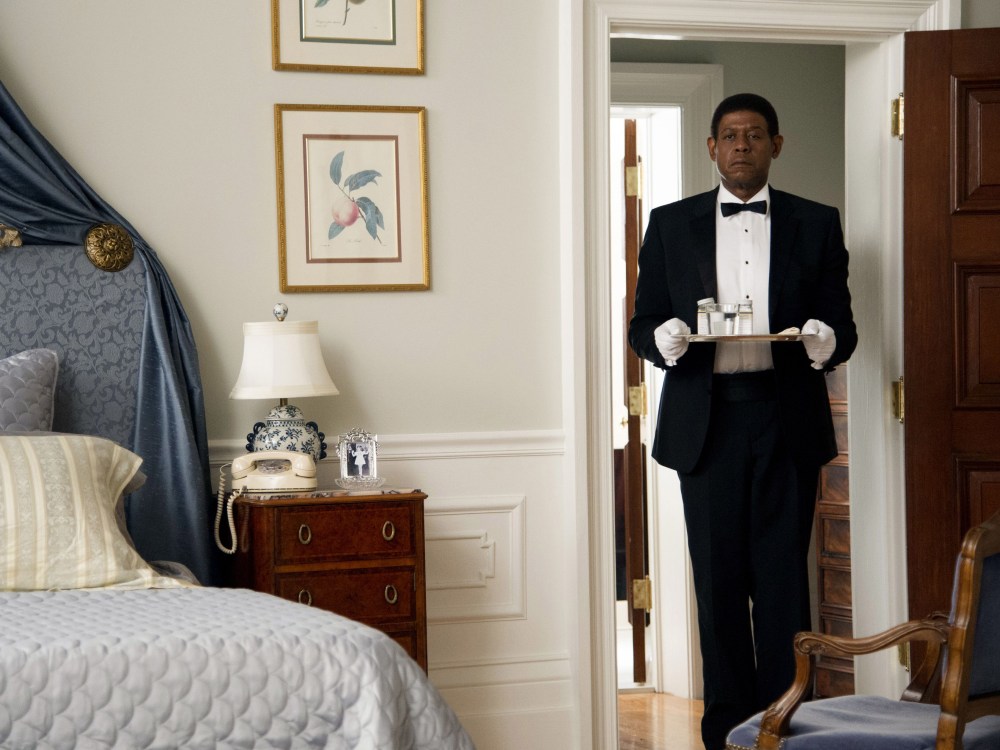
As the 50th anniversary of the 16th Street Baptist Church bombing in Birmingham approached and thousands celebrated the recent March on Washington commemoration, former White House Butler George Hannie relived his journey from 1940s segregated Alabama to the regal second floor residence of the President of the United States.
Born and raised in Northport, Ala., a city in Tuscaloosa County, Hannie grew up in the Jim Crow South. He remembered the police kicking him off street corners, and threatening him and other black residents with sticks.
Hannie studied diligently at Northport’s Riverside High School in the 1960s, when the cries of four African-American girls bombed in the 16th Street Baptist Church echoed throughout the nation, and Birmingham bled with police retaliation against nonviolent civil rights protests,
Lee Daniels’ film The Butler revealed the late Eugene Allen’s navigation through segregated America as a White House butler, but Allen’s story does not echo alone on the grounds of 1600 Pennsylvania Avenue. In interviews with MSNBC, real White House butlers shared their full life stories for the first time.
In the movie, Eugene Allen’s character, played by Forest Whitaker as “Cecil Gaines,” witnessed lynching, rape, and economic inequality in his lifetime. When asked how his experience compared to Allen’s, Hannie, who served for 46 years since President Lyndon B. Johnson, paused and heaved a melancholic sigh.
“I think the movie was very accurate –right on key,” he said emphatically with a Southern accent. “One hundred percent accurate. You understand?”
In telling his story, Hannie focused on the gleaming stories of triumph, epitomized in the love he shared for his mother. He reflected on the moment he escorted his mother up North Portico, the regal entrance to the White House, where he often saw kings, queens, and presidents walk.
“The most memorable moment I had at the White House is seeing my mother walk up North Portico, all alone, to visit me and George and Barbara Bush in their personal quarters,” Hannie said. “She was so nervous, but enjoyed herself. I said to myself well, my mother is just as important as all those kings and queens. I’m going to have my queen do it.”
Working in a navy exchange store in Washington, D.C., while his father served as a petty officer, Hannie landed a job at the White House through an unexpected visitor to the store. A man with an Alabama license plate drove up to greet Hannie, and the two became friends because of their home state connection. The man introduced Hannie to a woman who worked at the White House, and the rest was history.
Eugene Allen welcomed Hannie to the White House in July of 1966. Hannie mixed lemonade with Allen on his first assignment at a function on the south grounds. After that event, Allen took Hannie under his wing.
After Hannie gained the trust of the White House staff, he became the personal butler to LBJ and his family. He remembered conversations with the first family, and chuckled as he recalled President Johnson’s crude humor and behavior.
Hannie also attended President Dwight Eisenhower’s funeral and traveled with President Jimmy Carter on press planes. “Now imagine 1965, I’m in the town of Northport, Ala., reading about different people, and come to Washington to see all the people I read about in my government class,” Hannie said.
Although Hannie overheard the presidents’ personal conversations, he could only interject to inquire about their personal needs. Hannie insists he was never treated poorly.
“All of them were great to us because once they came upstairs on the second floor residence, the presidency was left downstairs. They became a regular human being once you got to know them,” Hannie said. “You had what they loved to drink, what they loved to eat, and you gave it to them when they got off the elevator, when they changed into their comfortable clothes. It became one happy family.”
Wage inequality between African-American and white butlers plagued the White House, according to Hannie. He admired the courage of activists in the Civil Rights Movement, but could only watch its events on television.
“We were not active in the Civil Rights Movement. Our role was to serve the president and his family. Period. Once they came to the White House, we represented the president and the first lady and took care of their guests,” Hannie said.
Nonetheless, Hannie still met influential civil rights activists such as Rosa Parks, John Lewis, Nelson Mandela, and celebrities, such as Denzel Washington, who once discussed widespread economic inequality with Hannie at an event.
When President Barack Obama became the first African-American president of the United States, Hannie was one of the first staff members to greet him at the White House. “I never thought I would see the first black president, but it was very nice and humbling to see him walk through that door,” Hannie said.
William “Bill” Hamilton, the White House storeroom manager, similarly felt proud the moment President Obama was elected, but feels the nation still has not fully progressed in the treatment of African-American citizens. “I just don’t feel people treat Obama as a president of the United States, even Congress. They’re not giving the man the due respect,” said Hamilton.
Hamilton served in the White House for fifty-five years, starting with President Eisenhower. He never had any problems with the presidents personally, though admitted he admired President George H.W. Bush and President Bill Clinton the most because they were family-oriented.
Like Hannie, Hamilton discovered the job through an inside contact, who worked at a nearby hotel. A native of Washington, D.C., Hamilton grew up close to the White House with 10 siblings. He remembered passing the White House as a boy, especially during public parades and the time President Harry Truman waved to the crowd.
Hamilton started as a houseman, cleaning and housekeeping at the White House. The staff never promoted him to butler because he challenged the unequal wages between black and white Butlers, Hamilton alleges, as he recalled his experience during President Richard Nixon’s administration. “I was the one who sued the chief usher J.B. West for unequal pay,” Hamilton explained. “The white workers were the ones getting promoted, and I just had to question why can’t we get promoted to some of these jobs? He just told me straight up that blacks would only be doing domestic work.” Hamilton retaliated. “That’s when I got mad. I said I don’t care if I lose my job or not, I’m getting sick and tired of this. Then people got mad. They said everything was fine before I came,” Hamilton said as he chuckled. When the White House staff did not address his complaint, Hamilton wrote a letter to the Department of Labor. Soon after, an investigator told Hamilton that if his story hit the papers, and the president was unaware, he would be fired. Hamilton never told President Nixon personally about his struggle, not that the staff would let him near the president’s quarters. Soon after Hamilton’s complaint, the staff moved him to the storeroom. “I didn’t really want to be in the storeroom. I wanted to be a butler, but they were mad. They said if I don’t drop this issue, I don’t get a raise,” Hamilton said. Reflecting back on his struggle for equal pay, Hamilton still believes domestic workers today are not paid enough. “I think it’s unheard of someone making %7.25, or $7.50 an hour. I don’t even know how they live.” Hamilton’s White House salary alone could not fully support his family, so he drove cabs part time to save money for his wife and seven children. One of Hamilton’s sons died in a car accident on a day he was working at a dinner for President George H.W. Bush. His family lived in low-income housing until earning two salaries disqualified him, and they had to move out. Despite hardship, Hamilton renewed hope when he heard Dr. Martin Luther King’s speech at the March on Washington in 1963. “I felt uplifted. I had more faith that my kids are going to be better than I am. It made me feel like I would achieve more for my family.” From the nervous conversations and quietness inside the White House, Hamilton sensed tension and unease from John F. Kennedy’s administration in the days leading up to the March. “Everyone told me not to go, but I said I am not worried. I was going anyway,” Hamilton recalled proudly. “The other butlers were just scared. They were all from the South, and it was the way they were brought up I guess.” Fifty years later, Hamilton attended the anniversary march at the Lincoln Memorial. He hopes in the days following, the nation will elect the first woman president, and promised he would campaign for Hillary Clinton if she decided to run. As the nation celebrates the 50th anniversaries of landmark events in the Civil Rights Movement, and recognizes Labor Day each year, the voices of George Hannie, Bill Hamilton, and Eugene Allen still whisper history into the national outcry for racial equality and labor rights. These White House veterans’ jobs required them to remain silent against the backdrop of American power, but to many, their resilience and dedication inevitably made their roles subversive, rather than subservient, as Dr. King’s character eloquently explains in the movie. “We have gone a long way, but we still have ways to go,” said Admiral Stephen Rochon, the first African-American chief usher at the White House in a MSNBC interview with Mara Schiavocampo. Rochon consulted Lee Daniels and star Forest Whitaker during the movie’s production. “We have to keep that dream alive.”
Dominique Mann Recommended


