








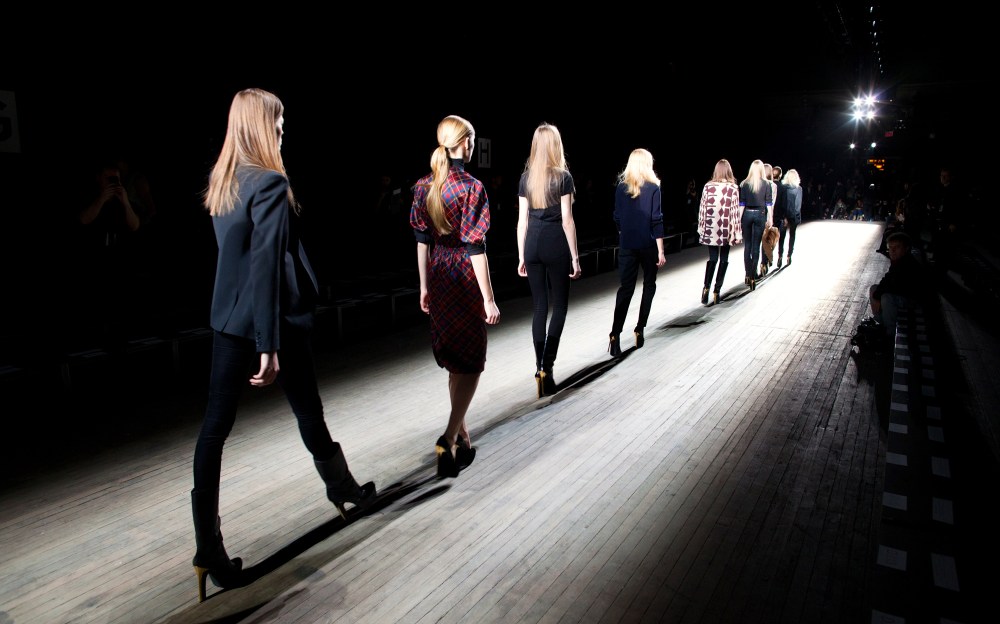
The fashion industry has always existed at the tipping point of art and commodity.
Designers push the limits of our imagination and aesthetic comfort zones in order to capture their vision of the world as it exists season after season. These individuals provide us with the physical means for self-expression and serve as visual ambassadors, commodifying the essence of an era. But while fashion houses and designers are given free artistic reign over their runways, they must keep in mind the reality of the end goal: selling clothes.
A clothing label is only as valuable as its popularity and appeal, which is why clothes must resonate with the buyer. Designers are tasked with creating a “vision” in the image of their consumer and displaying it in such a way that a person sees him or herself reflected back from a runway or store display window. It is a wonder, then, why the number of non-white models on the runway hit a new low during the Fall 2013 shows this past February.
For the past five years, Jezebel has recorded the diversity among the models used in New York’s biannual Fashion Week (the most recent of which just concluded). The Fall 2008 shows had:
- 87% white models,
- 4.9% black
- 5.4% Asian,
- and 2.7% Latina models.
Since then, the number of white models fluctuated, but in a declining pattern. The Spring 2013 shows (which took place in September 2012) exhibited the most diversity seen since Jezebel started recording with:
- 79.4% White models,
- 8.1% Black models,
- 10.1% Asian models,
- 1.9% Latina models,
While the numbers are far from where they should be, Spring 2013 provided encouraging statistics. However, during the Fall 2013 shows, the number of white models jumped back to 82.7%.
Why does this continue to happen? Casting director James Scully, in a March interview with BuzzFeed, asked the magic question: “Everyone notices, so why shouldn’t someone say something?”
In an e-mail to The New York Times, Calvin Klein women’s creative director Francisco Costa offered an excuse:
“There are only a handful of top-level professionally trained models of color at a particular level out there now, and they end up being booked by other fashion houses and can be seen on dozens of runways each season which is counter to what we are looking for.”
He essentially provides a solution behind his excuse for not having more diverse models in shows: there needs to be more non-white models signed by agents. But that means folks like Costa and others must demand diversity from casting agents and modeling agencies.
The fashion industry is a business like any other in that it exists in layers, and is driven by supply and demand. There is the designer who envisions a runway show with a specific “look” in mind, casting agencies that are employed to provide the designer with the “right” model, modeling agencies that sign models to send to casting agents based on the type of model that the industry calls for, and others along the way.
If one individual in this chain is striving to diversify the status quo and the others are not, then that individual will cease to exist in the industry. While some are speaking out, in general, it appears to be a risk not enough designers and casting directors are willing to take.
Scully–casting director for Tom Ford, Jason Wu, and a number of other high-profile designers–told BuzzFeed, “I feel the Dior cast is just so pointedly white that it feels deliberate.” He understands that there is no one holding these designers accountable–unless you’re like designer John Galliano, expelled by Dior after he made anti-Semitic comments two years ago. When there is no diversity on the runway, Scully points out, designers send the same message.
Other casting directors agree with his sentiment that “a great model is a great model, and no matter who she is, she can take on any role.” Most poignantly, he taps the thing that designers should fear the most. “I have millions of friends from all over the world, and if they don’t see themselves in the product, they don’t buy it,” Scully told BuzzFeed.
If anything, designers should be deterred from racism, whether it’s on purpose or a result of institutional trends, purely because it’s bad for business. The fact that the potential loss of profit does not seem to matter is a frightening indication that many iconic fashion labels have a singular vision of what beauty is and are not willing to change. That notion was repeated by model and runway coach J. Alexander when he joined host Melissa Harris-Perry for a discussion about race and fashion. Known by many for his stint as a judge on America’s Next Top Model, Alexander noted that the lack of diverse models on the runway sends the message that non-white individuals are forgotten or don’t buy clothes. J. Alexander pointed out the designers don’t think of race when they are compiling inspiration boards and thinking of their shows unless the theme of their clothing reflects a specific race or culture. That’s a practice he feels needs to change. It is times like these that others in the fashion world hide behind the artist side of the industry, indulging designers who are fulfilling their “visions” and seeking to display their collections in the most beautiful way they see fit. If that happens to be on an all-white cast, then so be it. Both iconic supermodels and newcomers are refusing to accept that answer. Fashion must represent the multicultural world that we live in. For this reason, model Bethann Hardison founded the Black Girls Coalition because, as she told The New York Times, “no one in power slaps these designers around.” How many times can a modeling agency tell a black model that they can’t take her because they already have their “black girl?” There are “no obvious repercussions for those who still see a colorless [runway] as an acceptable form of artistic expression.” For the Spring 2014 Fashion Week, Hardison is planning a social media campaign to make consumers and members of the industry aware of the designers who are not using black models. But is mere awareness the solution? Julee Wilson, style editor of The Huffington Post‘s Black Voices section, wrote in response to Hardison’s plan: “But will shaming these companies into submission really lead to long-term change? Adding a black model to a campaign and sprinkling a few of them into a Fashion Week show in response to the uproar is one thing, but diversifying the industry and causing an ideological shift is quite another. It’s smoke and mirrors versus a revolution.” The industry is not just limited to models and designers. Advertisers and magazine editors need to take a stand if change is ever going to come to the fashion world. Wilson shared her findings that Vogue, arguably the most influential fashion magazine in publication, has had only 30 black people on its cover (excluding group shots with three or more people) since its inception in 1892. In the past 14 September issues–the most coveted and profitable issue of the year–Vogue has had one black cover, Halle Berry in 2010. In fact, Berry’s issue was the first black September cover since Naomi Campbell became the first black woman on a Vogue September issue in 1989. It is abundantly clear that there remains a vital need for the industry to catch up with American racial realities. For now, we can only wait and watch as the Spring 2014 shows descend on New York, and hope voices like Hardison’s help the fashion world better reflect the real one.
Rachel Zuckerman Recommended

