








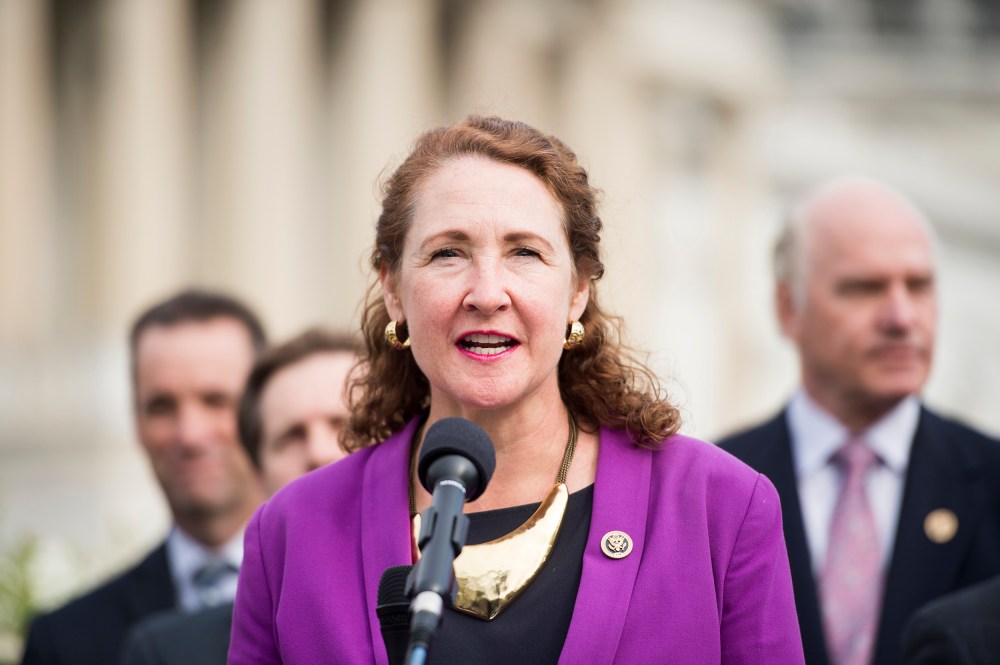
Rep. Elizabeth Esty, a former Supreme Court lawyer who now represents Connecticut’s 5th district, took a 10-year career break to raise her three children. And while she stayed active in her community during that time, elected office was never part of her post-career break plan.
But circumstances changed. And Esty, who was first elected in 2012, said taking that decade to be a full-time mom has made her a better public servant.
“I feel like everything I have done in my whole life helps inform what I am doing now and makes me better at it,” the Democrat recently told me. “It helps make me a better member of Congress, a more effective legislator and all those life experiences (which were not done to prepare me for what I am doing) have turned out to do exactly that.”
During her years as a full-time mom, Esty was an active participant in Parent Teacher Association and town council meetings. And like many women, she started her political career by running at the local level. Her children were 15, 12, and 9 years old at the time.
“[They] were all at the kitchen table ostensibly doing homework and I was sharing freely my low opinion of the current occupants of the town council and how they weren’t doing a good job with public education,” she recounted.
My 15–year-old daughter said to me, ‘Mom you always told us when you see a problem you should fix it yourself … We’re old enough. Run and I’ll run your campaign. But run or don’t complain.’
Rep.%20Esty
Esty started out small, winning a town council seat with her teen daughter at the helm of her campaign. She went on to serve two terms on the town council, then one as state representative before her successful run for Congress in 2012.
The congresswoman said she hopes more women will come off the sidelines and run for office, and is optimistic they will do so following the 2017 Women’s March, one of the largest mass demonstrations in U.S. history.
The signs are looking good: Since November 2016, more than 30,000 women have reached out to Emily’s List, an organization that supports pro-choice women candidates, about launching a campaign, according to the group’s website. In a typical year, that number hovers around 900. Erin Loos Cutaro, co-founder and CEO of She Should Run, a non-partisan organization that trains women to run for office, told me her organization has seen a similar surge.
Esty, who didn’t let a career break stop her from running for office, has a message to women who are considering a similar path “First: America needs you. Second: You can do this. And third: Remember, in politics, it’s never about you.”
Here are some more key takeaways from our interview with Rep. Esty — her thoughts and advice about career breaks and what to keep in mind if you’re considering a gig in politics:
On non-linear career paths and stops along the way:
Esty says to remember that the linear career path is not the only path. “Don’t despair if you make a choice to take a detour to invest in your family or something else…Life is long and interesting things can and do happen. There’s more than one way to get there and a lot of things can make you really good at what you end up doing,” she told me.
On why she decided to take time off:
Esty’s career break, like so many women, was unavoidable and stemmed from an untenable work circumstance. “I loved being a Supreme Court lawyer but when I had children, I just saw no way for me at that time. I found I wanted to be home and the practice I had, I could not do part-time. It was going to be full-time and full-time was 70 hours a week,” she said.
On how a career break can inform your career:
Esty says that a career break gives you skills and experiences that will add value to a future career, or even a run for office. “Your life experience can inform your political activity, it informs the issues you are passionate about and gives you granular knowledge about them,” she said.
She continued, “If you are a full-time parent, you’ve usually done a lot of volunteering … You find out one of the ways to get things done is by getting everyone on the same team. You have to share credit, and let other people think it was their idea. And in politics, that’s enormously effective.”
On the different treatment of men and women running for office:
Women and men are treated differently when running for office, Esty said. The bar is much higher for women. Mothers, especially, are treated differently than fathers. “My tagline might as well have been “one-term state representative” when I was running in the primary [for Congress]. I was running against a 27-year-old man who had never run for anything … I was in my early 50s, I had been a Supreme Court lawyer, I graduated from Harvard and Yale, I had served two terms on the town council and one term in the state legislature and yet my tagline was ‘one-term state representative.’ She recounted being asked by a reporter, who had known her for 10 years, “If you win, are you going to abandon your family when you go to Washington?’ You need to understand, when the reporter asked that question, my children were 23, 20 and 17. The youngest one would have graduated from high school and be in college before I took office. And this was in 2012!” On why we need more women in elected office: “Do we need more women at every level of government? Yes, we do. In cabinet agencies, running departments, running campaigns and winning campaigns and being the candidate themselves. Women have a different life experience. They will change the conversation and bring up different issues,” Esty said. She continued, “We need more women, not just for the diverse life experience but because women tend to think more generationally in terms of their responsibilities about a stewardship aspect to the earth and to the country and to democracy itself. They think in terms of self-sacrifice, that there are things that are worth sacrificing for, things that are more important than you. And your children are at the top of that list. To be able to think long term — not in three-week [continuing resolutions] — but generationally is an incredibly important grounding view.” Resources for women considering running or getting politically active: Center for American Women in Politics Ginny Brzezinski is Know Your Value’s comeback career contributor. Read more about her here.
Ginny Brzezinski Recommended


