








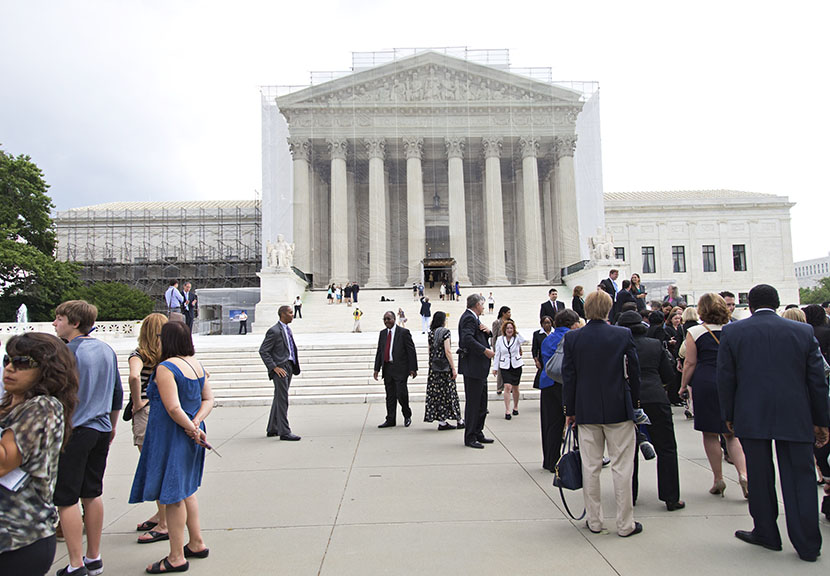
On Tuesday, the Supreme Court knocked out a core part of the Voting Rights Act and then told Congress to fix the mess.
In Shelby County v. Holder, Chief Justice John Roberts’ opinion is a model of extremism pitched as incrementalism.
It does not announce new standards for civil rights regulations. It does not declare the “end of racism.” It does not even downplay the significant achievement of the Voting Rights Act, which has caught, countered and prevented hundreds of voter suppression tactics.
Instead, Roberts presents a wholesale assault on Martin Luther King’s legal legacy as a question of number-crunching.
Who’s afraid of laws that work?
Congress uses “40-year-old data” to determine which parts of the country face the strictest voting supervision, and Roberts says that is unacceptable for today’s world.
You don’t have to be a lawyer to notice this logic is weird—that a law which is acceptable on one day becomes suspect as it ages. (Most laws are permanent or reauthorized, very few lapse automatically.)
But this is Roberts’ clinical attack on civil rights–call it constitutionalism with an expiration date.
Usually, when a law is effective and previous courts have upheld it, those features are considered virtues. They are reasons to retain a statute. For conservative jurists, however, race is just different.
As the historian Jelani Cobb has observed, civil rights laws are one of the only areas where judges seem to count a policy’s success as evidence against its continued use.
So take a look at this conclusion from Roberts’ opinion: “There is no doubt” that improvements in racial equality “are in large part because of the Voting Rights Act.”
He says that to indict the law’s continued existence—not to praise its utility.
It is that confounding logic, that skepticism toward laws that have supposedly outlived their purpose, which animates Roberts’ opinion. A cynical court-watcher could argue that Roberts chose to use the most palatable, and least risky, technique to dismantle the core of the Voting Rights Act. Thus the Court wins quietly if Congress fails to act, under this thinking, and if Congress does update the formula, the Court can swoop back in and invalidate the rule on constitutional grounds. But it turns out you don’t need to find a cynical observer.
Just look at Justice Clarence Thomas’s candid concurrence in Shelby. Thomas does not say much on the bench, but his opinions consistently present the loudest and harshest attacks on civil rights laws out of any current members of the court. He continues that trend in Shelby, calling out the chief justice.
Thomas argues that while Roberts “claims” to refrain from ruling on the constitutionality of Section 5, which applies the congressional formula to patrol voter suppression, Roberts’ opinion clearly explains why the law itself is unconstitutional.
“By leaving the inevitable conclusion unstated,” Thomas argues, the Court “needlessly prolongs” this dispute and the ultimate “demise” of Section 5 of the Voting Rights Act. His impatience is palpable.
Alabama’s discrimination
There are many other inconsistencies in the majority opinion, which Justice Ginsburg catalogues in a thorough, data-driven dissent.
She points to the statistics showing how frequently voting rights protections are necessary in today’s world. She recounts how discrimination in areas covered by Section 5 occurs not at double or triple the rate of the rest of the country−but at four times the rate, according to the findings of independent judges. As for “today’s world,” Ginsburg counters Roberts’ concern with the law’s dated metrics, stressing how it already provides an exception for any state that has ousted discrimination. Under a bailout provision, states can apply to be released from federal supervision of voting. In other words, you can check out anytime you like, as long as you’re not suppressing the vote based on race. And in a fairly staggering part of the case that Roberts could not explain away, Ginsburg also observed that the plaintiff in Shelby was not even eligible for bailout. That’s because Alabama has the second highest rate of voter discrimination after Mississippi. (That fact is not in dispute; it’s based on rulings from a large number of local judges, including many Republican appointees, documented in a 23-year study of litigation ending in 2005.) As Justice Sotomayor said in oral argument, that is not exactly a “model plaintiff.” What’s next It’s not the holes in Roberts’ opinion that matter now. Before most people would have time to read the lengthy ruling on Tuesday, many commentators were blithely declaring that any reform which requires Congress to act is “dead on arrival.” Premature cynicism may seem like a safe way to approach this Congress, but it’s actually off base. First, these civil rights laws were never supposed to pass in the first place. Observing that there’s an uphill battle for majoritarian legislation to enshrine minority rights is not an analysis of the legislative battle ahead – it’s a given. Second, even given a dysfunctional and extreme GOP House, there is no doubt that the climate for civil rights legislation is better now than at most other points in history. The vote totals for reauthorizing the Voting Rights Act have been steadily rising, not falling. There was not a single senator, in either party, who opposed reauthorization in 2006. So while it’s always hard to force action on the Hill, it is more plausible when there is a predicate. Civil rights advocates don’t need to get members of Congress on record here, they just need them to make good on their votes in 2006, and amend the law with newer data. Third, Democrats control the Senate and can bring a voting rights amendment to the floor. Will the majority of the Republican caucus reverse their votes? That’s pretty hard to imagine. Will potential presidential candidates like Marco Rubio go on record against Martin Luther King’s contribution to American law? Fourth and finally, there is the House. It does not pass a lot of bills, let alone bills that hail from the Democratic Senate, but there are exceptions. Even this House was moved to pass the Violence Against Women Act, once considered a long shot. After a Republican version of the law fell, Republicans decided they did not want to be known for opposing laws punishing violence against women. And even without a majority of Republicans, Speaker Boehner has brought certain priority bills to the floor. By that standard, advocates need to remind the country that our civil rights laws are more important than the usual congressional bickering. They are a demonstration of the progress we have made, as a people and a democracy, to combat our nation’s original sin. That’s why they’re still worth fighting for.
Ari Melber
Ari Melber, an Emmy Award-winning journalist, writer and attorney, is the host of “The Beat with Ari Melber” airing nightly at 6 p.m. ET on MSNBC. He also serves as MSNBC’s chief legal correspondent and an NBC News legal analyst. Before joining MSNBC, Melber practiced First Amendment law and served as a legislative aide in the U.S. Senate. He received a J.D. from Cornell Law School and is a member of the New York Bar. Recommended


