








Hours after Shoneice Reynolds joined fellow marchers in DC over the weekend to commemorate the 50th anniversary of the March on Washington, she got a call from back home in Chicago.
One of her former students, a 14-year-old, was shot and killed just days before the start of school last Monday. Reynolds, a former clerk in the Chicago Public Schools (CPS), the nation’s third largest school district, said the boy was the second of her former students killed since the end of school last spring.
“I shouldn’t be going to a funeral on Friday,” Reynolds said. “I would see him every other day in the office and I’d tell him, I have a son your age and you play football just like my younger son.”
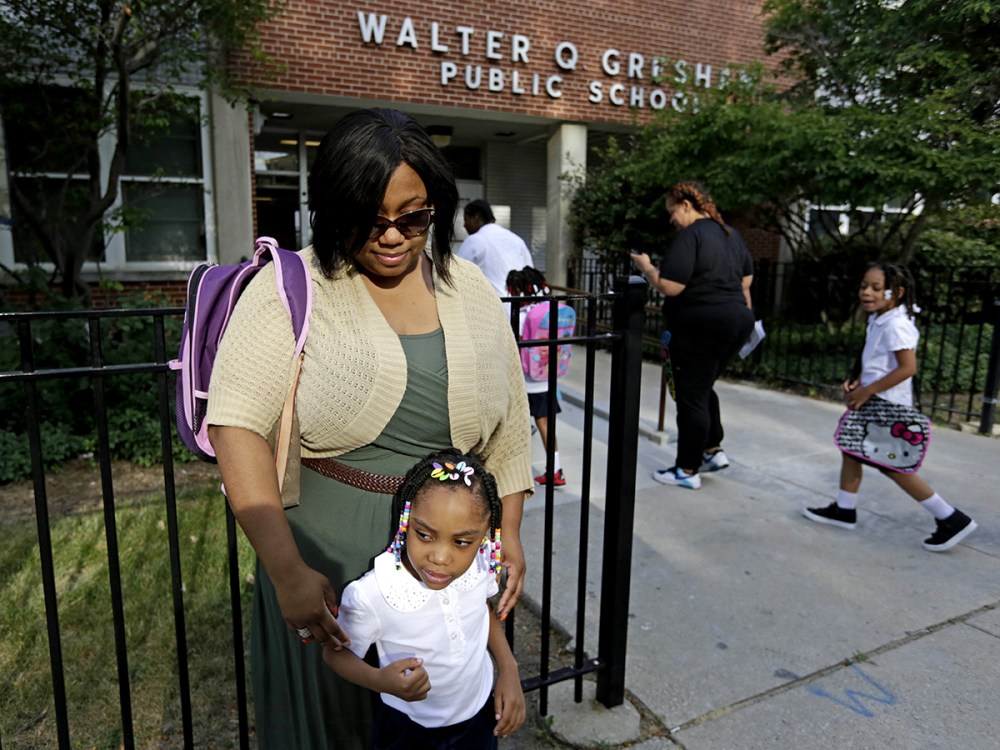
Reynolds worries for her own school-age children and all the others–some 400,000 public school students–who started school this week in Chicago.
Gun violence kills or maims dozens of students each year. That’s the most high-profile problem, but far from the only one.
CPS is facing a $1 billion deficit. The city shuttered some 50 public schools over the summer, sending thousands of kids to different schools, some in unfamiliar and unwelcoming neighborhoods. It is the largest planned school closure in American history. More than 2,000 teachers were laid off.
And there’s an ongoing battle over the school board’s budget which has cut about $180 million from direct classroom spending and from central office expenses. Opponents of the budget say schools have been gutted of enrichment classes and extra-curricular programs.
The school district says that closing underutilized schools was a necessary part of a larger strategy to deal with budgetary shortfalls. To address some of the safety concerns, the city has expanded its Safe Passage program, an initiative that has placed 1,200 unarmed workers wearing neon vests along the hardscrabble routes that many students travel to and from school.
That’s not enough for many parents. There have been a number of shootings during non-school hours along Safe Passage routes, and on the first day of school a man’s body was found in a trash bin on the South Side near one route.
“There’s no such thing as a safe passage for our children,” said Ellyson Carter, who has three grandchildren in the public school system. “Ain’t no sign or yellow vest gonna protect our children from no bullets. And what troubles me is them closing more schools. This has to stop. We cannot allow the mayor to just do what he want to do. The problem is he has too much power.”
Carter and others say the budget planners targeted schools in black and Latino communities, disinvesting even further in children who already suffer from poverty.
On Wednesday, several hundred parents and student advocates staged a protest and a one-day school boycott. Among their demands was a stop to school closures and an end to an appointed school board. Chicago is among a relatively small number of school districts in major cities across the country whose school board members are appointed (by the mayor) and not elected.
“We feel like that board is illegitimate,” said Jitu Brown, a community organizer. “We believe that shutting down neighborhood institutions, ignoring the voice of the people, sabotaging public schools in our neighborhoods and having no accountability to the public is a civil rights issue.”
“You have a disagreement? The court has spoken to that. You don’t like something? There’s another way to speak of it. Do not take the kids out of school and harm them and their future,” Mayor Rahm Emanuel said at a press conference earlier in the week, as news of the planned boycott was spreading. “Do not use the kids that way. They don’t have a day to waste when it comes to their education.”
Two days after the start of school–with protestors clamoring outside of the CPS headquarters–the board approved the district’s $5.58 billion budget which included hundreds of millions of dollars in cuts. Among the cuts are $68 million in classroom spending and $112 million from central office expenses. The district cites a $405 million increase in pension payments as a main reason for the billion-dollar deficit.
“The final budget passed today reflects the difficult decisions that needed to be made to close a historic billion-dollar budget gap, while protecting the critical investments necessary to allow our students to thrive and succeed in the classroom,” Barbara Byrd-Bennett, CEO of the school district, said in a statement on Wednesday. “We have reduced central office, administrative and operations spending wherever possible to keep cuts as far away from the classroom as possible.”
According to CPS, the start of the school year went off with just a few hitches, including a few late school buses, late lunch delivery and in once case a transformer explosion at an elementary school. No one was hurt in that incident.
“The few minor glitches that were reported were resolved immediately,” said Keiana Barrett, a CPS spokeswoman.
Barrett also touted the city’s Safe Passage program, saying, “our sister agencies and responsible community members throughout the city, our students were able to travel safely to and from the first day of school with no incidents.”
But frustrated and angry families see little reason to trust the board or the mayor. “Rahm Emanuel is not going to stop at 50 schools,” said Carter, the grandfather of three and member of Action Now, an activist group. “He rode in with a lot of support because he rode in on Barack Obama’s coattails. This is racial, it’s simple as that… He tries to make himself look good going to schools in our neighborhoods and taking pictures surrounded by black children. But if he cared about black children he wouldn’t have closed school in our neighborhoods.” “What are we going to do with our kids? We have enough black children standing on the corner with abandoned buildings and vacant lots,” Carter said. “If you want to close 50 schools, why didn’t he close one school in every ward?” Mayor Emanuel has defended the closures as a responsible step in addressing the needs of the city’s children. “If we don’t make these changes, we haven’t lived up to our responsibility as adults to the children of the city of Chicago,” Emanuel said shortly after the announcement of the planned closures was made. “And I did not run for office to shirk my responsibility.” Shoneice Reynolds, the former school clerk who recently lost two former students, was one of the parents demonstrating outside of the CPS budget meeting. “We were protesting for educational justice,” said Reynolds, who kept her 9-year-old son, Asean, out of school that day. Asean has become an activist in his own right and has become a young face in Chicago’s fight against school closures. The boy was a speaker during Saturday’s commemoration of the March on Washington, the youngest to grace the steps of the Lincoln Memorial that day. “Every school deserves equal funding and resources,” Asean said during his speech. “I encourage all of you to keep Dr. Martin Luther King Jr.’s dream alive. Help us fight for freedom, racial equality, jobs, and public education, because I have a dream that we shall overcome.” Reynolds eldest son is 15 years old, a year older than her former student, LaVander Hearnes, who was shot and killed on Saturday night. Hearnes was killed in the 3900 block of Wilcox Street, along a Safe Passage route for a nearby elementary school. Reynolds older son is also the same age as Patrick Sykes, another former student of Reynolds, who was shot and killed in May. Sykes was killed during a visit home to Chicago for the summer. He had moved away after his father was killed in the city two years earlier. She said Chicago school students need a safe passage to school–but equally important, they need better schools, run by a better system. “We need to push for an elected school board. We need our schools out of the mayor’s hands because evidently, 50 school closings, 3,000 teachers and peers fired, 70 librarians fired shows that he doesn’t have our best interest at heart,” she said. “You can no longer blame African-Americans. You can no longer blame teachers. You have to also blame elected officials, but since the school board isn’t elected, there’s no accountability.”
Trymaine Lee
Trymaine Lee is an NBC News correspondent. Recommended


