








On Dec. 18, the U.S. House impeached Donald Trump, at which point speculation shifted from the south side of the Capitol to the north side. By constitutional mandate, it would be up to the U.S. Senate to hold an impeachment trial, and the institution’s members would have to decide whether to bring Trump’s presidency to a premature end.
Two days later, on Dec. 20, former Sen. Jeff Flake (R-Ariz.) wrote an op-ed for the Washington Post, which took the form of a letter to the retired lawmaker’s former Senate Republican colleagues. Flake wrote, “President Trump is on trial. But in a very real sense, so are you. And so is the political party to which we belong.”
The Arizonan was one of many stressing the same point. Senate Minority Whip Dick Durbin (D-Ill.) told CBS News’ Margaret Brennan, “It isn’t just the president who’s on trial in an impeachment proceeding. The Senate is on trial, and we have a constitutional responsibility.” A week later, Sen. Pat Leahy (D-Vt.), currently the institution’s longest serving member, wrote a New York Times op-ed that added, “[I]t will not just be President Trump on trial. The Senate — and indeed, truth itself — will stand trial.”
Last week, as the House prepared to send the articles of impeachment to the upper chamber, House Judiciary Committee Chairman Jerry Nadler (D-N.Y.) echoed the message: “The Senate is on trial as well as the president.”
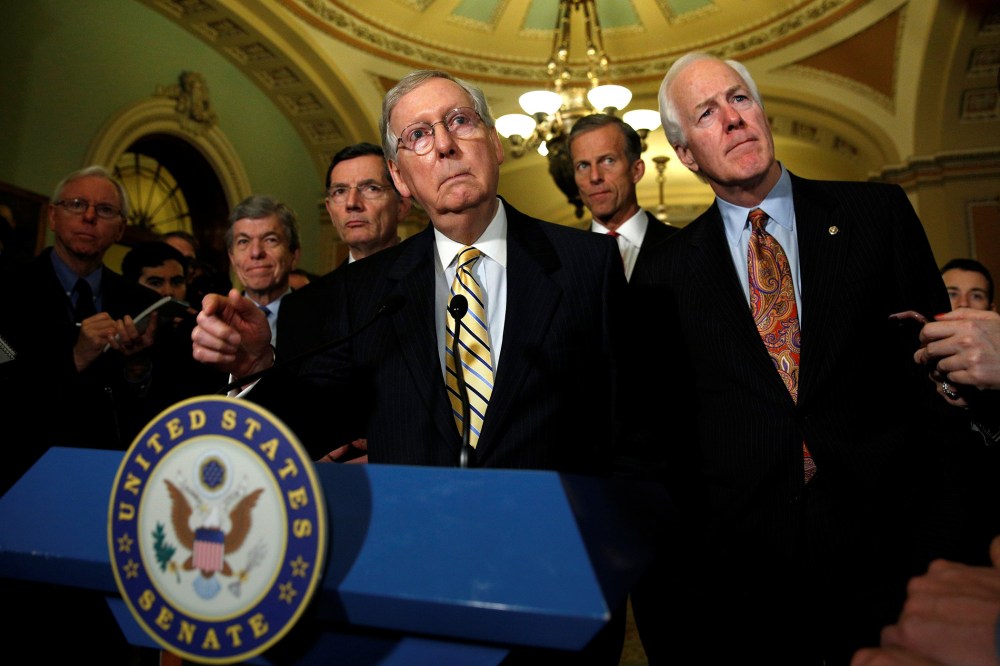
It’s against this backdrop that Senate Majority Leader Mitch McConnell (R-Ky.) has crafted a blueprint for the trial that appears designed to ensure that Donald Trump wins and the Senate loses.
Senate Majority Leader Mitch McConnell, R-Ky., will allot each side a total of 24 hours to present their arguments in President Donald Trump’s impeachment trial, but the time must be confined to two working days, according to the text of his organizing resolution, which NBC News obtained Monday.
The proposal also suggests that none of the evidence collected as part of the House’s impeachment inquiry will be admitted automatically. Instead, according to the text, the Senate will vote later on whether to admit any documents.
Not to put too fine a point on this, but it appears the fix is in — or at least it will be, if McConnell’s plan is implemented.
The timing of the announcement was itself notable: the Senate GOP leadership team had a month to present a proposed set of rules for the presidential impeachment trial, but McConnell waited until last night to unveil them, narrowing the window for members to evaluate the blueprint and craft possible amendments.
But it’s the blueprint itself that’s extraordinary. Breaking with the model embraced by senators during Bill Clinton’s 1999 impeachment trial, McConnell envisions an expedited model in which the proceedings are crammed into a couple of days, which raises the prospect of senators hearing arguments late in the evening — given Supreme Court Chief Justice John Roberts’ day job, proceedings aren’t expected to begin until the afternoons — when most Americans won’t hear them.
What’s more, as Rachel noted on the show last night, McConnell’s blueprint includes no guarantees of witness testimony, no guarantees that senators will be able to consider new evidence, and no guarantees that the trial will even allow the evidence collected through the House impeachment investigation to be admitted in the Senate proceedings. To be sure, that may yet change. There will be votes, for example, on proposed amendments to the Senate majority leader’s proposed game plan. What’s more, senators will have opportunities once the trial is underway to vote on introducing information, including witness testimony, and a handful of Republicans have expressed a willingness to do so. But that’s not the blueprint the GOP leadership has in mind. In public remarks last week, McConnell said, “This is a difficult time for our country, but this is precisely the kind of time for which the framers created the Senate. I’m confident this body can rise above short-termism and factional fever and serve the long-term best interests of our nation.” Those were pleasant words, though what McConnell neglected to say was that he believes it’s in “the long-term best interests of our nation” to deliberately cover up the sitting president’s illegal extortion scheme.
Steve Benen is a producer for "The Rachel Maddow Show," the editor of MaddowBlog and an MS NOW political contributor. He's also the bestselling author of "Ministry of Truth: Democracy, Reality, and the Republicans' War on the Recent Past." Recommended


