








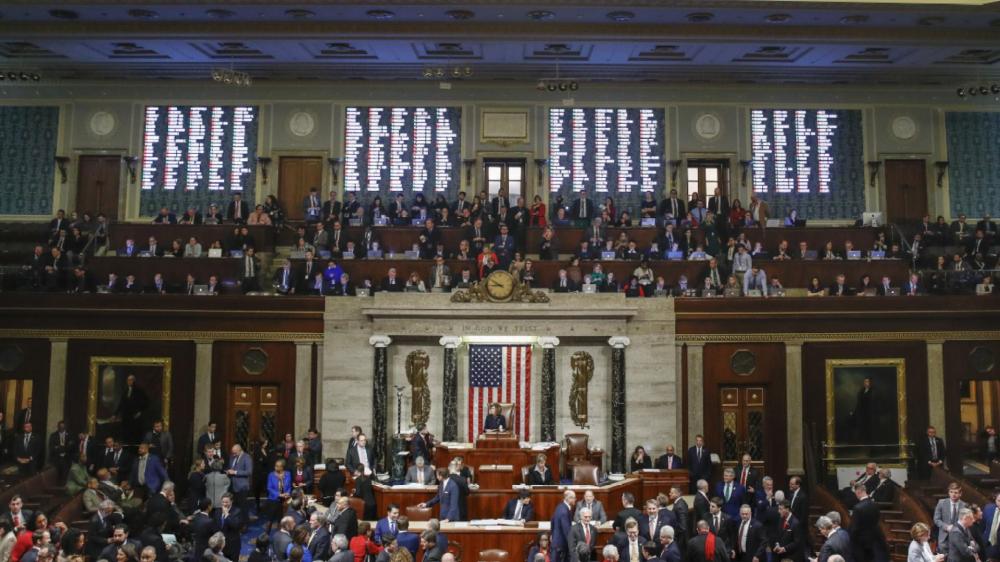
Those who watched the impeachment debate on the floor of the U.S. House yesterday know that one of the most frequently used phrases among Republican lawmakers was, “63 million.”
[Donald Trump’s impeachment] was an attempt, many Republicans argued, to throw out the will of the 63 million voters who supported Trump that year.
Rep. Steve Scalise (R-La.) said Democrats “hate the 63 million Americans” who voted for Trump. Rep. Clay Higgins (R-La.) said impeachment would “nullify 63 million votes.” Rep. Drew Ferguson (R-Ga.) said he chose to stand with the “63 million American voters” who supported Trump.
At one point, Rep. Bill Johnson (R-Ohio) went so far as to hold — in all seriousness — a moment of silence for the “63 million American voters” who backed the president in 2016. Johnson added that Democrats were trying to “disenfranchise” these Trump supporters.
At this point, we could talk about the fact that Trump actually came in second in the popular vote. We could talk about the fact that in the most recent federal elections — last year’s midterms — Democratic voters outnumbered Republican voters, 61 million to 51 million, and those Americans’ support for presidential accountability matter, too. We could even try to explain what words like “disenfranchise” and “nullification” actually mean.
But for now, let’s put those relevant details aside and consider an analogy.
Imagine a large business whose executive is retiring, prompting a long and difficult search for a replacement. The company has a large team that’s responsible for choosing a new executive, and one person eventually gets the job after a series of interviews, meetings, and discussions. (Most of the hiring committee chose someone else, but for complicated reasons, the second-place finisher ends up getting hired.)
In time, the executive gets to work, and the company’s profits look good, but there’s evidence of trouble. The executive appears to be engaging in rather brazen corruption; he puts his personal interests above the business’ interests; he shamelessly abuses the powers of his office without apology; he seems a little too eager to please a rival company; and he’s caught lying and covering up his antics.
Some on the company’s board of directors, after pushing off concerns for months, decide it’s time to get rid of the corrupt executive.
“Whoa, hold on a second,” the executive’s allies say. “We hired this guy. You’re saying we should fire him, just because you believe you’ve uncovered widespread evidence of wrongdoing?”
“Well, yes,” the executive’s detractors reply. “That’s what happens when people in positions of authority are caught breaking the rules.”
“This is outrageous,” the executive’s supporters insist. “You must hate the members of the hiring committee.” Obviously, no sensible person would ever make such an argument, but that’s effectively what many House Republicans spent yesterday arguing. Democrats should focus less on Trump’s abuses and more on the wishes of the voters who elected the president — though they didn’t know at the time what Trump would do once in office. And therein lies the rub: by the GOP’s reasoning, no democratically elected president could ever be impeached because the process itself would be a slap in the face to those who elected him or her. Except that’s plainly absurd. Americans elect someone to do a job, and if that person engages in serious corruption while on the job — trying to extort a vulnerable foreign ally, for example, in order to cheat in an election — then it stands to reason that person would be removed from his or her position. It’s why the impeachment power exists. I don’t understand what it is Republicans don’t understand.
Steve Benen is a producer for "The Rachel Maddow Show," the editor of MaddowBlog and an MS NOW political contributor. He's also the bestselling author of "Ministry of Truth: Democracy, Reality, and the Republicans' War on the Recent Past." Recommended


