








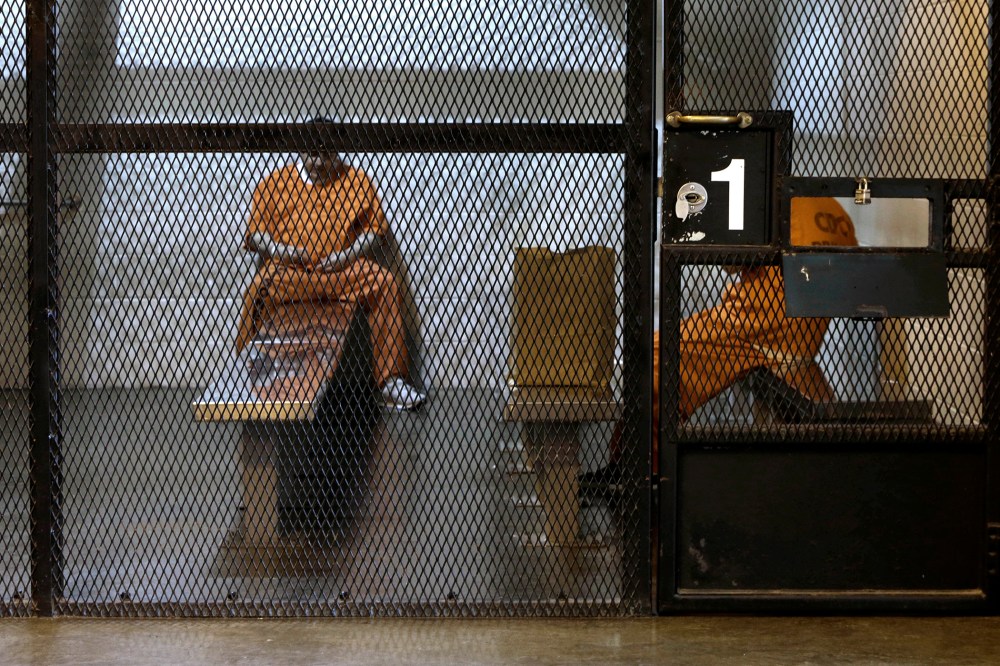
The United States has 5% of the world’s population — but 25% of its prisoners.
Fortunately, at a time of great partisan divide, prison reform is one area with bipartisan consensus. Officials ranging from President Obama to Kentucky Republican Sen. Rand Paul have publicly acknowledged that our country faces a criminal justice crisis. An increasing number of Americans understand there’s no reason we should have the world’s most gigantic prison population. That is why Obama should act now, with bipartisan support and momentum, to tackle the growing problem of mass incarceration.
A National Commission on Mass Incarceration is the best way to address this crisis. Bills to create a similar commission have been introduced in Congress before, with little success. But the president — with the mere stroke of his pen — can create such a commission all on his own, without having to convince a gridlocked Congress to act.
This has been done before. In 1967, racial disparities and a lack of economic opportunity provoked a series of urban riots across the country. President Lyndon B. Johnson responded by appointing the 11-member Kerner Commission, which after months of investigation produced a report that sold over 2 million copies — and proposed a series of reforms to address the circumstances that led to the riots.
Almost half a century later, our country has made serious strides to address racial disparities and improve civil rights (although we have much more work to do). But in at least one area, incredible disparities persist — at an enormous cost to the economy, taxpayers and Americans across the nation.
With more than 2 million Americans behind bars — a disproprtionate number of whom are minorities — mass incarceration is a 10-ton elephant we cannot afford to ignore. The left and right both acknowledge our current policies simply don’t work and have rapidly diminishing political returns.
By creating a National Commission on Mass Incarceration, modeled on the Kerner Commission, President Obama can bring together prominent public figures from across the political spectrum to examine the scope of this problem, its roots and potential solutions.
Such a commission would help bring necessary national attention to a problem that affects all Americans — urban and rural, white, black, Hispanic, and Asian, rich and working class. Those who end up in prison — and certainly people of all backgrounds have been harmed by a criminal justice system that sees lengthy incarceration as a suitable punishment for many nonviolent crimes — aren’t the only ones harmed by mass incarceration in America.
For each prisoner, taxpayers foot an average bill of $30,000 a year. That’s nearly double the annual earnings of a full-time, minimum-wage worker. Funding for prisons and detention now takes up more than 30% of the Justice Department’s budget. That means fewer dollars for law enforcement, drug treatment and rehabilitation, and re-entry programs to reduce recidivism — all priorities with a better record than imprisonment at reducing crime.
As noted in a Brennan Center report released this week, a national commission could study the drivers of the explosion in jails and prisons nationwide. It could also study the economic, racial and societal toll of mass incarceration to better highlight to the public how it holds our country back.
Amid partisan bickering around the budget, health care and foreign policy, the growing political consensus across party lines on rolling back overly-harsh (and often racially discriminatory) sentencing policies has gotten lost. But policymakers who are forced to grapple with the subject — mainly governors facing prison overcrowding and lawmakers tasked with overseeing the criminal justice system — do recognize the problem. In states like Texas, Georgia, Delaware and Idaho, meaningful state-level reforms have reduced prison populations without compromising public safety. In Congress, bills like the Smarter Sentencing Act, which would roll back overly-harsh sentencing policies, have bipartisan support. And Attorney General Holder has backed those efforts while using his powers to make modest, but significant reforms to sentencing policy. One of the mandates of a National Commission on Mass Incarceration would be to identify solutions premised on achieving a clear, measurable nationwide goal — for example, cutting the country’s incarcerated population by 25% before 2025. This would require policy recommendations at the federal, state and local level. In particular, “front-end” reforms that slow the flow of people into prisons will have the greatest impact by preventing unnecessary incarceration in the first place. Reforms at the state and federal level have been piecemeal and slow moving. And they will continue to be so as long as there is no national political momentum or public outcry for reform. As long as mass incarceration continues to hide in plain sight, there is no political incentive for lawmakers to address what has become one of the largest civil rights atrocities in American history. Average Americans are starting to understand the depth of the mass incarceration crisis, and how it affects their lives, even if they’ve never had a loved one in the criminal justice system. A report from the National Commission on Mass Incarceration, like its predecessor from the Kerner Commission, would help illustrate to the general public that our criminal justice policy has reached a critical point — and that we can’t afford to wait for reform. Inimai M. Chettiar serves as director of the Justice Program at the Brennan Center for Justice at NYU School of Law.
Inimai Chettiar Recommended


