








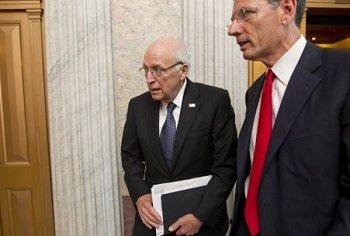
Following up on yesterday’s item, former Vice President Dick Cheney was on Capitol Hill, warning Republican policymakers to reject the automatic defense cuts that Republican policymakers proposed but no longer like.
During his visit, Cheney was lavished with praise by the likes of John McCain — remember when they disagreed about torture — who said, “Everyone acknowledges the great job he did when he was secretary of Defense, so I think he is clearly qualified to discuss the issue.” It’s possible McCain’s definition of “everyone” is different than mine.
Regardless, Cheney’s warnings are a reminder about just how concerned congressional Republicans are about the automatic Pentagon cuts that are due to kick in at the end of the year. The concerns are so pronounced, they’re apparently causing short-term memory loss.
It may have seemed like a fine idea [last summer], but now that the reality of steep cuts to the military are coming into focus, Republican lawmakers don’t like what they see.
Rep. Buck McKeon, the chairman of the House Armed Services Committee and one of the most outspoken critics of the automatic defense cuts, is one of the few members to admit he now regrets voting for the Budget Control Act.
The California Republican “was assured by his leadership that the cuts won’t happen,” said his spokesman, Claude Chafin. Still, Chafin said, it’s the Democrats — and not GOP leaders — who are solely to blame.
“What [McKeon] regrets — and I think what everybody regrets — is that when they voted for the Budget Control Act, the deal was that the other side, the president and Senate Democrats, would be honest brokers in negotiations,” Chafin added. “That never came to fruition.”
This fantasy land is just remarkable. It’s one thing to mischaracterize decades-old events, assuming people will have forgotten, but Republicans seem to have forgotten their own actions from less than a year ago.
Let’s take another little stroll down memory lane.
Last summer, congressional Republicans — literally all of them — said they would deliberately crash the economy unless Democrats accepted a major debt-reduction package. Democratic leaders, fearing the worst, agreed to pay some sort of ransom.
As part of the negotiations, President Obama offered GOP leaders $4 trillion in debt reduction. Republicans turned it down — despite its conservatism — because it included modest tax increases.
With a deadline looming and the GOP-created crisis taking a serious toll on the American economy, Democrats and Republicans reached an agreement: there would be some spending cuts right away, but it would be up to a super-committee to find another $1 trillion in cuts. To create an incentive, Republicans said they’d accept $500 billion in defense cuts if the super-committee failed.
Soon after, the super-committee flopped, done in by Republicans who refused to compromise. And wouldn’t you know it, GOP policymakers decided their own contribution to the process was not only a disaster waiting to happen, they also decided the Republican idea was Democrats’ fault. “What’s becoming increasingly apparent … is that our Democratic friends are willing to play Russian Roulette with our economy,” Senate Minority Leader Mitch McConnell (R-KY) said on Tuesday. “We think playing Russian Roulette with our economy is a really bad idea.” Senate Minority Whip Jon Kyl (R-AZ) evoked a more graphic metaphor. “It’s actually worse than Sen. McConnell said because Russian Roulette implies that you’ve got 5 chances out of 6 that you won’t kill yourself,” he said. “[Former Sen.] Phil Gramm used to have a saying around here — never take a hostage you’re not willing to shoot. But the Democrats apparently are willing to take hostage the American economy…. They are apparently ready to shoot the hostage.” Kyl, of course, not only helped push the debt-ceiling hostage standoff, he then took the lead in killing any super-committee deal. Either Republicans don’t remember 2011, or they assume you don’t. Indeed, they’re even taking advice from Cheney — Mr. Deficits Don’t Matter — who helped create the debt mess Republicans pretended to care about in the first place.
The place for in-depth analysis, commentary and informed perspectives. Recommended


