








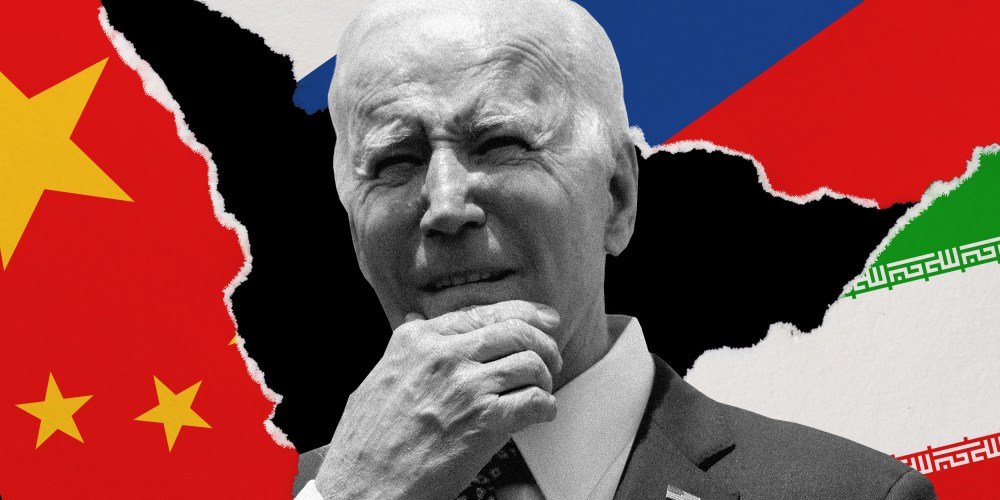
Americans are tired, at odds with themselves and in no shape to handle more foreign entanglements — much less the three-front catastrophe looming before us. Yet here we are, with the U.S. potentially facing a drawn-out war in Ukraine that risks escalating into a direct U.S.-Russia confrontation, the collapse of the Iran nuclear deal that may lead to war with the Persian Gulf power and now an unnecessary crisis with Beijing over Taiwan, triggered by Nancy Pelosi’s ill-advised trip to Taipei.
Ultimately, this trifecta of crises further de-prioritizes the real existential threat of our era.
Ultimately, this trifecta of crises further de-prioritizes the real existential threat of our era: climate chaos. But that’s another story. For now, the Biden administration still has the opportunity to prevent one of these potential crises: the Iran nuclear conflict.
There is neither victory nor even a certain outcome in sight in Ukraine in the short to medium term. The U.S. and its allies, as well as the Russians, are preparing for a prolonged conflict. Stamina and commitment will determine the outcome of that war. Yet, as MIT professor Barry Posen writes, even after more resources are poured into the war, the most likely outcome will still be “a long, bloody, and ultimately indecisive war.”
Beyond the more than $50 billion the Biden administration has sent to Ukraine in military aid (and the Ukrainian government has already asked for another $40 billion) and although the White House appears unlikely to provide another supplement before the midterm elections, the longer the conflict goes on, the greater the risk of escalation. This includes not only the potential use of nuclear weapons but also more direct U.S. involvement in the war. (I’ll note that the Biden administration should be commended for keeping U.S. troops out of the war.)

It is true that the United States cannot and should not dictate the terms of a diplomatic solution to the Russian-initiated war. But it can and should help create the conditions for diplomacy. So far, there’s been far too little diplomacy, particularly considering the imperative of avoiding a direct U.S.-Russia clash. Secretary of State Antony Blinken, for instance, spoke to his Russian counterpart, Sergei Lavrov, for the first time since the Russian invasion only five days ago.
The Taiwan crisis, as I mentioned above, was entirely unnecessary. The Biden administration could have prevented it from erupting in the first place by leaning on Pelosi to postpone her visit. Yes, Pelosi has a “right” to travel to Taipei. But that is not the relevant question. Rather, the question is whether such a trip is strategically wise and whether it advances U.S. interests. It does not.
The full dimensions of this crisis are not yet fully understood. But as my colleague Michael Swaine argues, “This situation has the potential to become an even worse version of the 1995-96 Taiwan crisis, given the fraught state of current U.S.-China relations and China’s vastly improved military capabilities.”
Although Biden missed the opportunity to prevent the crisis from emerging in the first place, he can still invest in de-escalatory mechanisms to defuse the conflict and prevent a confrontation with Beijing.
As if potential conflicts with these two nuclear powers weren’t bad enough, diplomacy over Iran’s nuclear program is on life support.
As if potential conflicts with these two nuclear powers weren’t bad enough, diplomacy over Iran’s nuclear program is on life support. A fresh, possibly final round of talks is currently taking place in the Austrian capital of Vienna. However, there aren’t any clear signs that the two sides have mustered the courage to agree to politically inconvenient compromises. As a senior E.U. diplomat involved in the talks told me, “We have never been this close. But that still doesn’t mean that we will have a deal.”
There is little doubt that disaster will strike if the deal collapses and both sides decide to escalate. During his visit to Israel last month, Biden and Israeli Prime Minister Yair Lapid signed the “Jerusalem Declaration,” a joint pledge to deny Iran nuclear arms. The day before, Biden told Israeli TV that he would use military force to prevent a nuclear Iran as a “last resort.” Though the U.S. has long declared that it would go to war to prevent Iran from building a nuclear bomb, reiterating that threat amid ongoing talks and while visiting Israel — the foremost opponent of a nuclear agreement with Iran — was a stark reminder of how close we are to a confrontation.
In the past two months alone, the U.S. side has doubleddown on Trump’s maximum pressure sanctions, addingseveral new sanctions and promising even more economic pressure. Iran, in turn, has responded by activating 500 new advanced centrifuges, significantly enhancing its nuclear capabilities.
If this trend continues, the absence of a nuclear deal means that Iran will move closer to a bomb, and the U.S. closer to war.
The Biden team may have calculated that in such a scenario, the American public would blame Iran and Trump, since he, after all, pulled out of the nuclear deal in the first place. But a recent poll by Data for Progress pours cold water on that gamble. It reveals that voters are split, with 33% blaming Biden and 34% blaming Trump. The voters are not being entirely unfair. Trump deserves the lion’s share of the blame for pulling out of the deal and doing everything he could to destroy the agreement. But Biden had a golden opportunity to rejoin the deal via executive order during his first week in office, as he did with the Paris Agreement on climate change and the World Health Organization. Instead, he chose to keep Trump’s sanctions in place and to negotiate his way back into the Joint Comprehensive Plan of Action (the Iran deal or the JCPOA) only after first spending valuable months consulting with the three countries that had pressed Trump to pull out of the deal in the first place — Saudi Arabia, Israel and the United Arab Emirates — all while insisting that Iran had to take the first step. Israel, the UAE and Saudi Arabia all prevailed on Biden not to “rush back into” the agreement. “Is he lying awake at night worrying about this? He’s probably got other things to worry him more,” a well-placed source told Politico. Tehran perceived these early actions of the Biden administration with a distrustful eye. The Iranians believed Biden aimed to prolong Iran’s suffering under Trump’s sanctions to weaken it and force Iran to accept stricter terms. Iran’s response was as predictable as it was dangerous: If Biden pressures Iran with Trump’s sanctions, Iran will counter-pressure the U.S. by expanding its nuclear activities even further. And some of the most problematic Iranian escalations, such as increasing uranium enrichment to 60%, came during Biden’s watch, not Trump’s. In short, Biden’s fumbling of diplomacy in his early months poisoned the atmosphere and made a bad situation worse. The Iranians then added to the problems both by refusing to engage directly with the U.S. and by doing their own fair share of time-wasting. But the polls should remind the White House that if talks fail, it will be seen as much as their failure as that of Trump and Iran. Still, there is plenty of good news in the polls. American voters overwhelmingly prefer the nuclear issue to be resolved diplomatically over taking military action — 78% versus 12%. And 67% of voters support a renewal of the JCPOA, the Iran deal, with only 20% opposing it. Among Democrats, the support is even stronger: 82% of Democrats want to see the JCPOA renewed. Whether the JCPOA is revived or not does not depend solely on Biden, of course. It will take flexibility and political will from both sides to get to yes. But the president has significant control over this issue. Biden should do all in his power to revive the deal, not only because of the blame he will shoulder if he fails or the support from the public he will earn if he succeeds, or even the obvious security benefits the deal brings to the U.S., but also to avoid a disastrous three-front crisis that America can ill-afford.
Trita Parsi
Trita Parsi is the executive vice president of the Quincy Institute and the author of “Losing an Enemy — Obama, Iran and the Triumph of Diplomacy.” 


