








The Senate has fought for more than three months for an extension of unemployment benefits that will expire in just a matter of weeks.
The bill that’s poised to pass would restore unemployment benefits retroactively to an estimated 2.3 million Americans whose checks have stopped since Dec. 28 because of congressional inaction. But at most, the benefits will only continue through the end of May—much sooner than Democrats had originally been hoping for. And even that’s hardly a given, as House Republicans might not even bring up the bill for a vote, much less pass it.
How did we get to this point?
Federal unemployment insurance has been on life support ever since both parties agreed to leave the benefits out of the two-year budget agreement that Republican Rep. Paul Ryan of Wisconsin and Democratic Sen. Patty Murray of Washington inked in December. The rationale was that GOP opposition to extending them was too strong, and the issue would imperil the uneasy ceasefire on Capitol Hill after the shutdown. Democrats vowed to revisit the issue after the budget passed, but quietly acknowledged that UI’s exclusion from the budget didn’t bode well for its future prospects.
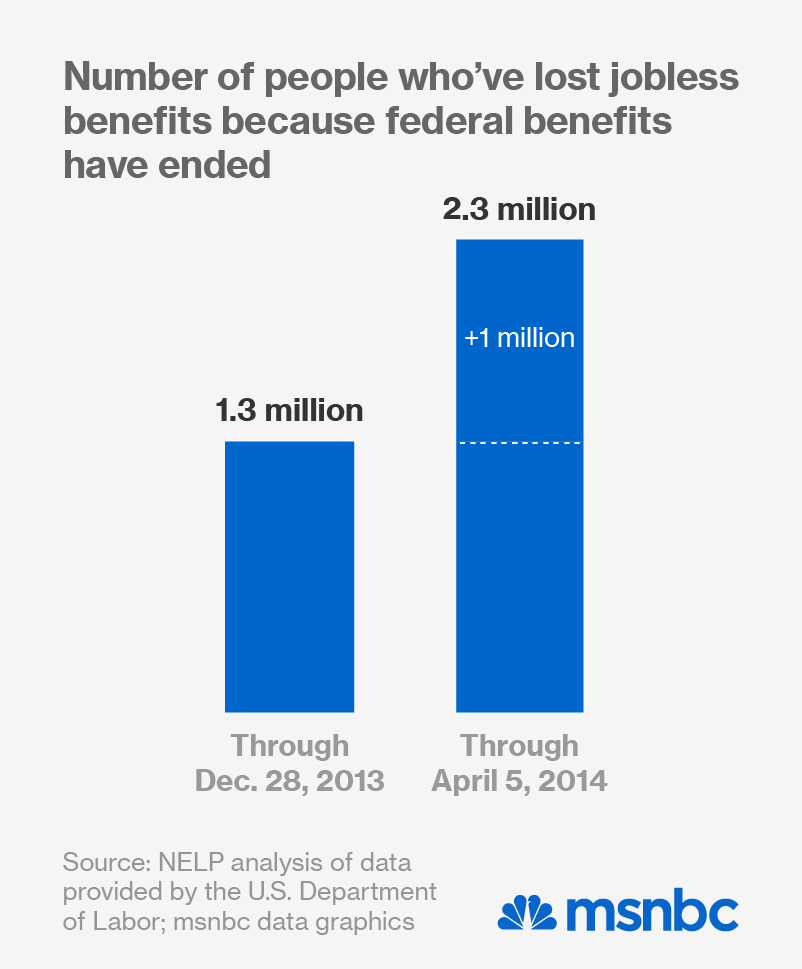
On Dec. 28, unemployment checks were cut off for 1.7 million long-term unemployed, who’ve been jobless and looking for work for longer than six months. And those numbers have continued to grow as state benefits have expired for some 600,000 additional jobless workers, without a federal backstop, according to estimates from the National Employment Law Project.
Meanwhile, the gridlock has continued as Republicans have blocked action for weeks in the Senate. Democrats were originally hoping for a year-long, $25 billion extension of federal benefits, as Congress had agreed to in the January 2013 fiscal cliff deal. But Republicans have insisted that any package be paid for, and finding enough politically acceptable offsets for a year-long package seemed to be out of the question.
Democrats responded by proposing a three-month extension, paid for by a tweak to the federal pension insurance program. Initially, the idea was to pass the short-term bill as a bridge to a year-long extension. But Senate Republicans blocked the bill in February by one vote: A handful of swing GOP members said that Democrats had shut them out of the process, while other Republicans opposed any extension of the program altogether, arguing that benefits were meant to be temporary and were deterring the jobless from looking for work. Hope for a bridge to a year-long extension soon faded. Legislators instead settled on a five-month extension and finally reached a bipartisan compromise with enough to votes to pass in mid-March, including GOP-backed provisions to bar millionaires from receiving benefits. The bill is now expected to pass the Senate this week by a slim margin, having already cleared important procedural hurdles. But the House GOP leadership hasn’t budged, as Boehner has dug in to oppose the legislation. He argues the bill fails to meet the test of creating jobs, despite independent analysis from the Congressional Budget Office that it does just that by stimulating spending. Even if the bill comes up for a vote, Republicans could amend the legislation in ways that Democrats find unacceptable. And if the proposal dies with the House, it’s likely to kill off any hope that federal benefits will come back. Unemployment insurance advocates still see a glint of hope. Seven House Republicans have already pressed Boehner to act on the issue in December, and they’re reportedly drafting a similar letter to send him after the Senate votes this week, according to sources close to the Hill debate. But the majority of the GOP caucus still isn’t on board. And that could spell the end of yet another attempt to break the gridlock in Congress.
Suzy Khimm Recommended


