








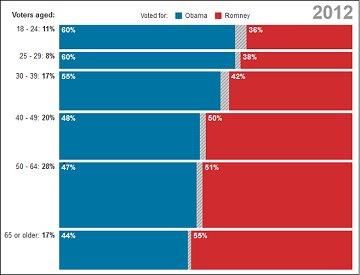
There was a fair amount of skepticism going into the presidential election as to whether President Obama could count on younger voters’ support the way he did four years ago. But it’s clear the youth vote once again made a critical difference, as a new Pew Research Center report helped document.
The divide between young voters and older voters was as stark this year as it was in 2008. While Obama lost ground among voters younger than 30, he still won this age group by 24 points over Mitt Romney (60% to 36%). […]
In Florida, Ohio, Virginia and Pennsylvania, Obama also failed to win a majority of voters 30 and older. Yet he swept all four battleground states, in part because he won majorities of 60% or more among young voters.
Just as critically, young people made up as large a share of the overall electorate as they did in 2008, according to the national exit poll (19% in 2012, 18% in 2008). As recently as September, young voters were significantly less engaged in the campaign than they had been four years earlier. But their interest and engagement levels increased in the campaign’s final weeks.
As a matter of election analysis, this is certainly noteworthy data, which helps explain why the president was able to do as well as he did.
But in the larger context, this has even greater salience. There’s been ample talk of late about Republicans having a “demographics” problem — the GOP is an overwhelmingly white party with pockets of regional appeal in a nation that’s growing more racially and ethnically diverse.
But as Pew helps remind us, Republicans also have a serious generational problem that should also make the party nervous.
Reflecting on the Pew Center’s report, Jon Chait explained that younger voters aren’t just voting Democratic more than older generations; they’re also vastly more liberal than their elders, which has the potential to force “a full-scale sea change in American politics.”
Democrats today must amass huge majorities of moderate voters in order to overcome conservatives’ numerical advantage over liberals. They must carefully wrap any proposal for activist government within the strictures of limited government, which is why Bill Clinton declared the era of big government to be over, and Obama has promised not to raise taxes for 99 percent of Americans. It’s entirely possible that, by the time today’s twentysomethings have reached middle age, these sorts of limits will cease to apply. Obviously, such a future hinges on the generational patterns of the last two election cycles persisting. But, as another Pew survey showed, generational patterns to tend to be sticky. It’s not the case that voters start out liberal and move rightward. Americans form a voting pattern early in their life and tend to hold to it. That isn’t to say something couldn’t shake these voters loose from their attachment to the liberal worldview. Republicans fervently (and plausibly) hoped the Great Recession would be that thing; having voted for Obama and borne the brunt of mass unemployment, once-idealistic voters would stare at the faded Obama posters on their wall and accept the Republican analysis that failed Big Government policies have brought about their misery. But young voters haven’t drawn this conclusion — or not many of them have, at any rate. Nate Cohn had a related piece last week, published before the Pew study came out, noting that the GOP’s problems with younger voters seems likely to get worse, not better, in part because of younger voters’ racial and ethnic diversity, and in part because of their distaste for the Republicans’ culture war. When GOP leaders ponder what steps they’ll need to compete in the near future, they’d be wise to add “stop alienating young people” to the to-do list.
The place for in-depth analysis, commentary and informed perspectives. Recommended


