








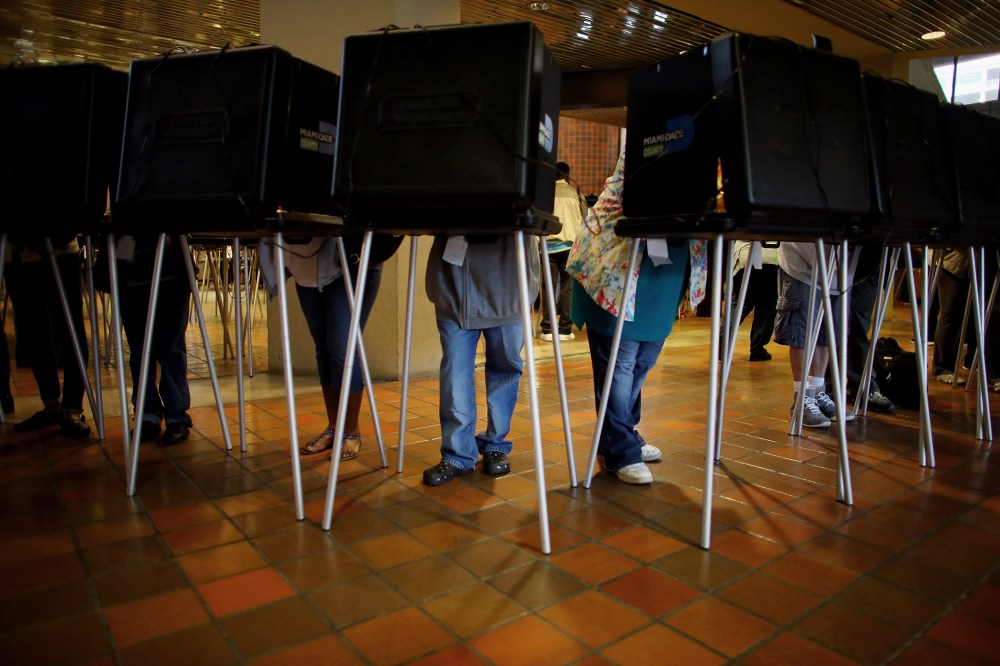
It’s been a few months since voters in Florida easily approved a ballot measure called Amendment 4, which restored the voting rights of an estimated 1.5 million former felons. It was one of the biggest and most consequential steps forward for voting rights in the United States in decades.
Republicans in the Sunshine State didn’t appear to be especially pleased with the change. For example, Gov. Ron DeSantis (R), a former far-right congressman, was accused of trying to “slow walk the implementation” of the voter-approved measure. Now, the GOP-controlled legislature is eyeing an important new change to the law, which would be a major step backwards. Politico reported this week:
A bill that would limit voting rights that ex-offenders gained under the ballot measure cleared its first stop in a Republican-controlled Florida House committee on a party-line vote Tuesday, and the president of the state Senate said he expects his chamber to draw up a companion measure.
Democrats and others condemned the move, likening the legislation to a poll tax imposed on African-Americans during the Jim Crow era.
The debate is relatively straightforward: the Republican proposal would allow former felons to have their voting rights restored, as the new law demands, just so long as they first pay court costs and fines associated with their previous misdeeds. Those who don’t pay — or can’t afford to pay — wouldn’t be able to register to vote.
Was this a condition in the voter-approved Amendment 4? No, but many GOP state policymakers believe it’s a worthwhile addition.
Many Democrats and voting-rights advocates have labeled the Republican proposal a “poll tax,” and it’s easy to understand why.
Slate‘s Mark Joseph Stern summarized the problem nicely:
To understand why this provision is a poison pill, it’s important to understand the system of “cash-register justice” practiced by Florida and many other states. To finance its criminal justice system, Florida imposes both fines and “user fees” on defendants upon conviction. Individuals may be fined up to $500,000 for their crime, then saddled with a mind-boggling array of administrative fees. Defendants must pay hundreds or thousands of dollars to fund court costs, “crime prevention” programs, and local jails. They must pay a fee to apply for a public defender, to receive medical treatment in prison, to reinstate a suspended driver’s license, and to participate in drug abuse treatment. Those who receive probation must pay “surcharges” to fund their supervision or room-and-board at a halfway house, as well as electronic monitoring and urinalysis. Most of the fees and fines are never paid in full, largely because former felons usually can’t cover the costs. And that’s where the new GOP proposal enters the picture: those who don’t pay won’t be eligible to vote, the voter-passed amendment notwithstanding. The practical effects of this are likely to be extraordinary: Amendment 4 was expected to re-enfranchise 1.5 million Floridians, but the new state legislation will disenfranchise more than a third of them. It’s not yet a done deal — we’ve only reached the stage at which the bill passed a state House committee — but in Florida, the state House, the state Senate, the state Supreme Court, and the governor’s office are all controlled by Republicans.
Steve Benen is a producer for "The Rachel Maddow Show," the editor of MaddowBlog and an MS NOW political contributor. He's also the bestselling author of "Ministry of Truth: Democracy, Reality, and the Republicans' War on the Recent Past." Recommended


