








A new daily ritual seems to have taken hold for much of the political establishment. Step 1: wait until 1 p.m. eastern. Step 2: go to Gallup’s homepage and look at the horse-race numbers. Step 3: go absolutely berserk. Step 4: wait 24 hours and start over.
Over the last week or so, Gallup’s daily tracking poll has found Mitt Romney leading President Obama by an increasingly large margin. Some see this as reason enough to assume that Romney will be elected president and believe the conventional wisdom should be shaped accordingly. Others, including Republican pollsters, believe Gallup’s numbers are suspect.
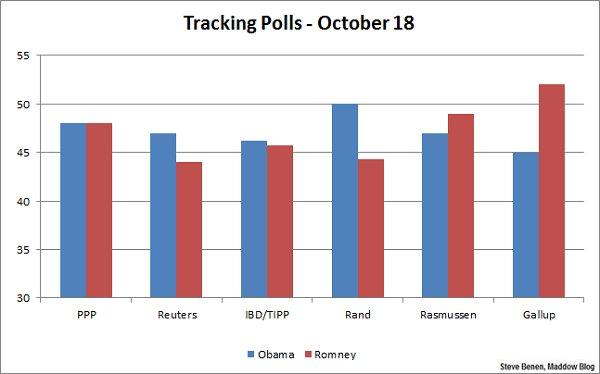
If my email inbox is any indication, a whole lot of folks are asking the same question: “What’s up with Gallup?” Before we dig in, let’s first pause to note that Gallup is obviously one of the nation’s largest and oldest pollsters, but it’s not the only outlet publishing a tracking poll. I put together this chart showing yesterday’s results from all the tracking polls that I know of.
You’ll notice, of course, that Gallup’s results are unique. That doesn’t mean they’re wrong; it’s just that this is the only pollster showing the Republican with such a hearty advantage. You’ll also notice that’s a fair amount of variety — those looking for results that will make them feel better are certainly able to do so.
That said, it’s intellectually lazy to assume the poll telling you what you want to hear is the one that’s correct.
Taking a step further, Gallup published a more detailed breakdown on Wednesday, and it was immediately apparent that while Romney was ahead nationally, it was built on regional imbalance — the Republican was up nationally in Wednesday’s results by five points, but trailed the president in the East, West, and Midwest. How did he build up a five-point edge if he trails in most of the country? By enjoying a whopping 22-point advantage in the South.
That may bring some comfort to Democrats, but I’d note that three key battleground states — Florida, Virginia, and North Carolina, all of which Obama won four years ago — are all in the South, and if Romney wins them this year, that’s a major step towards 270 electoral votes.
But these details, while relevant, still don’t explain what’s up with Gallup’s strange results.
For detailed statistical and historical analyses, I’d strongly recommend pieces published yesterday by Nate Cohn and Nate Silver, both of whom explored the results in a very detailed and informative way. But there’s one tidbit in Silver’s piece that jumped out at me: “[T]he Gallup poll has a history of performing very poorly” when its results are “deeply inconsistent with the results that other polling firms.”
Apart from Gallup’s final poll not having been especially accurate in recent years, it has often been a wild ride to get there. Their polls, for whatever reason, have often found implausibly large swings in the race.
Recommended


In 2000, for example, Gallup had George W. Bush 16 points ahead among likely voters in polling it conducted in early August. By Sept. 20, about six weeks later, they had Al Gore up by 10 points instead: a 26-point swing toward Mr. Gore over the course of a month and a half. No other polling firm showed a swing remotely that large.
Then in October 2000, Gallup showed a 14-point swing toward Mr. Bush over the course of a few days, and had him ahead by 13 points on Oct. 27 — just 10 days before an election that ended in a virtual tie.
In 1996, Gallup had Bill Clinton’s margin over Bob Dole increasing to 25 points from nine points over the course of four days.
After the Republican convention in 2008, Gallup had John McCain leading Mr. Obama by as many as 10 points among likely voters. Although some other polls also had Mr. McCain pulling ahead in the race, no other polling firm ever gave him larger than a four-point lead.
My point is not to disparage Gallup as a pollster, but only to note that there is a track record to consider. Maybe it’s right and Romney is on his way to cruising to a big win, but it’s just as likely the other polls are closer to reality.
Let me just add two other angles to consider. First, I suspect some on the right are thinking, “A ha! Now the left thinks the polls are ‘skewed’!” It’s important to realize that scrutinizing outlier data is qualitatively different from what the right was up to a few weeks ago. Conservatives were seriously arguing that there was an elaborate conspiracy involving all major pollsters and news organizations. As best as I can tell, there is no comparable nonsense on the left.
Second, though I confess to occasionally forgetting this maxim myself, overreacting to one daily poll is unwise. There are plenty of websites that collect lots of polls, average the results together, and provide a fuller picture of where the race stands. I’d recommend paying more attention to them than any individual poll.
The place for in-depth analysis, commentary and informed perspectives.
