









The following is an adapted excerpt from Ruchika T. Malhotra’s new book, “UNCOMPETE: Rejecting Competition to Unlock Success.”
The average person spends 147 minutes a day on social media — or nearly 2.5 hours according to consumer research company GWI. At its best, social media is a wonderful way to connect with and keep up with loved ones, especially those who are far away.

It can help advance your career, too. Over the years, posting regularly on my social media channels has been extremely necessary for building and finding my audience. It wouldn’t be a stretch to say that this book wouldn’t be in your hands without the time I’ve spent online. Social media has helped activists from around the world assemble and organize, championing important global causes, raising the voices of marginalized people, and holding oppressive governments accountable through large protests.
However, although social media has its perks and can be an agent for good, it’s one of the main drivers of envy in the modern age. That’s according to behavioral scientists, mental health experts, and even some technologists. Most adults are intuitively aware of how our feeds are carefully curated highlight reels — not honest depictions — of others’ lives. We all know that the photos are heavily filtered and that some of the videos are completely staged. But envy still threatens to consume and compel us to compete whenever we see others’ lives compared to ours when we log into these apps.
Martha Burwell and I saw evidence of how social media impacted women’s feelings of comparison and envy in our “uncompete” survey. Women reported feeling high levels of envy because of comparisons on social media, especially with their colleagues’ achievements and their physical appearance. Compared with white respondents, women of color felt more envy and pressure to change their looks at work based on their social media use.

In a different study, university students who used social media for more than three hours each school day suffered from poor sleep, poor academic performance, and much higher rates of depression, substance abuse, stress, and suicide. One of the reasons for this could be the constant comparison bred by social media platforms, concludes psychologist Nicholas Kardaras.
But completely disengaging from social media is not a viable option for most of us. Certainly not for many women of color, who often make invaluable work and community connections that aren’t always accessible in real-life situations.
Undeniably, it’s a privilege to be someone who can completely cut out social media and still be able to generate income or connect with your community. So rather than advocating for total abstinence from social media, I’ve curated some ways that experts recommend engaging more intentionally. In doing so, we have a better chance to create collaborations and cultivate an abundance mindset. I believe that it is possible to uncompete on social media if we do it mindfully.
Step 1: Discern Who Really “Wins” on Social Media
Social media is designed to have us believe that our “worth” is based on how many followers we have and how much engagement there is with the content we post. Its algorithms rely on us comparing ourselves and competing with others on a regular basis. But when feelings of envy creep in, we can pause and remember that social media has become a powerful tool for companies to monetize our attention and benefit from our insecurities. We can reject the tactics of competition, start uncoupling our self-worth from the metaverse, and look within for validation. The best way to begin is by asking ourselves why we’re using social media in that moment — “I’m on Instagram to post a photo I just took,” “I want to see what my friends are up to,” “I’m reading it for news”— rather than just mindlessly reaching for it.

If we engage in social media with a purpose in mind, we have a higher chance of noticing when and how envy is showing up in our bodies. Then there’s a greater possibility for us to log off and do an activity that grounds us, such as going for a walk outdoors or listening to our favorite music.
Step 2: Reframe Envy
The envy that comes from seeing people’s highlights on social media, especially when we’re struggling in our lives, can steal away every ounce of joy. The incessant comparison and the pressure to portray a perfect life and receive a comparable or greater amount of engagement than those we follow remain constant.
It’s not easy, but being able to reframe some of those emotions and negative self-talk when we see others winning on social media could be useful in helping us navigate our feelings effectively.
Here are some of the ways I’ve tried to reframe my envious feelings in my journey to uncompete online:
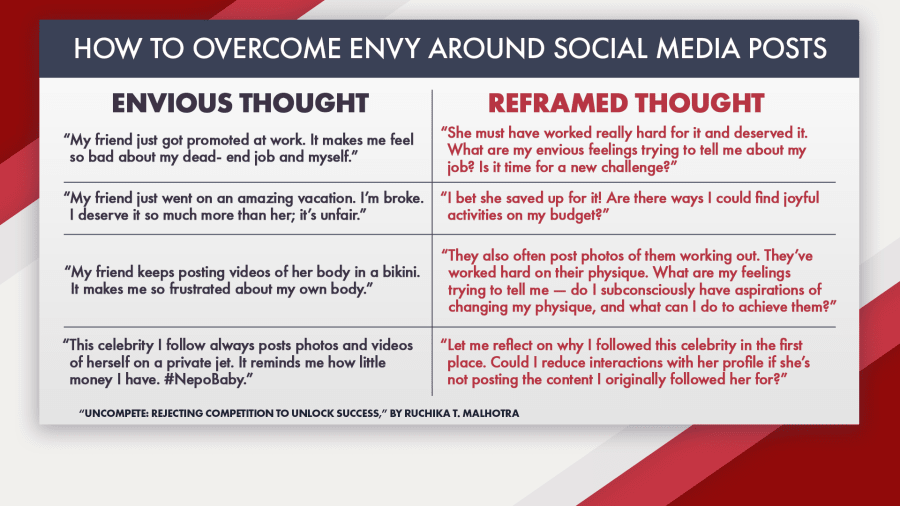
Step 3: Take Meaningful Breaks from Social Media
It’s no secret that social media algorithms are designed to reward us for posting more and spending more time on the apps. Our phones also activate the parts of our brains that produce dopamine, and this is why it’s so difficult for us to put them down. Taking a break from social media is a great way to reset our internal thoughts, which often turn negative and self-hating the more time we spend on it. Experts recommend setting planned breaks from social media such as during weekends, evenings, or even one day per week. I’ve also benefited from setting timers that log me out of social media after I’ve spent a certain amount on it.
Step 4: Follow, Support, and Boost Those Who Are Using Social Media Thoughtfully Following creators and websites that do not immediately stoke feelings of competition is a great way to combat envy and strengthen our resolve to uncompete. There are so many creators out there who are sharing more realistic looks at their lives. For example, Zoe Blaskey and Motherkind, Mom Life Comics, and the Not Safe for Mom Group are Instagram accounts that offer honest approaches to motherhood and how hard it is. Brown Girl Therapy by Sahaj Kohli, Lizzo, and Alex Light promote body confidence. POC in Tech and Decolonize Myself provide antiracist content. We can also use our own social media to practice radical generosity and solidarity by supporting and boosting other creators, especially businesses or channels owned or run by women of color. Every July, I turn over all my social platforms to amplify creators who applied to be amplified (via an online form). My social team then shares each applicant’s content once every weekday of July, so by the end of the month, we amplify more than twenty individuals, spreading the word on books, podcasts, businesses, nonprofits, art, and other amazing projects that people had shared. A few people asked me why I had turned over my platforms for the whole month – after all, don’t I have my own books, consulting, and speaking services to amplify? Why a month, why not just a day every week? What if I lost followers? People were choosing to follow me for, well, me? Obviously, I understood the concerns, and it was a “risk” in terms of pure growth and engagement numbers. But Amplify July is a huge hit for me every year. I don’t lose followers. I get to learn about interesting people around the globe who also uncompete and create a better online community and world. More than anything, I seem to “trick” the algorithms away from suggesting creators who seem to live “perfect” lives of travel, luxury, and beauty and toward recommending other accounts that are built on community and collaboration. Win win! Step 5: Advocate for Less Addictive, Safer Social Media Algorithms To uncompete at scale, we need social media companies to acknowledge that social comparison and competition are harmful. As consumers and humans, we need them to radically rewrite their business models so their profits are not directly tied to their users’ feelings of envy. This is literally how their algorithms work: They’re trained to understand and incite our deepest insecurities! For instance, on days we’ve been feeling vulnerable about our appearance, we get a stream of content suggestions on platforms like Instagram specifically showing us photos and videos of conventionally attractive women as well as suggestions of expensive products to buy. One of the ways I’ve tried to stay informed is by supporting organizations advocating for better social media platforms. A short list includes the Center for Humane Technology, the Organization for Social Media Safety, and the National Cybersecurity Alliance. I’m not trying to tell people how to “break up with their phone.” All I want is for us to believe really believe — that we have an active choice in how we spend our time online and to demand that companies act responsibly in turn. Excerpted from “UNCOMPETE: Rejecting Competition to Unlock Success,” by Ruchika T. Malhotra. Reprinted by permission of Viking, an imprint of Penguin Publishing Group, a division of Penguin Random House, LLC. Copyright © 2025 by Ruchika Tulshyan.
Ruchika T. Malhotra
Ruchika T. Malhotra is the author of "Inclusion on Purpose" and the forthcoming book, "Uncompete." She is also the founder of inclusion strategy firm, Candour. She lives in Seattle with her husband and son. Recommended


