








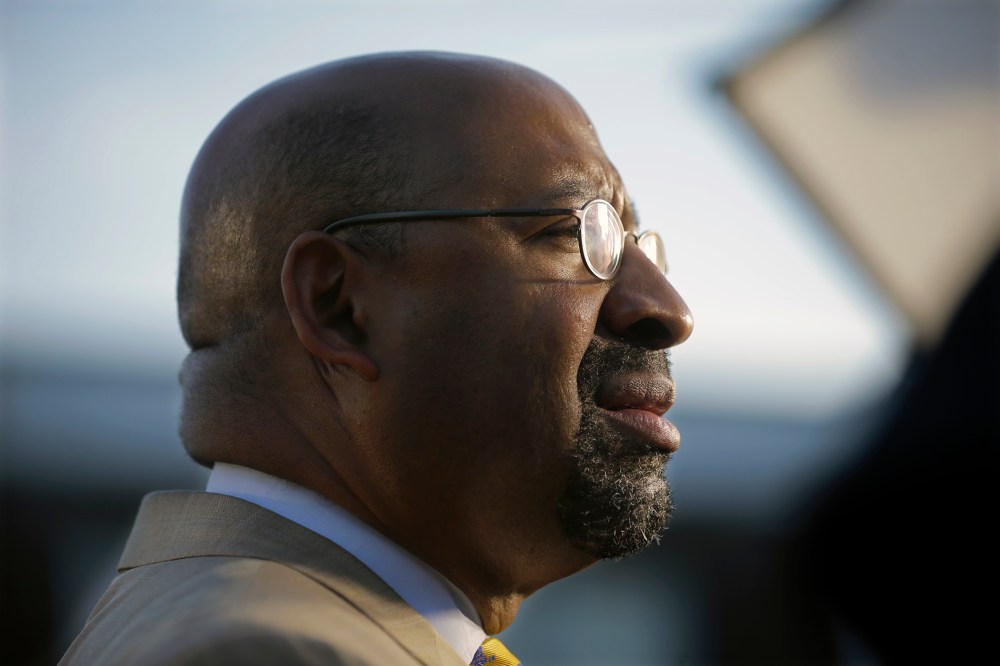
In the hours after last week’s deadly derailment of Amtrak train 188 in Philadelphia, Mayor Michael Nutter emerged as a fixture at the crash site. Standing yards from the wreckage, he offered a steady voice amid the twisted steel and hurt.
In the coming days, Nutter would exhibit the traits of any good leader during a time of tragedy. He was a source of measured sympathy and a deliberate communicator. He looked the part of a quarterback during a two-minute drill in crunch time, seamlessly orchestrating plays between the city’s disaster management teams.
But when news broke that the engineer of the train had barreled through a dangerous curve at more than 100 miles an hour, double the speed limit on that stretch of rail, Nutter lost his cool and blasted the engineer as “reckless.”
“I don’t know what was going on in the cab, but there’s really no excuse that can be offered, literally, unless he had a heart attack,” Nutter told CNN.
While federal investigators, still in the early phase of their probe into the crash, which killed eight people and injured more than 200, rebuked Nutter’s rash assessment, the mayor believed he spoke with candor and passion. “I often speak from the heart, which at times is terrifying for the folks that I work with and the press office,” Nutter said.
But the remarks and the headlines generated by them distracted from the otherwise high marks the mayor’s leadership would have earned him. For Nutter, that is familiar territory: steering his city during a time of tragedy — there have been several during his two terms as mayor — but then crippling his own performance with off-the-cuff remarks that hamper his success.
“Meet Michael Nutter, Transportation Engineer Extraordinaire,” John Featherman, a columnist with the Philadelphia Inquirer wrote mockingly. “This new Michael Nutter is anything but calm and measured. Instead, he’s accusatory, in-your-face and belligerent,” he opined. “Perhaps he’s been out of his field of expertise the past 7-1/2 years.”
Nutter has been criticized for various policies, from supporting the police department’s stop-and-frisk policy to the closure of dozens of public schools in mostly black neighborhoods, to the perception that he’s cared more about wooing gentrifiers than helping those in neighborhoods entrenched in poverty and violence.
But time and again it has been his mouth that has made the most stir.
In 2012, when outrage over the school closures boiled over, he told critics to “grow up and deal with it.”
He’s accused people who support decriminalizing marijuana of creating a false equivalence between civil rights and the idea that “black guys should be allowed to smoke as much dope as they want,” while claiming that they ignore the black victims of gun violence. He’s also chided young black men to “take those God-darn hoodies down … and buy a belt.”
And then there is his salty tongue, which has become the stuff of legend, calling the city’s criminals various types of “assholes”: “little assholes” and “complete assholes” and “real assholes.”
“Sometimes in this administration the message is lost on the messenger,” said Doug Oliver, a candidate running to replace Nutter as mayor in 2015, who for three years served as Nutter’s press secretary during his first term. “But when I talk about Mayor Nutter’s legacy, I do so with an understanding that I’ve never seen anyone wake up every single day and work harder on behalf of the city of Philadelphia.’”
‘Not sexy, but effective’
Nutter’s unnecessary overreach last week wasn’t particularly egregious given the storm cloud of emotions brewing over the crash site. But it reinforced a common thread of Nutter’s mayoralty: The loose talk often overshadows his actual effectiveness. And he has long been considered effective as mayor of Philadelphia — a city with a long, terrible history of crooked leaders, a racist mayor, mayors who were inept and mayors who seemed all too willing to live up to journalist Lincoln Steffens early 20th century assessment of the city as “corrupt and contented.”
In 2007, when Nutter was campaigning, Philadelphia was reeling from high levels of violence in the streets and corruption in City Hall. Nutter vowed to cut the murder rate in half and weed out the cronyism that had besmirched the previous administration. He has largely succeeded. During his time in office, Philadelphia — one of the poorest and toughest cities in the country — has stemmed street violence, grown its population and curbed political corruption.
Yet, for all his accomplishments, he is neither overwhelmingly loved nor celebrated.
“He has established himself as a pretty cool character and very level-headed. He’s more of a policy guy than a politician and not everyone loves that,” said Randall Miller, a professor of political science at St. Joseph’s University in Philadelphia. “Most people agree that he’s been a very effective mayor. But you could build a very sturdy building with the electrical work and plumbing done perfectly, but no one really notices that stuff. That’s the kind of guy he is as mayor. It’s not sexy, but it’s effective.”
Nutter came into office as a reform candidate and a different breed of Philly politician. He didn’t seem as affable as former mayor and Gov. Ed Rendell. And unlike his much slicker, scandal-plagued predecessor, John Street, Nutter was nerdish in a post-black struggle sort of way, much in the manner of so many ascendant African-American politicians during the dawn of the Obama era, when the cache of “souls to the polls” politics gave way to a broader framing of what modern black politicians could be.
Nutter swept into office with 83% of the vote, becoming the city’s third African-American mayor, and won a second term four years later with 76% of the vote.
“If you put him in front of a record player he can move, but that’s not something we see,” Miller said. “He wants us to see Michael Nutter in a suit and in control, not playing to any particular constituency and thinking about the larger plan.” Once in City Hall, Nutter cleaned house, hired a team of smart outsiders and created a Chief Integrity Office. In the last eight years, the city has attracted 50,000 new residents, most of them young and college educated, the prized population cities compete over. Over time, the public’s trust in City Hall seems to have risen while the murder rate has plummeted. In 2007, there were 392 murders compared to 248 in 2014. As of May 18, homicides are down 45% from the same time in 2007, according to Philadelphia police. The city’s high school graduation rate has also improved, climbing from 53% in 2007 to 65% in 2014. For the first time in six years, the majority of Philadelphia residents have a positive outlook on the city, according to a recent poll by The Pew Charitable Trust. What’s love got to do with it? Nutter, 57, a West Philadelphia native and graduate of the illustrious University of Pennsylvania Wharton School of Business, is now in the waning months of his last term. On Tuesday, the city will hold primary elections to choose the Democratic nominee that will likely succeed Nutter. While Nutter has given no indication of what might be next, his star has shone brightly on the national stage. Nutter has become the face of city mayors against gun violence, is a past president of the U.S. Conference of Mayors and was recently voted “Most Admired” by a group of American mayors. He was also tapped by President Obama to sit on the President’s Task Force on 21st Century Policing. Yet, the job has remained a relatively thankless one for the mayor. Last year, when President Obama visited The City of Brotherly Love to stump for Gov. Tom Wolf, a crowd of thousands of loyal Democrats booed Nutter when Obama mentioned his name and again when he was introduced to the stage. “Everybody just came through the worst economic recession anyone who is alive has known and Philadelphia is still standing,” said Oliver. “That’s not the brick and mortar monument for greatness, but when your city weathers the storm… [and you] steer the boat through a tidal wave, I certainly understand the frustration of shoe strings being wet. But the boat is still here,” he said,. Perhaps the most haunting criticism has been the Philadelphia public schools budget crisis that resulted in thousands of teachers and nurses laid-off, mass school closures and crippling cuts to already struggling schools. The closures sparked upheaval among parents and was exacerbated by the deaths of two young students, 7 and 12, who died after falling ill at schools that had no full-time nurse on duty. “Michael Nutter has certainly moved Philadelphia forward in a lot of ways,” said Helen Gym, founder of Parents United, a student advocacy group and Philadelphia mayoral candidate. “But his legacy around public education and issues that really hit certain communities is a lot more complicated. There’s a strong undercurrent of dissatisfaction and a lot of communities are feeling left behind.” Miller likened Nutter to another largely unheralded leader: Ulysses S. Grant, the Civil War general who led the Union Army against the Confederacy. Grant was respected but never cheered by his troops the way other more gregarious generals had been. He was only cheered once, Miller said, when he took on the Confederate Army’s Gen. Robert E. Lee. When the battle between the two was nearly over, instead of falling back to regroup, Grant went after him. And his troops finally cheered. “There was a sense of a great victory that was going to come. There’s no sense of a great victory coming with Nutter, no great crisis moment where he rallies the troops like Rudy Giuliani marching with the twin towers coming down,” Miller said. “There hasn’t been a moment that has been so dramatic where Nutter has rallied folks and got them to do something they thought they couldn’t do. What he’s done isn’t heroic, but it is in another sense because it’s the stuff that needs to get done if anything else is going to get done in the next 20 years in Philadelphia.”
Trymaine Lee
Trymaine Lee is an NBC News correspondent. Recommended


