








“Following up.”
That was the message Bill Baroni, Gov. Chris Christie’s top appointee at the Port Authority of New York & New Jersey, sent to Christie’s re-election campaign manager Bill Stepien on the fourth day of the now-infamous September 2013 lane closures at the George Washington Bridge.
As traffic choked the borough of Fort Lee, N.J., the city’s mayor, Mark Sokolich, had sent an urgent personal message to Baroni asking whether the closures might have “punitive overtones” and wondering how any long-term traffic changes might affect a billion-dollar redevelopment project located adjacent to the bridge.
Sokolich had been trying to reach Baroni all week, but was being given what another Christie appointee at the agency called “radio silence.” In spite of that treatment, Sokolich told Baroni he hoped that the “recent decent decision by the Port Authority will be reversed quietly, uneventfully and without political fanfare.”
According to new documents released this week, Baroni forwarded Sokolich’s letter to Stepien about ten minutes after receiving it. Baroni’s only message to accompany the letter was “following up.”
But following up to what?
That is just one of the questions at the heart of the Bridgegate scandal – a story that began with a seemingly innocent change to the way toll lanes were allocated on the world’s busiest bridge. It is now clear that those changes and the dangerous traffic jams they caused were the result of a deliberate act plotted and covered-up by a handful of Governor Christie’s close associates who worked in top positions at the Port Authority, in the governor’s office in Trenton, and in his re-election campaign.
The newly-released emails and text messages do not directly implicate the governor himself in these activities, but confirm again that a few top aides and appointees with whom he interacted on a regular, if not daily, basis were regularly updating one another on the planning, execution, impact, and fallout of the bridge lane closures.
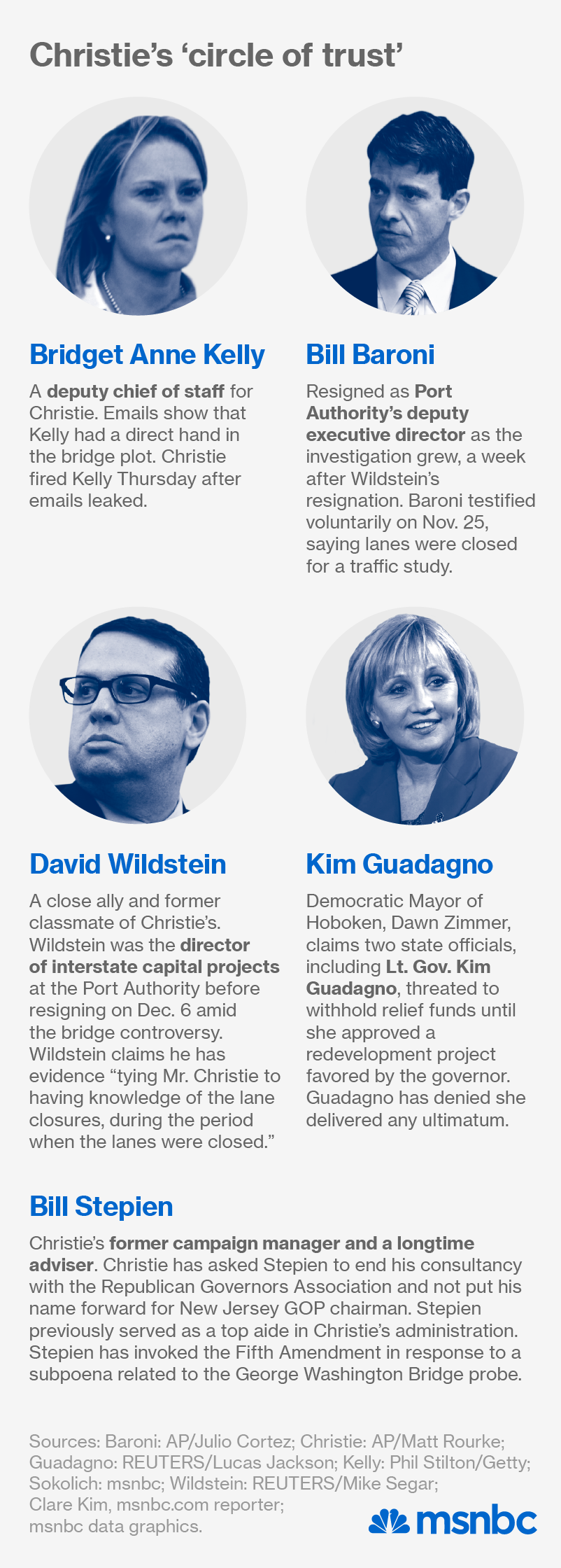
In early January hundreds of emails and documents were made public as part of the New Jersey legislature’s investigation into the lane closures and subsequent efforts to conceal the actions and motivations of those who participated in their planning and execution. What is known is that four key players seem to have been aware of the lane closures as they were happening: Port Authority deputy director Bill Baroni; David Wildstein, another Christie appointee at the agency; Bridget Anne Kelly, the governor’s deputy chief of staff; and Bill Stepien, Christie’s two-time campaign manager.
Earlier emails showed that Stepien and Kelly both received copies of Mayor Mark Sokolich’s September 12 letter. But those earlier messages suggested Stepien had gotten a copy from Wildstein.
Thanks to Monday’s disclosure we now know that Stepien also received the Fort Lee mayor’s letter directly from Baroni, along with the a note that he was “following up.”
Besides raising the question of what conversations occurred prior to this note, the email reveals just how much Stepien was being kept in the loop by Baroni and Wildstein during the lane closures just weeks before Stepien steered Christie to a landslide re-election win.
All the emails described above were within a window of ten minutes on September 12. Baroni received Soklich’s letter at 12:44, sent it to Wildstein at 12:47, and then sent it to his own unofficial personal Gmail account a minute later. The message he forwarded to Stepien from that personal account was sent at 12:53, a minute after Wildstein sent Stepien and Kelly the same letter. Wildstein, too, was using his personal Gmail account.
The email chain shows how Stepien and Kelly were being provided with real-time information about the political implications of the lane closures as they were happening. Moreover, that information was not only coming to them from Wildstein, Christie’s political fixer at the Port Authority. In Stepien’s case it was also coming from Baroni, the number two executive at the bi-state agency — further implicating both men in the operation itself.
The new documents also revealed that in late November, Stepien sent Baroni a text message thanking him for testifying that the lane closures were part of a traffic study being conducted by the Port Authority – a story later discredited by numerous staff members at the agency as well as Port Authority Executive Director Patrick Foye. “You did great, and I wanted to thank you,” Stepien wrote. Baroni thanked him in return, saying that while he expected the legislative committee’s “nonsense” to continue, he had nevertheless “explained the counter narrative.” These messages were exchanged well after Christie had won re-election, raising the question of why Stepien – in late November – would be interested in the presentation of a ‘counter narrative’ unless he had a stake in its reception. The new documents show that Stepien was coordinating press responses to Bridgegate questions with the governor’s office in October, and providing Baroni with updates, also via text message, about a story being written by the Wall Street Journal. Previously released messages show that Stepien and Wildstein discussed that article after it was published. The new documents show that in January, too, Stepien was being told about reporting on Bridgegate. On January 6, Matt Mowers, a Christie campaign deputy who now is the executive director of the New Hampshire Republican Party, emailed Stepien to let him know that a New Jersey reporter had been in touch, presumably about Bridgegate. Mowers also told Stepien that he would soon be meeting with New Hampshire Republican presidential campaign veteran Tom Rath, and wondered whether Stepien wanted any information from Rath. New Hampshire is a key presidential battleground and traditionally holds the first primary. Even as Christie’s campaign operatives were beginning to plot a route for their boss to run for president, this story loomed in the background. Yet however narrowly illuminating these messages may be, their larger context and the motive behind Bridgegate remains sketchy and will remain so until Mercer County superior court judge Mary Jacobson rules on whether Stepien and Kelly have to comply with a subpoena and provide New Jersey lawmakers with documents, emails, and text messages relating to the lane closures. Through their lawyers, both Stepien and Kelly have argued that providing those documents could implicate them in a crime, and a hearing was held last week on whether the two could assert a Fifth Amendment privilege in refusing to cooperate with the legislature’s investigation. Judge Jacobson expects to issue a ruling later this month.
Brian Murphy Recommended


