








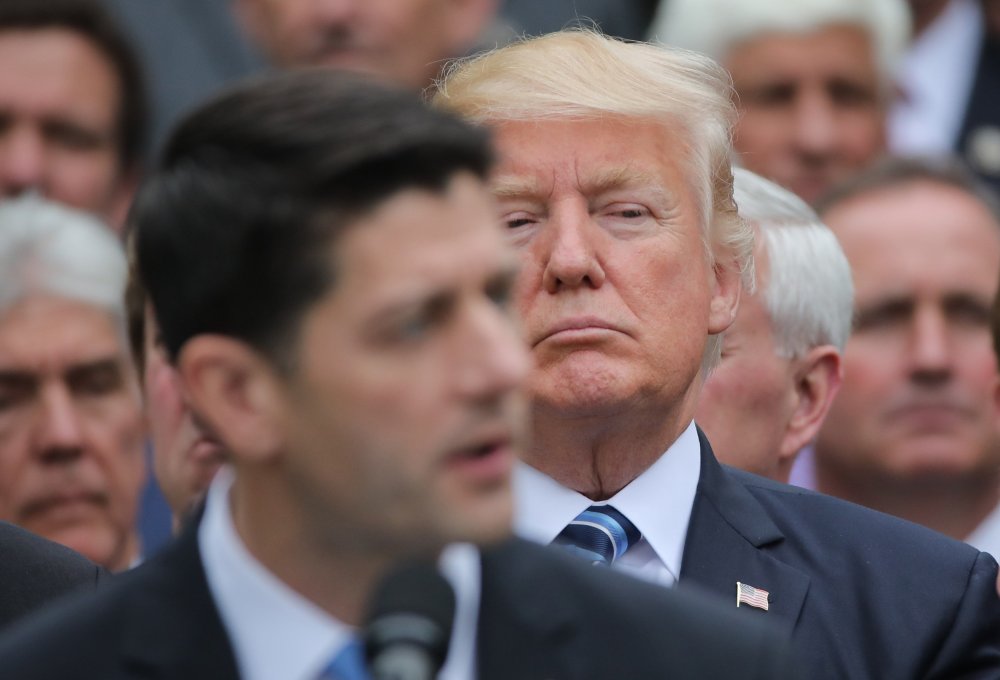
Reading the feature piece in the New York Times Magazine on House Speaker Paul Ryan, it’s hard to miss the fact that the Wisconsin Republican doesn’t seem to care for questions about Donald Trump. That’s not especially surprising; if I were Ryan, I wouldn’t want to field a bunch of questions about the president, either.
But the Speaker, as he wraps up his congressional career, suggested he’s made a difference with Trump behind the scenes, taking steps to prevent what Ryan described as “tragedies.”
Ryan prefers to tell Trump how he feels in private. He joins a large group of Trump’s putative allies, many of whom have worked in the administration, who insist that they have shaped Trump’s thinking and behavior in private: the “Trust me, I’ve stopped this from being much worse” approach.
“I can look myself in the mirror at the end of the day and say I avoided that tragedy, I avoided that tragedy, I avoided that tragedy,” Ryan tells me. “I advanced this goal, I advanced this goal, I advanced this goal.”
I locked in on the word “tragedy.” It sets the mind reeling to whatever thwarted “tragedies” Ryan might be talking about. I asked for an example. “No, I don’t want to do that,” Ryan replied. “That’s more than I usually say.”
Perhaps we’re supposed to be reassured by the idea that Paul Ryan intervened — in ways that the public doesn’t know about — to prevent Trump from making even more spectacular missteps than the ones we’re all familiar with.
But it’s nevertheless unsettling how often this seems to come up.
Just three months into Trump’s presidency, one of his confidants told Politico, “If you’re an adviser to him, your job is to help him at the margins. To talk him out of doing crazy things.”
Implicit, of course, in the observation was the fact that the president was inclined to do “crazy” things, and Trump needed those around him to steer him in a more responsible direction. Four months later, in August 2017, Axios spoke to a half-dozen senior administration officials, each of whom were described as working closely with the president. “You have no idea how much crazy stuff we kill,” one of them said, explaining that some White House officials stick around in order to help Trump “fight his worst impulses.” Keep in mind, this president has already taken all kinds of misguided steps and embraced all kinds of unfortunate ideas, which makes it all the more alarming that we keep hearing from folks — from White House aides to the Speaker of the House — who insist that Trump would act on his most outlandish instincts were it not for their influence. None of this is comforting.
Steve Benen is a producer for "The Rachel Maddow Show," the editor of MaddowBlog and an MS NOW political contributor. He's also the bestselling author of "Ministry of Truth: Democracy, Reality, and the Republicans' War on the Recent Past." Recommended


