








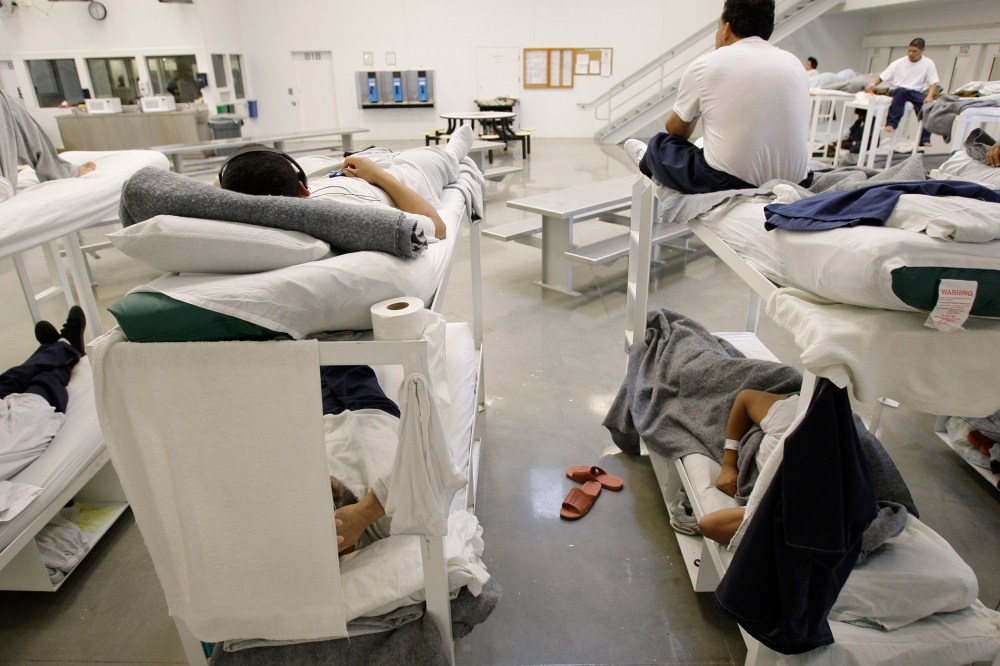
Immigrant detainees are facing threats of retaliation on their fifth day of a hunger strike at the Northwest Detention Center in Tacoma, Washington, according to supporters who have spoken with the strike’s leaders.
Sandy Restrepo, an immigration attorney, said Monday that some of the detainees at the Immigration and Customs Enforcement facility have been threatened with forced feedings, and that detainees seeking asylum had been threatened with the denial of their cases.
Maru Mora Villalpando, a representative with Latino Advocacy, a group that has been supporting the hunger strikers, said that some of the men who started eating yesterday had rejoined the strike. Villalpando also said that one of the group’s lawyers is following up on allegations that two detainees were physically compelled to sign deportation papers.
“We know the retaliation continues,” she told msnbc.
ICE officials said in a statement Monday that 130 of the facility’s nearly 1,300 detainees were still on strike. “In accordance with ICE detention standards, detainees who do not eat anything for 72 hours will be considered to be on a hunger strike and referred to the medical department for further evaluation,” the statement read.
Northwest Detention Center is run by GEO Group, a private corrections company that has faced criticism for lobbying against immigration reform despite promises it would stay out of last year’s debate over changing the current system. Nearly two million immigrants have been deported during President Obama’s administration.
“Most [undocumented immigrants] are detained because they are working without a social security number, but the federal government is okay with these people working for GEO group for one dollar a day,” Villalpando told msnbc. “It’s a kind of slave labor, and the conditions are just not humane.”
And the protesters are not afraid of retaliation if it brings more attention to conditions at ICE facilities around the United States. “They want the public to know that they’re people, and this is supposed to be a civil proceeding, and they’re being [in a way] neither civil or even human … they’re treated worse than animals.”
The strike began Friday as a protest against ongoing deportations and substandard conditions at the detention center, including quality of food and treatment, lower commissary prices, and better pay for work done at the facility. Detainees are fed potatoes and milk. According to Villalpando, snacks available in the commissary can cost the equivalent of five days’ pay. On Monday, the detainees expanded their demands to include release on bond for detainees, saying in a letter, “Without a bond we spend months, even one-to-two years locked up without knowing what’s going to happen to us and our families and without being able to economically support our families, causing them to fall deeper into poverty.” Family and supporters of the protesters have planned a press conference at 5 p.m. Tuesday in Tacoma, where the wives of some of the men on strike will also offer updates. Supporters of the hunger strikers said that 1,200 detainees began the strike on Friday, while ICE officials put the number at 750. “[The protesters] see themselves as whistleblowers, as civil rights activists. They know some of their cases might end with them being deported, but they know it’s not just about them,” Villalpando said.
Meredith Clark
Meredith Clark is a freelance writer and editor. She was previously a senior news producer for "Patriot Act with Hasan Minhaj," a reporter with MSNBC.com, the digital politics and culture editor at Glamour and a senior news and politics editor at Refinery29. She has written for Vulture, Rolling Stone, Self, Marie Claire, Cosmopolitan, The Daily Beast and Bustle. Recommended


