









James Orr is already doing everything an unemployed person is supposed to do. Six months after the contract at his last job expired, he’s still doggedly applying for openings in his field across the country. As a long-time IT professional, he already has the technical skills which employers are ostensibly so hungry for.
Orr, 55, is not the victim of any so-called “skills gap,” and he doesn’t lack the incentive to work. Instead, like millions of other jobless Americans, he’s the victim of economic realities which have barely changed since the 2008 financial collapse. And his situation, along with the situation of over 2 million other unemployed workers, has only become more perilous since Congress failed to renew long-term unemployment benefits in late December.
“I’m living on the edge here, man,” Orr told msnbc. “It’s crazy, but life happens.”
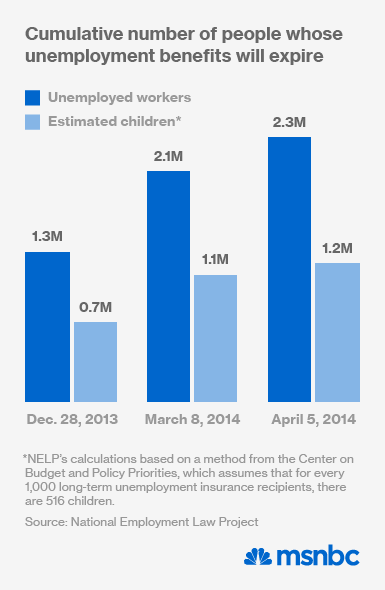
When long-term jobless benefits first expired on December 28, the effects were immediate for those 1.3 million Americans who had already been without a job for six months or longer. But the pool of the long-term unemployed continues to grow with each passing month. By this Saturday, that pool will have grown to include at least two million Americans who are no longer eligible to collect benefits, according to data released by the National Employment Law Project (NELP) [PDF] on Tuesday. Next month, NELP projects that the number will rise to 2.3 million unless Washington takes action first.
But while plenty has changed for people like Orr since the expiration of long-term unemployment benefits, there is little indication that the same holds true in Congress, where Republican opposition has repeatedly stalled any attempt to reinstate benefits. That hasn’t stopped Rhode Island Democratic Sen. Jack Reed from introducing another bill to extend long-term unemployment insurance on Tuesday, the same day that NELP released its data. Whereas Democrats had previously attempted to extend benefits by three months, Reed’s latest bill would resuscitate the program for six. In a statement, he said that he just needs one more Republican in the Senate to cross the floor in order to reach the 60-vote threshold that would overcome any potential filibuster.
“Reauthorizing emergency UI [unemployment insurance] benefits in times of economic hardship has historically not been a partisan issue, and it’s time we revert to that longstanding tradition of extending a hand to our fellow Americans in their time of need,” said Reed.
It’s one thing to persuade one more senator to support the legislation and quite another thing to make sure the bill has even a fighting chance in the Republican-controlled House. In early January, House Speaker John Boehner, R-Ohio, said his caucus would be open to extending long-term jobless benefits only if “it was paid for and if there were provisions that we could agree to that would get our economy moving again.” Reed insists that the extension would be “paid for” using cuts in the recently passed 2014 Farm Bill, but it’s unclear whether that alone will make the bill palatable to House Republicans. Speaker Boehner’s office did not respond to a request from msnbc for comment on that question. Meanwhile, the clock is ticking for Orr. Unable to pay rent, he fears that he may be evicted from his Englewood, Colorado apartment as soon as this week. He has two sons in college who are still financially dependent on him and his ex-wife. And although he’s applying to jobs around the country, he can no longer afford to move anywhere unless a potential employer offers to cover the cost of relocation—something which fewer employers in his industry seem to be doing ever since 2008. Without a salary or unemployment insurance, Orr is now scraping by on food stamps and loans from family members, hoping that he’ll get a break soon. “The first time in my life I need government assistance,” said Orr, “and all of a sudden, when I need it, it’s not there.”
Ned Resnikoff is an urban policy analyst, researcher, writer, and editor. His byline has appeared in a variety of publications, including the New York Times, San Francisco Chronicle, Dissent, and The Nation. He writes the newsletter Public Comment, which can be found at publiccomment.blog. Recommended


