








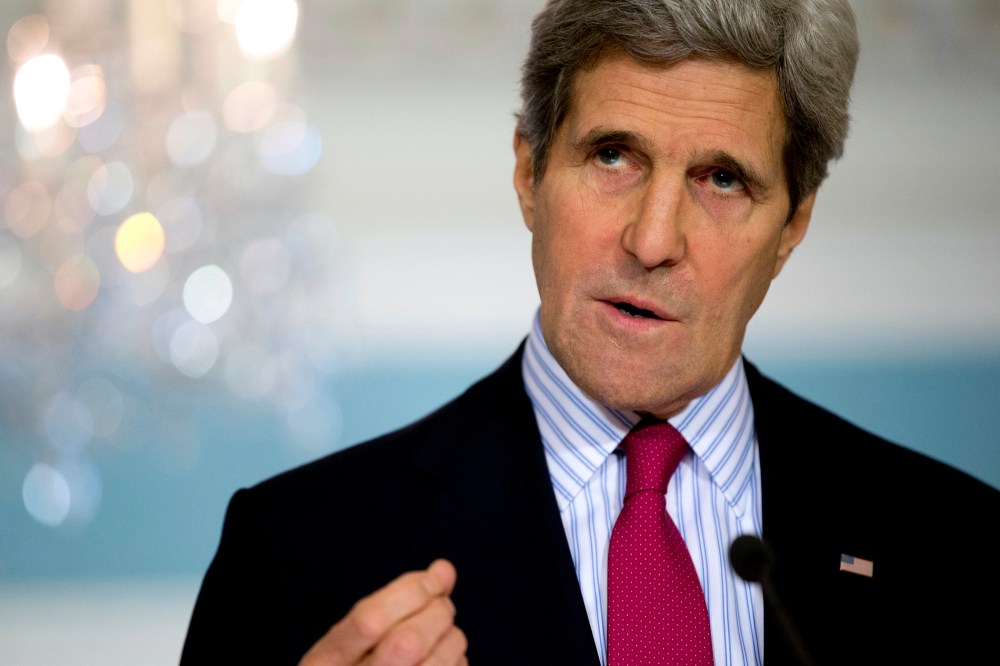
U.S. Secretary of State John Kerry is heading to Kiev on Monday night for discussions on the movement of Russian troops into Ukraine’s Crimea region.
He confirmed the talks over Twitter.
I will be headed to Kyiv, Ukraine tomorrow night for discussions there Tuesday.
— John Kerry (@JohnKerry) March 2, 2014On Sunday, he condemned Russian President Vladimir Putin’s “act of aggression” for his choice to invade Ukraine and warned of “very serious repercussions,” including trade sanctions.
“It’s really 19th century behavior in the 21st century,” Kerry said Sunday on NBC’s Meet the Press. He suggested Putin is “possibly trying to annex Crimeam,” saying, “You just don’t invade another country on phony pretexts in order to assert your interests.”
The White House announced plans over the weekend to “suspend” preparations for the G-8 summit of industrialized nations scheduled to take place in Sochi. On Sunday, British Foreign Minister William Hague confirmed the United Kingdom also pulled out of upcoming talks.
“There’s a unified view by all of the foreign ministers I talked with yesterday — all of the G-8 and more — that they’re simply going to isolate Russia; that they’re not going to engage with Russia in a normal business-as-usual manner,” Kerry said. “The ruble is already going down and feeling the impact of this.”
Kerry signaled Russia would continue to get hit economically if they don’t reverse course and withdraw forces from the Russian-speaking Ukrainian region of Crimea. He warned “there could even be ultimately asset freezes” and visa bans.
Kerry declared Putin will come out of this ordeal the loser. “He’s going to lose on the international stage, Russia is going to lose, the Russian people are going to lose, and he’s going to lose all of the glow that came out of the Olympics, his $60 billion extravaganza.”
Kremlin spokesman Dmitry Peskov declined to respond to Kerry’s remarks.
“This could be a very dangerous situation if this continues in a very provocative way,” U.S. Defense Secretary Chuck Hagel warned Sunday on CBS’ Face the Nation. “We have many options, like any nations do.”
Hagel added resolving the crisis through diplomacy remains a top priority. “We’re trying to deal with a diplomatic focus. That’s the appropriate, responsible approach,” he said.
President Obama spoke with Putin on the telephone for 90 minutes Saturday, offering to lead a formal mediation between Russia and Ukraine. Obama expressed deep concern over Russia’s “clear violation of Ukrainian sovereignty and territorial integrity,” according to a White House statement. Ukraine began mobilizing its own forces Sunday after Russia’s parliament declared Putin had the proper military authority to invade its neighboring peninsula. Russia leases a naval base in the Ukrainian province of Crimea. The Ukrainian ambassador to the United Nations said the country is taking steps to defend itself from Russia, but might ask other countries for help. “We are to demonstrate that we have our own capacity to protect ourselves as decided today in parliament and we are preparing to defend ourselves,” Ambassador Yuriy Sergeyev said on CNN’s State of the Union. “If aggravation is going in that way, when the Russian troops are enlarging their quantity with every coming hour, naturally we will ask for military support and other kind of support.” Sen. Marco Rubio told NBC’s David Gregory that Russians “basically violated every major treaty they’ve ever entered into,” calling it a “government of liars.” “They’re increasingly behaving like an enemy of international peace and international norms,” Rubio, a member of the Senate Foreign Relations Committee, said onMeet The Press. However, he argued no one is advocating for military strikes against Russia and urged NATO alliances to be strengthened to help stabilize the government in Kiev. NATO Secretary General Anders Fogh Rasmussen said Russia’s actions “threaten peace” across Europe and called on them to de-escalate tensions. “What Russia is doing now in Ukraine violates the principles of the United Nations charter. It threatens peace and security in Europe,” Rasmussen told reporters on Sunday. He urged all parties involved to “continue all efforts to move away from this dangerous situation.”
Sarah Muller Recommended


