








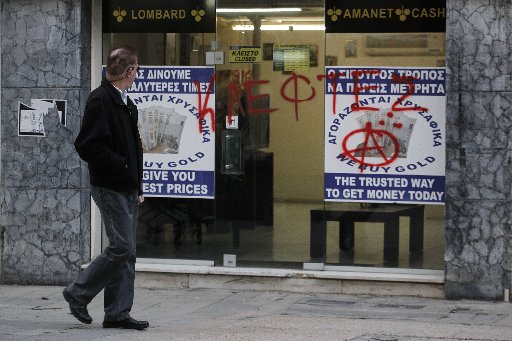
Welcome to Cyprus, the latest theater for the ongoing European debt crisis. With its banks shuttered for now, the nation has reverted back to a cash-only economy. In exchange for a €10 billion (about $13 billion USD) European Union bailout on its ailing banks, the Cypriot government is expected to raise €5.8 billion (roughly $7.5 billion) on its own.
So how did a banking crisis in this tiny island nation manage to put the entire Eurozone on red alert? It has a lot to do with who banks in Cyprus and why.
While the nation has a population smaller than Dallas, Texas, its banks hold about $162.6 billion in total assets, or roughly seven times the country’s total GDP. Much of that money comes from wealthy Russians.
“It’s a highly criminalized sector,” said Nick Shaxson, a Zürich-based journalist and the author of Treasure Islands: Uncovering the Damage of Offshore Banking and Tax Havens. He said Russian depositors in Cyprus “have been using the sector for tax evasion and secrecy based activity.”
Cyprus is one of an estimated 50 or 60 countries, said Shaxson, that “have made a strategy out of being a tax haven.” While the Cypriot economy’s woes can be blamed on a number of contingent factors—including a “Spain or Ireland-sized” real estate bubble, Euro membership, and financial ties to neighboring Greece—the deterioration of its banking system has also exposed some of the vulnerabilities and dangers of the tax haven system. However it ends, the implications of the Cyprus disaster could be global.
Last year, the federal government reportedly lost $150 billion to offshore tax havens as corporations and wealthy Americans shifted their money to nations with lower taxes and looser disclosure rules. As a result, said Shaxson, “the richer sections of society pay less in taxes, and the poor sections of society pay more, or they suffer” as a result of reduced public services.
“Inequality is one of the great things that emerges from this system,” he said. Furthermore, “there’s a huge amount of illegal activity involved,” due to the secrecy involved in offshore banking. For example, the Russian mafia allegedly has significant offshore holdings in Cyprus.
When Cypriot banks invested in Greek assets, allowing Greece’s debt crisis to infect their own economy, the government of Cyprus tried at first to protect the country’s offshoring industry by raising bailout funds through a one-time “tax” on small (mostly local) Cypriot bank customers. The tax would have spared bank deposits over €100,000, more likely to be held by foreign depositors. In the face of a public outcry, that deal was eventually scrapped. The new deal breaks up one of the biggest Cypriot banks and imposes new restrictions on capital flows in order to prevent a bank run. Those new controls, though ostensibly temporary, “will mark the end of an era for Cyprus, which has in effect spent the past decade advertising itself as a place where wealthy individuals who want to avoid taxes and scrutiny can safely park their money, no questions asked,” writes New York Times columnist Paul Krugman. “But it may also mark at least the beginning of the end for something much bigger: The era when unrestricted movement of capital was taken as a desirable norm around the world.” Such a shift could permanently reshape, or even eradicate, the tax haven system as currently understood. In the meantime, however, offshore assets in Cyprus might just move elsewhere, such as Latvia or the Cayman Islands. And as Wonkblog’s Neil Irwin writes: “The next time there is a banking panic in Europe, it will move much faster, and be much harder to control, than those of the recent past, as depositors try to get ahead of future losses and capital controls.” The next crisis might be right around the corner.
Ned Resnikoff is an urban policy analyst, researcher, writer, and editor. His byline has appeared in a variety of publications, including the New York Times, San Francisco Chronicle, Dissent, and The Nation. He writes the newsletter Public Comment, which can be found at publiccomment.blog. Recommended


