








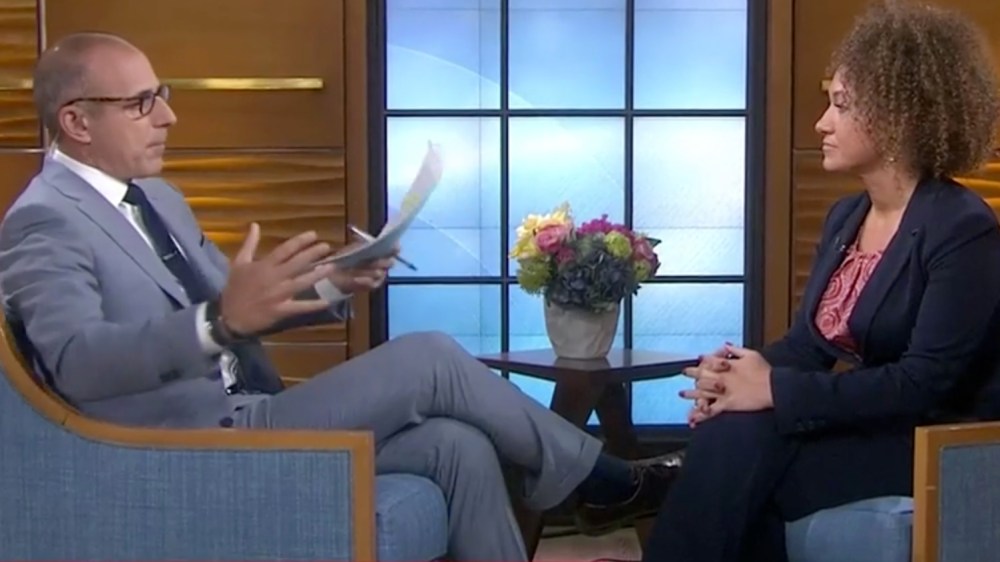
Rachel Dolezal, the former NAACP chapter president who resigned this week after her parents revealed that she is white, went public Tuesday about the controversy and why she identifies as a black woman.
RELATED: Rachel Dolezal: ‘I identify as black’
Breaking her silence for the first time since a national firestorm erupted over her identity, Dolezal spoke with “TODAY” host Matt Lauer and msnbc’s Melissa Harris-Perry about how she justifies describing herself as African American, how and when she appeared to change her race, and more. Here are the highlights.
On her black identity
“I identify as black,” Dolezal told Lauer during her interview on “TODAY.” Later, speaking with Harris-Perry, Dolezal said that “means several things.”

“First of all, it means that I have really gone there with the experience in terms of being a mother with two black sons and really owning what it means to experience and live blackness. So that’s one aspect. And another aspect would be that I from a very young age felt a spiritual, visceral, instinctual connection with black is beautiful. Just the black experience and wanting to celebrate that,” she said.
On her skin
“I certainly don’t stay out of the sun, you know, and I also don’t as some of the critics have said, put on black face as a performance,” Dolezal told Lauer. “I have a huge issue with black face, this is not some freak “Birth of a Nation” mockery black face performance.”
“This is on a very real connected level how I’ve actually had to go there with the experience, not just a visible representation but with the experience, at the point which that really solidified was when I got full custody of [my son]. And he said, you’re my real mom and he’s in high school and for that to be something that is plausible, I certainly cant be seen as white and be Isaiah’s mom.”
On being a con artist
“I don’t think anything that I have done with regard to the movement, my work, my life, my identity, I mean, it’s all been very thoughtful and careful, sometimes decisions have been made for survival reasons or to protect people that I love,” she told Harris-Perry. “And all things included, when it boils down, the entire world could say stand down. But when it comes to being there for my kids, for my sister, I would never stand down on that.”
On being transracial
“Well, so the thing about it is, and I’ve never said, like, ‘I’m transracial’. You know, but #transracial why does it matter, is not. It’s kind of like, all lives matter. All lives matter,” Dolezal said in her msnbc interview. “Everybody’s life matters. But that’s why we have to say black lives matter because the highest disproportionality, police brutality, disenfranchisement, education disproportionality in school discipline, curriculum, misrepresentation, all of this.” On being white again “Life is a journey and you’re kind of evolving and growing all along the way. And so if it’s accumulation of all these choices that you’ve made,” she told Harris-Perry. “And the Rachel that I was before Thursday is still the Rachel I am now and the Rachel I’m going to be in the future.” “And so I haven’t kind of twist faces back and forth. I think that it can be read as, I was supposed to condition to sanction part of myself. I finally, you know, had the freedom to start owning this and celebrating and re-connecting. What it is in a spiritual sense, a cultural sense, race, ethnicity, et cetera. When it comes to then, you know, there’s also a window where it’s then re-sanctioned.” On what she would do differently “You know, there are probably a couple interviews that I would do a little differently if circumstances in retrospect I knew what I know now. But overall, you know, my life has been one of survival,” Dolezal said in her “TODAY” interview. “And the decisions that I have made along the way including my identification have been to survive, and to carry forward in my journey and life continuum.” On her sons’ perspectives “Well, I actually was talking to one of my sons yesterday, and he said mom, racially, you’re human and culturally you’re black, and you know, so we’ve had these conversations over the years. I do know that they support the way that I identify, and they support me,” she told Lauer. “We’ve have each other’s back, we’re the three musketeers.”
Abby Borovitz Recommended


