








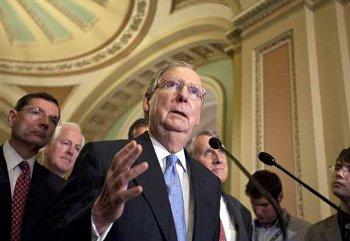
We talked yesterday about the non-partisan Congressional Research Service pulling a recent report that documented what many already knew: giving tax breaks to the rich helps concentrate wealth at the top, but it does not boost the economy. Republican lawmakers, led by Senate Minority Leader Mitch McConnell (R-Ky.), had the report killed.
More information is coming to light.
Thomas Hungerford, the CRS researcher who produced the report, told HuffPost that he stands by it. “Basically, the decision to take it down, I think The New York Times article basically got it right, that it was pressure from the Senate minority to take it down,” Hungerford said. “CRS reports go through many layers of review before they’re issued and as far as the tone and the conclusions go, people who specifically look at the writing and the tone said it was okay. So it’s not going to be that and as I can tell you outright, I stand by the report and the analysis in the report.”
Hungerford said that he had never experienced suppression like this before….
For its part, McConnell’s office insists “people outside of Congress” also raised concerns about the CRS report, but Tim Noah explained that these outsiders are apparently limited to conservative think tanks, including the Heritage Foundation.
It’s important to understand that the Congressional Research Service, generally recognized as Congress’ own think tank, has a well-deserved reputation for non-partisanship. The CRS is counted on to provide lawmakers with the most reliable and accurate information available, and the notion that partisan lawmakers can pressure, censor, and possibly even intimidate independent researchers is simply unacceptable.
In other words, we just can’t have public offices’ scholarship being stifled because Republicans find reality politically inconvenient. Our system of government isn’t supposed to work this way.
I talked yesterday with the office of House Ways and Means Committee Ranking Member Sander Levin (D-Mich.), who’s begun an informal investigation to determine the extent to which the CRS faced coercion from Mitch McConnell’s office.
But stepping back, I hope folks will consider the larger war-on-reality dynamic.
This was consistently one of the more offensive hallmarks of the Bush/Cheney era. In 2005, for example, after a government report showed an increase in terrorism around the world, the administration announced it would stop publishing its annual report on international terrorism. Reality proved problematic, so rather than addressing the problem, the Republican administration decided to hide the reality.
Soon after, the Bush administration was discouraged by data about factory closings in the U.S., the administration announced it would stop publishing information about factory closings. When Bush’s Department of Education found that charter schools were underperforming, the administration said it would sharply cut back on the information it collects about charter schools. The Bush administration worked from a strange assumption: if we get rid of the data pointing to a problem, maybe the problem won’t look so bad. It redefined ridiculous governing, but it seemed to make Republicans feel better to bury their heads in the sand. If a report tells you something you don’t want to hear, the obvious move is to get rid of the report. And now, we’re seeing a similar problem. Republicans have adopted trickle-down, supply-side economics as the foundation for their entire worldview. The Congressional Research Service used reliable, objective information to report what most mainstream economists widely accepted — if the goal is boosting economic growth, giving people who already rich a tax break doesn’t do anything except make the gap between rich and poor more dramatic. But, again, it’s easier to bury reality than deal with it.
The place for in-depth analysis, commentary and informed perspectives. Recommended


