








I continue to believe one of the more troubling aspects of the debt-ceiling crisis is the fact that those who’ve instigated the crisis don’t seem to know what the debt ceiling is. It’s difficult enough to reach a sound remedy to the looming calamity; it’s worse when some policymakers do not yet grasp the basic details of the debate.
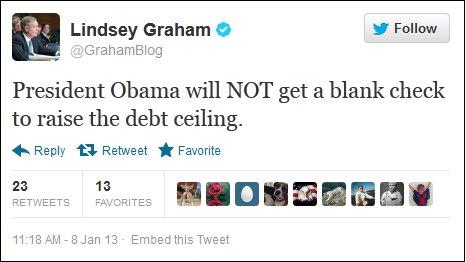
Last week, for example, Senate Minority Leader Mitch McConnell (R-Ky.) suggested debt-ceiling increases empowers the White House to “spend taxpayer dollars without any limit,” though this simply doesn’t make sense. Yesterday, Sen. Lindsey Graham (R-S.C.) added this gem:
Those who followed the 2011 Republican debt-ceiling crisis might recall that the “blank check” talking point was a GOP favorite, repeated ad nauseum, so it shouldn’t come as too big a surprise to see it make a comeback.
But as a substantive matter, it’s still gibberish. We’re not talking about writing checks, blank or otherwise; we’re talking about borrowing money to pay for things Congress has already bought. A debt-ceiling increase wouldn’t give President Obama any funds or resources; a debt-ceiling increase would allow the administration to finance money that Congress has already authorized to be spent.
As we discussed last week, it’s really not that complicated. Congress approves federal spending, the executive branch follows through accordingly. When the legislative branch spends more than it takes in, the executive branch has to borrow the difference.
Who’s asking for a “blank check”? What does that even mean? The next question is whether Lindsey Graham is being cynically dishonest or shockingly ignorant. I don’t know the senator personally, and I obviously can’t read his mind, but the man has been in Congress for nearly two decades. He’s voted for many debt-ceiling increases and he’s twice positioned himself as a leading proponent of holding the debt ceiling hostage to advance a far-right agenda. In other words, Graham has had plenty of time to familiarize himself with the basics of the policy. If, after 18 years on Capitol Hill, the senator still doesn’t know what the debt ceiling is, perhaps Graham is in the wrong line of work and he should stop playing with weapons he doesn’t understand. It’s more likely that the Republican understands quite well that the “blank check” talking point is nonsense, but he’s repeating it anyway in the hopes Americans will be confused by nonsense.
The place for in-depth analysis, commentary and informed perspectives. Recommended


