








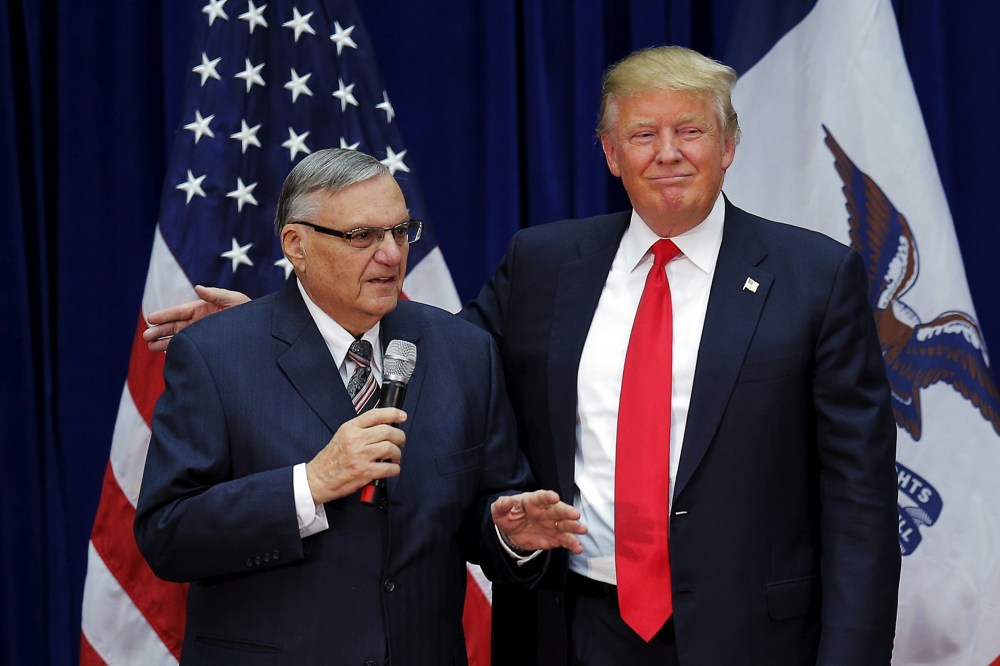
Donald Trump recently boasted that he enjoys “the complete power to pardon.” And at first blush, that sounds about right: the Constitution says a sitting president “shall have Power to grant Reprieves and Pardons for Offenses against the United States.”
It seems pretty straightforward. Many may have legitimate concerns about a president pardoning a disgraced former sheriff who abused his office, ignored a federal court order, and targeted people of color while acting as if he were above the law, but if the president’s pardon power is effectively unlimited, it looks like there’s no available recourse.
But what if those assumptions about presidential prerogative are overly simplistic? What if there’s still plenty of scrutiny to do on Trump’s Arpaio pardon?
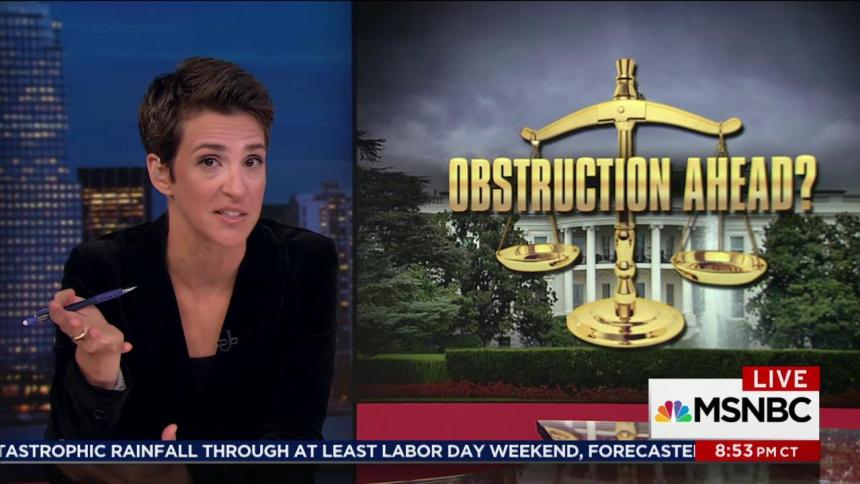
Rachel noted earlier this week, for example, that there are ongoing questions about whether the president obstructed justice when he pressed the Justice Department on whether federal charges against Arpaio could be quashed before the case even went to trial. Trump’s pardon doesn’t make this question go away.
Yesterday, however, the story took another step forward. The Washington Post‘s Jennifer Rubin, a conservative commentator, highlighted a letter from a group called Protect Democracy, which is combating Trump’s violations of legal norms, to the public integrity section of the Justice Department’s criminal division. The letter made the case that the Arpaio pardon is, at best, legally suspect.
While the Constitution’s pardon power is broad, it is not unlimited. Like all provisions of the original Constitution of 1787, it is limited by later-enacted amendments, starting with the Bill of Rights. For example, were a president to announce that he planned to pardon all white defendants convicted of a certain crime but not all black defendants, that would conflict with the Fourteenth Amendment’s Equal Protection Clause. Similarly, issuance of a pardon that violates the Fifth Amendment’s Due Process Clause is also suspect. Under the Due Process Clause, no one in the United States (citizen or otherwise) may “be deprived of life, liberty, or property, without due process of law.” But for due process and judicial review to function, courts must be able to restrain government officials. Due process requires that, when a government official is found by a court to be violating individuals’ constitutional rights, the court can issue effective relief (such as an injunction) ordering the official to cease this unconstitutional conduct. And for an injunction to be effective, there must be a penalty for violation of the injunction — principally, contempt of court. If you read the whole letter, Protect Democracy makes the compelling point that the presidential pardon power is considerable, but it’s not limitless, and the Arpaio pardon deserves more scrutiny. Ron Fein, legal director of Free Speech for People, and one of the authors of the letter, added, “The president can’t use the pardon power to immunize lawless officials from consequences for violating people’s constitutional rights,” And that’s a pretty good summary of what Trump did this week. The president’s decision to pardon may be behind, but the legal questions aren’t over.
Steve Benen is a producer for "The Rachel Maddow Show," the editor of MaddowBlog and an MS NOW political contributor. He's also the bestselling author of "Ministry of Truth: Democracy, Reality, and the Republicans' War on the Recent Past." Recommended


