









In June 2016, after the Democratic presidential primaries, Barack Obama officially threw his support behind Hillary Clinton. Donald Trump, borrowing a page from Fox News, pushed a very specific line: “Never before,” the Republican tweeted, “has a president endorsed someone under investigation” by the Justice Department.
Because, obviously, if someone seeking the nation’s highest office is under investigation from the Justice Department, that’s inherently cause for alarm, right?
In November 2016, less than a week before Election Day, Politico reported on Trump’s closing message:
Trump predicted that Clinton’s election would bring “an unprecedented and protracted constitutional crisis” because of the looming investigation and suggested Americans would not want to endure a second Clinton administration marred by scandal.
Three days later, Trump insisted that Clinton, as president, couldn’t possibly be expected to govern — because the investigation into her email server protocols would make such an endeavor impossible.
Of course, at the time, the federal investigation into Clinton’s emails had wrapped up, and the FBI found no criminal wrongdoing. Trump’s rhetoric served as fuel for his rabid followers, but it had no meaningful basis in reality.
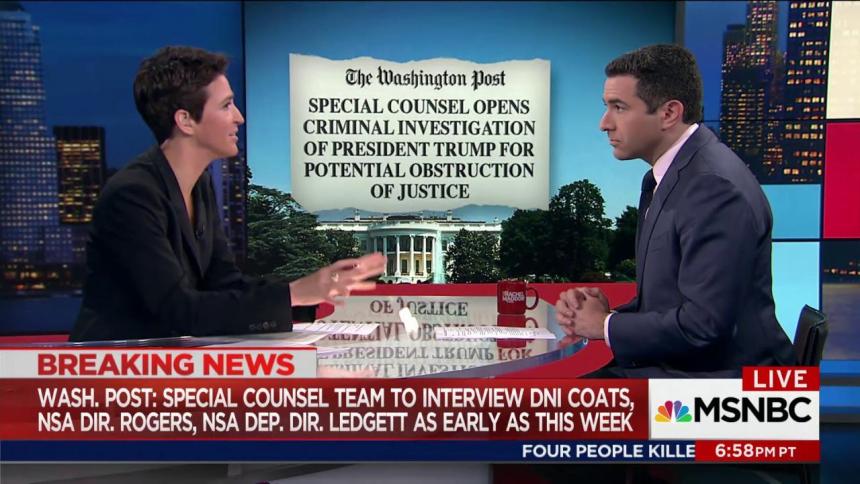
But about eight months later, his rhetoric is suddenly relevant anew — because it’s Trump who is now a sitting president who’s under a criminal investigation, facing allegations he obstructed justice as part of the Russia scandal. It leads to a question the White House should at least try to answer: does Trump still believe the nation is forced to endure a “protracted constitutional crisis” when the American president is the subject of a federal probe?
It’s not just Trump and his team who should face the question. The week before Election Day, Sen. Marco Rubio (R-Fla.) told a group of voters, “Obviously, we all understand the importance of this presidential race. I would just ask everybody this: Can this country afford to have a president under investigation by the FBI? Think of the trauma that would do to this country.” Yes, think of it. The Huffington Post noted in March there were similar comments during last year’s campaign from prominent members of Team Trump, including Sean Spicer, Kellyanne Conway, and Reince Priebus. What do you suppose the odds are that Trump World has changed its mind?
Steve Benen is a producer for "The Rachel Maddow Show," the editor of MaddowBlog and an MS NOW political contributor. He's also the bestselling author of "Ministry of Truth: Democracy, Reality, and the Republicans' War on the Recent Past." Recommended


