








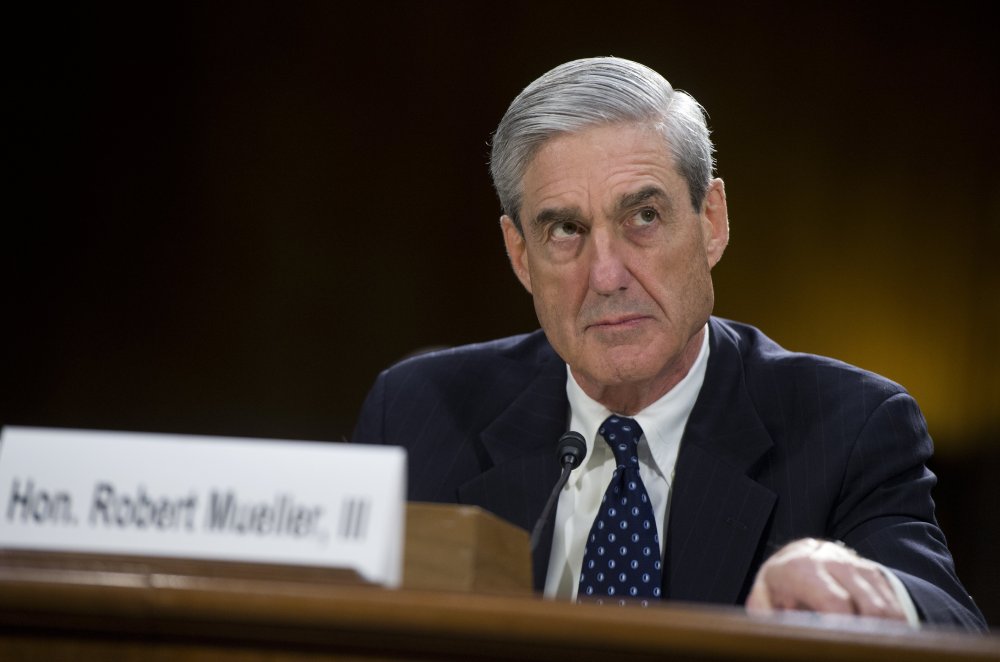
A couple of months ago, Donald Trump sat down with writers from a far-right website and explained, as best he could, why he thinks Special Counsel Robert Mueller’s investigation is “illegal.” The president’s case fell somewhere on the spectrum between unpersuasive and silly.
Among other things, Trump pointed to the significance of a “business dispute” between him and the special counsel in 2011 — Mueller sought a refund on some dues at a Trump-owned golf club and never heard back from the club’s management — and claimed he could produce “100 pictures of [Mueller] and Comey hugging and kissing each other.”
This morning, asked about the fact that his acting attorney general, Matt Whitaker, wasn’t confirmed by the Senate to a senior Justice Department post — an unprecedented personnel move for someone serving as the nation’s top law enforcement official — Trump tried to change the subject by turning back to the special counsel.
“Look, Mueller — a big complaint people have — Mueller was not Senate-confirmed. So he’s doing a report. He wasn’t Senate-confirmed. Whitaker was Senate-confirmed. […]
“Mueller was not Senate-confirmed. Why didn’t they get him Senate-confirmed? He should have been Senate-confirmed… Don’t tell me about Whitaker. Don’t tell me about Whitaker, because Mueller was not Senate-confirmed.”
Oh dear.
First, Robert Mueller was not confirmed by the Senate because special counsels are named by the Justice Department. Under current law, this is not a Senate-confirmed position. It’s like asking why the White House chief of staff was never confirmed by senators; there is no process in place for such a move.
Second, this is not “a big complaint people have.” Aside from sporadic op-eds in conservative media, few have pointed to this as an area of concern.
Third, in the hypothetical world in which the Senate confirms special counsels, Mueller wouldn’t have faced any meaningful opposition. Trump’s suggestion was that “they” — I have no idea who “they” refers to — bypassed the confirmation process to obscure Mueller’s unnamed problems. In reality, the special counsel enjoys broad, bipartisan respect. And finally, there’s Trump’s assertion that Matthew Whitaker “was Senate-confirmed.” Actually, Whitaker was confirmed as a federal prosecutor 14 years ago. This does not mean he was confirmed to a high-ranking post at the Department of Justice, where he could make the transition to acting A.G. As has become obvious over the last couple of days, legal experts believe that in order to serve as attorney general, even temporarily, an official needs to have been confirmed by the Senate. Whitaker wasn’t. The funny thing is, Trump seemed to realize this question was coming, and this was the answer he came up with. Even when the president tries to do a little homework, he sounds like a guy trying to give a book report on a book he didn’t read.
Steve Benen is a producer for "The Rachel Maddow Show," the editor of MaddowBlog and an MS NOW political contributor. He's also the bestselling author of "Ministry of Truth: Democracy, Reality, and the Republicans' War on the Recent Past." Recommended


