








In one of the more important interviews of his presidency, Donald Trump spoke with ABC News’ George Stephanopoulos in June 2019, and fielded some questions about foreign election interference. In the wake of the revelations surrounding the Russia scandal, it stood to reason that the Republican would recognize the importance of rejecting campaign “help” from abroad.
But he didn’t. Instead, Trump said that if a foreign country offered him dirt on an opponent, he’d “take it.” In fact, the president mocked the idea of alerting the FBI to foreign intervention, insisting, “Give me a break. Life doesn’t work that way.”
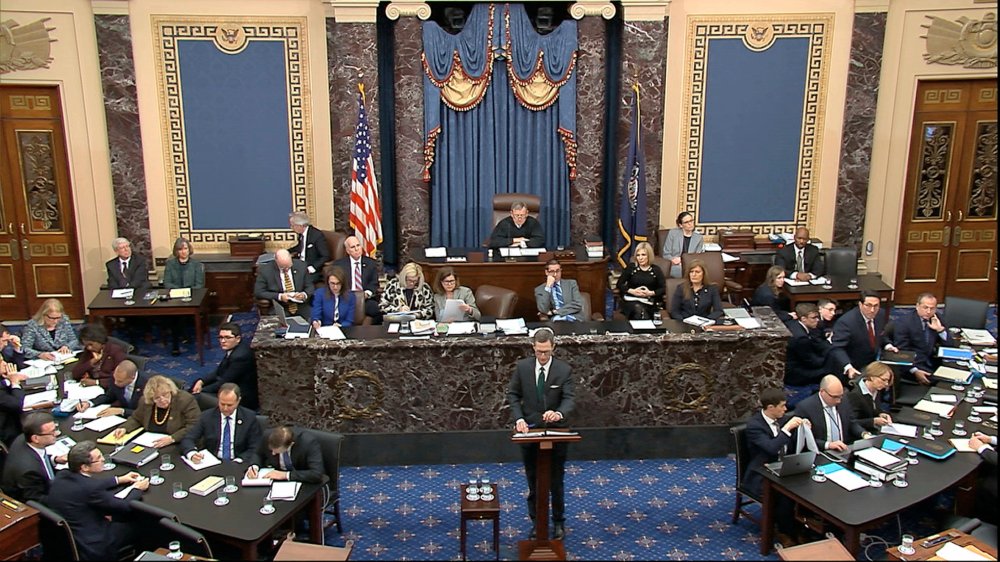
It was against this backdrop that one of the president’s attorneys fielded an important question during yesterday’s Senate impeachment proceedings. The Washington Post reported:
Toward the end of the night, Democrats bridled over comments by [Deputy White House Counsel Patrick Philbin] responding to a question from Sen. Christopher A. Coons (D-Del.) about Trump’s apparent public solicitation of Russia and China for compromising materials on his campaign rivals. Philbin argued that Trump’s remarks did not, in fact, represent a violation of campaign finance laws that make it illegal to accept or solicit a “thing of value” from foreign sources.
“Apparently it’s okay for the president to get information from foreign governments in an election — that’s news to me,” said Rep. Zoe Lofgren (D-Calif.), a House manager, as fuming Democrats accused Philbin of engaging in a wholesale rewrite of federal law to cover for Trump.
Lofgren was hardly alone. Coons’ question specifically noted that the president’s legal defense team filed a legal brief with the Senate as part of the impeachment proceedings, and the document noted that Congress has “forbidden” foreign involvement in American elections. The Delaware Democrat asked whether Trump agrees with this, given that he said largely the opposite in the Stephanopoulos interview.
Yesterday, Philbin sided with his client’s view, saying that a president can accept “credible information” from foreign sources, and it wouldn’t necessarily count as “campaign interference.” The deputy White House counsel added, “I think the idea that any information that happens to come from overseas is necessarily campaign interference is a mistake.”
FBI Director Chris Wray has said that if candidates for public office are offered foreign intelligence to help their campaigns, the proper response is to alert federal law enforcement. Attorney General Bill Barr has drawn similar conclusions. Trump and his legal team, however, are of the opinion that if the foreign intelligence is credible and interesting, it’s fair game.
There’s a reason Democrats were furious with Team Trump’s posture. It’s one thing for a confused president to pop off in an interview about a subject he doesn’t understand; it’s something else for one of his White House lawyers to echo Trump’s bad argument on the floor of the Senate during an impeachment trial.
Sen. Mark Warner (D-Va.), the vice chairman of the Senate Intelligence Committee, described himself as “stunned,” adding that Philbin’s argument “contradicts everything that our committee has said, everything the intelligence community has worked on.”
As The Hill noted, Sen. Martin Heinrich (D-N.M.), another member of the Intelligence Committee, had a similar reaction. “We are encouraged to at all times report even just contact with foreign efforts at interference in our elections or of manipulation of our government activities,” he said. “This idea that you would take information from a foreign government seeking to impact an election and then weaponize that or use that just because it may be credible — I’ve just never heard anything like that. I think it’s absolutely unconscionable,” he added. […] He said the nation has historically done whatever it could to insulate government decision-making and elections from foreign influence. “This basically said throw open the doors,” he said of the White House’s argument. Sen. Chris Murphy (D-Conn.) added via Twitter, “It’s all out in the open now. The president’s counsel just argued that there is nothing wrong with any candidate for office soliciting dirt on their opponents from foreign countries. They’re not even trying to fake it anymore.” Of course, none of this is happening in a vacuum. As was true in the aftermath of the Stephanopoulos interview, we’re confronted with a dynamic in which Trump and his legal team have signaled to possible international benefactors that the sitting American president would welcome their interference in his re-election efforts. The president is well aware of the scandal that unfolded after the 2016 race, but Team Trump has left little doubt that he wouldn’t mind seeing a sequel.
Steve Benen is a producer for "The Rachel Maddow Show," the editor of MaddowBlog and an MS NOW political contributor. He's also the bestselling author of "Ministry of Truth: Democracy, Reality, and the Republicans' War on the Recent Past." Recommended


