








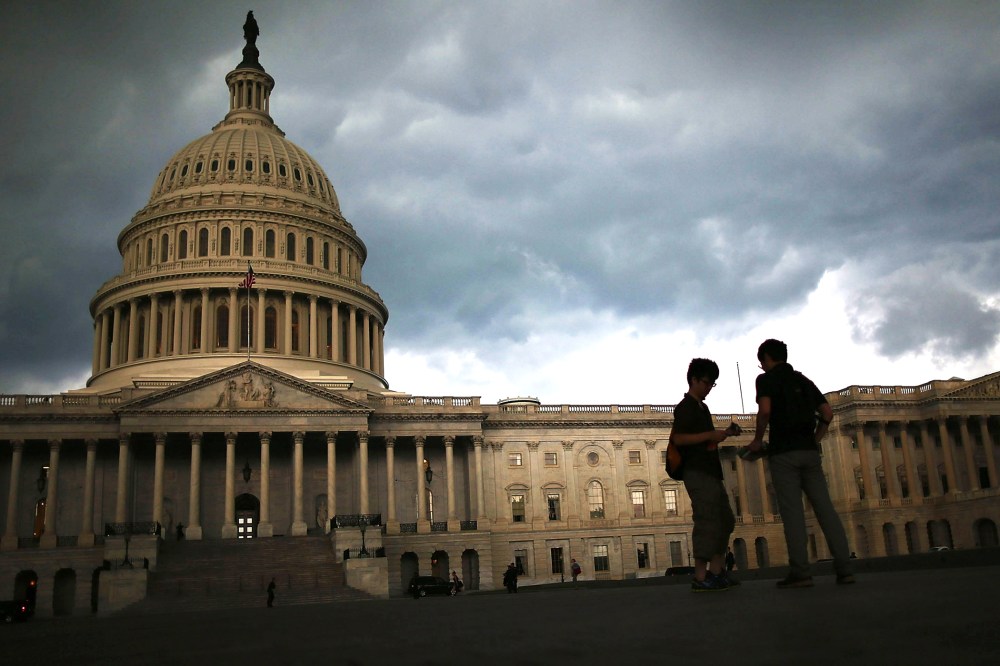
In the spring, after the first of several Republican failures on health care policymaking, House Speaker Paul Ryan (R-Wis.) told reporters, “We’re going through the inevitable growing pains of being an opposition party to becoming a governing party.”
Very recently, some GOP officials decided they’d figured out how to overcome those growing pains. The Washington Post reported the other day, “After nearly a year of frustration, dysfunction and infighting, Republicans believe they are on the cusp of demonstrating that they can govern.” The proof, apparently, is the GOP’s progress on a regressive and unpopular tax plan.
But the confidence is borne of confusion. Ramming through poorly crafted legislation is an exercise in raw political power, but governing requires a very different skill set. A “governing party,” to use Paul Ryan’s phrase, acts deliberately and judiciously, carefully examining an issue and paying attention to the consequences of every proposed solution.
Any fool can write a piece of legislation, but to demonstrate an ability to govern requires forethought about what that legislation would do. With this in mind, Politico reports today that the Republicans’ tax plan is “riddled with bugs, loopholes and other potential problems that could plague lawmakers long after their legislation is signed into law.”
Some of the provisions could be easily gamed, tax lawyers say. Their plans to cut taxes on “pass-through” businesses in particular could open broad avenues for tax avoidance.
Others would have unintended results, like a last-minute decision by the Senate to keep the alternative minimum tax, which was designed to make sure wealthy people and corporations don’t escape taxes altogether. For many businesses, that would nullify the value of a hugely popular break for research and development expenses.
Some provisions are so vaguely written they leave experts scratching their heads…. In many cases, Republicans are giving taxpayers little time to adjust to sometimes major changes in policy. An entirely new international tax regime, one experts are still trying to parse, would go into effect Jan. 1, only days after lawmakers hope to push the plan through Congress.
Greg Jenner, a former top tax official in George W. Bush’s Treasury Department, told Politico, “The more you read, the more you go, ‘Holy crap, what’s this?’”
To see this as evidence of Republicans being able to govern is to misunderstand what’s happened. GOP policymakers wrote a bad bill in a bad way, ignoring problems that do exist while creating problems that didn’t previously exist. They ignored warnings, failed to think their actions through, rushed at breakneck speed, scribbled ideas into the margins of their legislative text, and approved sweeping legislation without reading it, scoring it, or fully understanding what it would do.
I can appreciate the fact that most Americans probably don’t much care about the nuances of the legislative process. But last week offered a striking example of an irresponsible process leading directly to an irresponsible result. The editorial board of the Washington Post said congressional Republicans “just failed Governing 101.” The editors of Bloomberg View added, “In their rush to pass something, anything, that they can call ‘tax reform,’ congressional Republicans have achieved the impossible: They have made an awful plan even worse…. The end result is sheer absurdity: a reform that actually complicates the tax code further, and that must contradict itself and partially self-destruct to attain some semblance of the fiscal discipline Republicans claim to value. It’s hard to imagine a more egregious waste of time and energy, or a worse outcome for taxpayers and the broader economy.” Postscript: I suspect some of my friends on the right will note that legislative drafting errors are common in every major bill, including the Affordable Care Act, so the Senate Republicans’ missteps in the tax plan are not terribly surprising. There’s some truth to that. The point, however, is that a governing party at least tries to identify some of these pitfalls before a vote, through lengthy examinations in congressional hearings and outside scrutiny from subject-matter experts. GOP senators made a conscious decision in this case to do the opposite.
Steve Benen is a producer for "The Rachel Maddow Show," the editor of MaddowBlog and an MS NOW political contributor. He's also the bestselling author of "Ministry of Truth: Democracy, Reality, and the Republicans' War on the Recent Past." Recommended


