








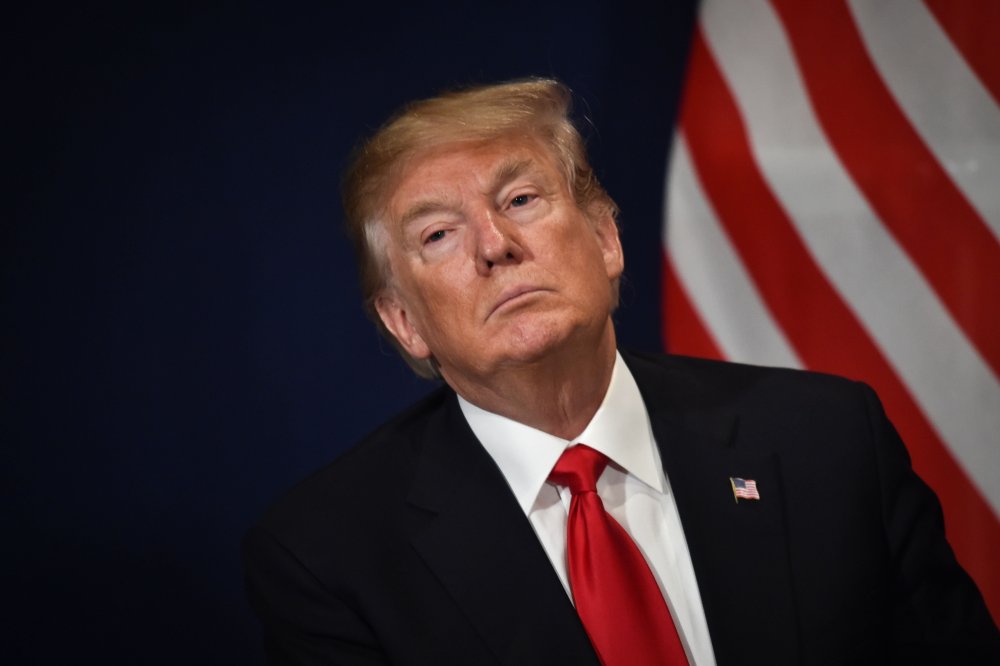
Much of Donald Trump’s economic team told him tariffs on steel and aluminum would undermine the economy. The president’s national security team told him the tariffs would run counter to our national security interests. His diplomatic team concluded the policy would be bad for U.S. foreign policy.
And yet, Trump nevertheless concluded that these tariffs are a great idea. The process behind his announcement was a mess, even by this White House’s standards: Trump made this decision without any internal review by government lawyers or his own staff. NBC News reported, “No one at the State Department, the Treasury Department or the Defense Department had been told that a new policy was about to be announced or given an opportunity to weigh in in advance.”
Even Trump’s allies in Congress weren’t told anything about the policy before it was announced.
What’s more, as Rachel noted on the show last night, Trump himself seemed to blurt out the specific size of the tariffs to reporters, almost as an afterthought, reinforcing the impression that the president and his team have just been winging it on an important economic policy.
The Washington Post‘s Greg Sargent added yesterday that the stated legal justification for the tariffs “is deeply dubious, and the substantive case for it that Trump himself has offered is based on absurdities.”
All of which leads to an awkward fact about contemporary American governance: there’s no reason to assume the president has any idea what his policy is, what it means, how and why it’ll be implemented, or what it will do once the policy is in place.
The president is working from the assumption that a trade deficit — any trade deficit — is necessarily a problem that requires an immediate solution. That’s plainly false. He insists trade deficits are proof of the United States “losing” money, which is both wrong and nonsensical. He believes trade wars are “easy to win,” which is dangerously misguided.
Most of the things he says about the issue — from the size of the U.S. trade deficit with China to our surplus with Canada — are factually incorrect.
In fact, it’d be a mistake to assume Trump’s “fix” will address Trump’s perceived “problem.” Joseph Gagnon, a senior fellow at the Peterson Institute for International Economics, and a co-author of a 2017 book of policy recommendations on how to reduce trade imbalances, told the New York Times the other day, “If you look across countries, there’s no evidence that high tariffs reduce your trade deficit.” And even if we did dramatically reduce trade deficits, we may not like the consequences.
Adopting an exceedingly charitable tone, Zeeshan Aleem said the other day, “The president doesn’t seem to have a full grasp of what’s going on here.”
It’s one thing to consider a White House plan on the merits and conclude that it’s the wrong way to go. On tariffs, we’re having a different kind of conversation: Trump, after making this issue one of the centerpieces of his campaign, is moving forward with a risky plan he doesn’t understand, about an issue on which he doesn’t recognize the scope of his own confusion. “There’s no coherent goal at all in Trump’s approach on trade,” Matt Yglesias explained yesterday, adding that the White House’s “chosen policy instrument bears no relationship to any larger objectives.” Unlike most areas of public policy, Trump is able to move forward on issues like these entirely on his own. The decision-making authority rests entirely in the hands of one individual — the president — who in this case, is indifferent to the concerns raised by many of his own aides and allies. What we’re left with is an amateur president making unilateral policymaking decisions about an issue he thinks he understands, but doesn’t. Worse, Trump seems wholly uninterested in getting up to speed on trade policy — why interfere with “executive time”? — either because he doesn’t understand the information available to him or because he’s too lazy to care. This isn’t what governing in a modern superpower is supposed to look like.
Steve Benen is a producer for "The Rachel Maddow Show," the editor of MaddowBlog and an MS NOW political contributor. He's also the bestselling author of "Ministry of Truth: Democracy, Reality, and the Republicans' War on the Recent Past." Recommended


