








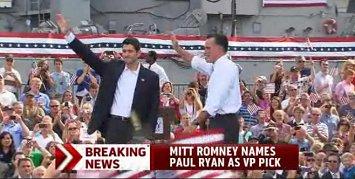
For months, Mitt Romney repeated a common complaint about President Obama’s professional background: he’s spent his life in the political world, not the real world. While Romney’s a businessman (notwithstanding 18 years seeking public offices), Obama’s never run a business and never run a state. It makes Obama, the argument goes, a poor choice for national office.
Oddly enough, Romney hasn’t repeated that line of criticism in a while. I guess we know why.
[Paul Ryan] worked in politics his entire life, beginning as an aide to Sen. Bob Kasten, then working for Sen. Sam Brownback and as a speechwriter to Rep. Jack Kemp. He’s known as a relatively ideological politician who has put forward a detailed policy plan to remake the federal government. It’s a rather different message about what’s important. And how does Romney say the problem with Barack Obama is that he’s “never spent a day in the private sector” and then put Ryan a heartbeat away from the presidency?
Indeed, in May, Romney went so far as to say working in the private sector for “at least three years” should be a prerequisite to national office. Now, Romney wants to put Ryan one heartbeat from the presidency, despite the fact that Ryan’s adult life bears all of the characteristics of a background Romney disdains.
I don’t intend this as a “gotcha” moment, exactly, but rather, my larger point is I’m not exactly sure why Romney thinks Ryan should be the vice president, or would even be good at the job.
Everything we know about Romney — he’s a cautious, management-focused executive, who values experience and private-sector success — suggests Ryan’s the last guy he’d want as a governing partner in the White House. Putting aside the radicalism of the Ryan budget plan, at least for a moment, Ryan hasn’t run so much as a lemonade stand.
He’s a 42-year old, seven-term congressman who’s never even held statewide office and has no natural constituency. Ryan voted for every element of the Bush-Cheney agenda — including votes for the bank bailout, the massive Medicare Part D expansion that he didn’t see the need to pay for, and multiple increases to the debt limit.
Ryan’s also a very high-profile figure from the least popular Congress since the dawn of modern polling. He is, in other words, a professional politician who has played a key role in making Capitol Hill even more loathed than it’s ever been. Ryan, like Romney, also has literally zero background in foreign policy, national security, or international affairs. What is it about this resume that Romney looks at and says, “Yep, that’s my kind of guy”? The answer is, nothing. Romney was almost certainly pushed into this announcement by a conservative establishment that doesn’t trust him or feel excited to rally behind him, and Romney didn’t have the standing or intestinal fortitude to push back. It’s a Quayle/Palin kind of decision that reinforces the perception that Romney is not only unsatisfied with the state of the race, but is starting to feel genuine fear about his candidacy.
The place for in-depth analysis, commentary and informed perspectives. Recommended


