








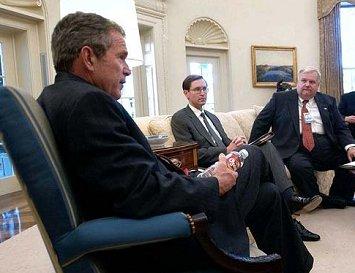
Economist Glenn Hubbard, dean of Columbia Business School, saw his reputation suffer when he became an advisor to the Bush/Cheney White House and Mitt Romney’s presidential campaign. This will not help the rehabilitation of his credibility.
His new book Balance, due for release on May 21, approvingly cites the recently discredited research of Harvard economists Carmen Reinhart and Kenneth Rogoff in its opening argument, on page 5.
Hubbard and co-author Tim Kane of the Hudson Institute, a conservative think tank, don’t just repeat Reinhart and Rogoff’s assertion that economic growth suffers when government debt crosses 90 percent of gross domestic product. They take that claim a step further, fitting it into their broad thesis that America is DOOMED if it can’t get government spending under control. A 90 percent debt ratio is associated not only with slightly slower growth, they suggest, but also with just maybe the very collapse of America.
Specifically, Hubbard’s book argues that the Reinhart/Rogoff study “suggests that countries with a total debt to gross domestic product (GDP) ratio that exceeds 90 percent face a tipping point of decline.”
Now, the Reinhart/Rogoff report has already taken a severe beating, and exposed as a study with serious and damning flaws, but note that Hubbard’s book isn’t just citing a bogus conclusion; it’s also exaggerating an exaggeration — Reinhart and Rogoff argue that a 90% debt-to-GDP ratio prevent growth, not that it’s the tipping point towards national decline.
Adding insult to injury, Hubbard and his co-author argue that there’s “a consensus” among economists in support of the Reinhart/Rogoff research, which (a) wasn’t true before; and (b) certainly isn’t true now.
And why is this important? A few reasons, actually.
First, when it comes to being taken seriously as a credible voice on economic policy, Hubbard is clearly flirting with the point of no return. You’ll recall, for example, that during his tenure as chairman of the White House Council of Economic Advisors under George W. Bush, — Hubbard not only defended ridiculous policies, the Bush gang had him promote policies he’d argued against before joining the president’s team.
In other words, as we talked about a year ago, Hubbard became known as an economist who would say things he didn’t really believe, simply because political circumstances forced him into it.
During the 2012 campaign, he wrote an anti-Obama op-ed based on claims that were “completely made up.” Then-Treasury Secretary Tim Geithner said Hubbard’s argument was a “remarkably hackish observation for an economist.” Austan Goolsbee, himself a former chairman of the White House Council of Economic Advisors, added, “Glenn seems to have jumped the shark.” Exaggerating a discredited claim clearly isn’t going to help. Second, it’d be far preferable if Hubbard didn’t complain too much about deficits at all. It was, after all, his former boss who put two massive tax breaks on the national charge card, and relied on deficit financing to pay for two wars, Medicare expansion, and a Wall Street bailout. For Bush’s former economist to complain about deficits now seems problematic given the former administration’s track record. And third, Hubbard’s book is a reminder of just how important it is to see the Reinhart/Rogoff thesis discredited. It wasn’t an obscure argument; it was the driving intellectual rationale for austerity, and now it’s bunk.
The place for in-depth analysis, commentary and informed perspectives. Recommended


