








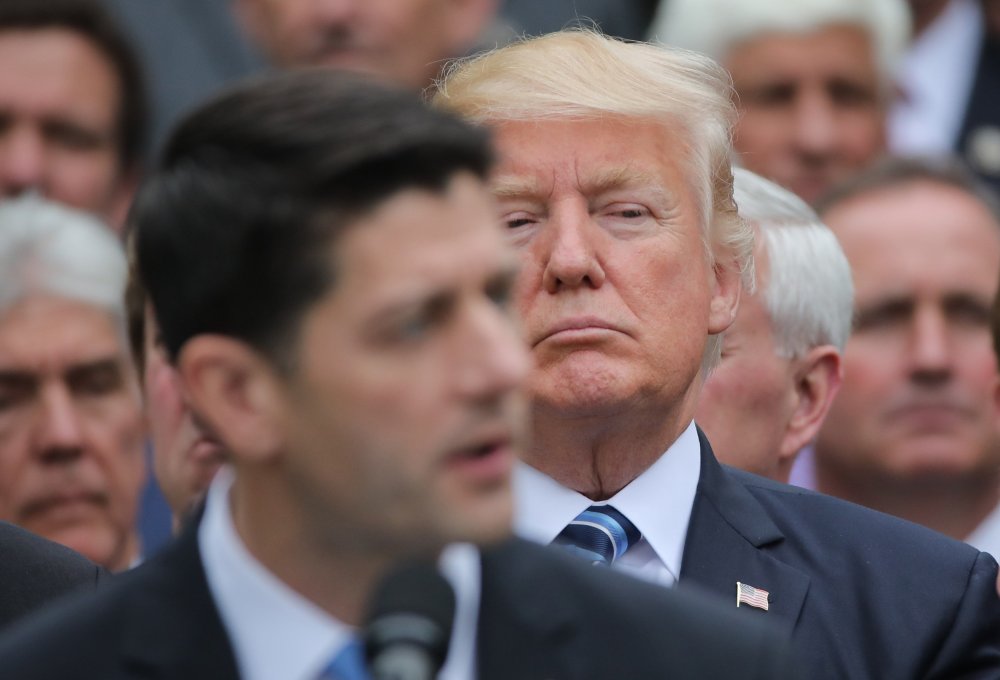
Toward the end of a Capitol Hill press conference yesterday, a reporter asked House Speaker Paul Ryan (R-Wis.) a rather simple question. From the transcript:
Q: Do you think that the administration has been tough enough on Russia?
RYAN: Oh, yeah…. We have moved miles in the right direction on our Russia policy…. We have so improved our policy with respect to Russia, far more hawkish, far more realistic.
Perhaps the House Speaker hasn’t been paying close enough attention to Donald Trump’s latest moves on Russia.

Indeed, Ryan’s timing could’ve been better. Shortly before he praised the administration’s toughness on Russia, the president changed his mind — and embarrassed U.S. Ambassador Nikki Haley — about imposing new sanctions on Russia over its support for the Assad regime in Syria and assuring officials in Moscow they had nothing to worry about. That’s not what a hawkish, tough-on-Russia president would do.
This news came just days after we learned Trump threw a profanity-laced tantrum when he thought his administration’s expulsion of Russian diplomats might make it look like we were being harsher toward Putin’s government than Europe. That’s not what a hawkish, tough-on-Russia president would do, either.
There was also a report today in the New York Times about Trump yelling angrily at his television when he recently saw Nikki Haley “criticizing Russia over its intervention in Ukraine.” That’s not what a hawkish, tough-on-Russia president would do, either.
All of this comes less than a month after Trump congratulated Russian President Vladimir Putin in the wake of his sham election, despite being handed briefing materials that said, in all-capital letters, “DO NOT CONGRATULATE.” That’s also not what a hawkish, tough-on-Russia president would do.
There’s a deeply strange conversation underway, in which Trump, Paul Ryan, Sarah Huckabee Sanders, and their allies insist that this White House has been impressive in its “toughness” toward Moscow. “Nobody has been tougher on Russia than I have,” the president recently said about himself.
And as part of that same conversation, we’re confronted with voluminous evidence that points in the exact opposite direction.
In fact, more often than not, the Republican president tends to act as if he’s terrified of Russia, to the point that many routinely ask what Putin’s government may have over Trump to make him appear so intimidated. Almost immediately after H.R. McMaster delivered blistering remarks against Russia, for example, Trump fired him. After Congress approved sanctions on Russia, Trump dragged his feet on implementing the policy. And as regular readers know, that’s just scratching the surface. The data points are almost overwhelming: when the Russian government moved against U.S. diplomats, Trump thanked Putin. When Congress approved sanctions against Russia, Trump blamed American lawmakers, not Putin, for undermining relations between the two countries. Trump has repeatedly and publicly praised Putin’s authoritarian leadership style. Trump’s political operation weakened the Republican Party’s platform in ways that made Moscow happy. As president, Trump welcomed Russian officials in the Oval Office, at Putin’s request, and during their chat, the American president shared highly sensitive, classified information with his Russian guests in exchange for nothing. All of which makes me wonder if maybe Republicans have some new definition of “tough” they haven’t yet shared with the public.
Steve Benen is a producer for "The Rachel Maddow Show," the editor of MaddowBlog and an MS NOW political contributor. He's also the bestselling author of "Ministry of Truth: Democracy, Reality, and the Republicans' War on the Recent Past." Recommended


