








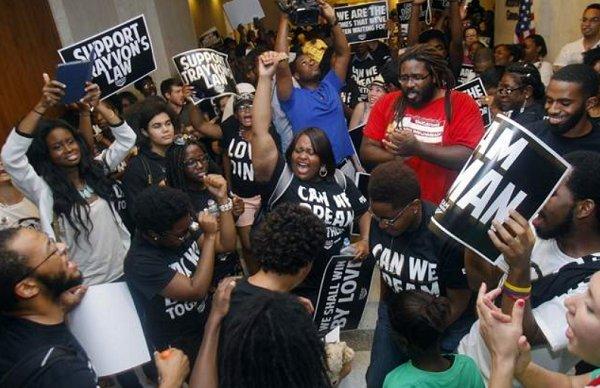
In recent weeks, progressive activists in Florida have pushed a very specific message: in the wake of the George Zimmerman trial, state policymakers need to revisit the controversial “Stand Your Ground” law. Their task hasn’t been easy — Florida Gov. Rick Scott (R) has refused to consider changes to the status quo.
Late last week, however, there was an unexpected breakthrough.
Florida House Speaker Will Weatherford announced Friday that he will order hearings this fall on the state’s “stand your ground” law, a victory for the young protesters known as the Dream Defenders who have spent the past two weeks protesting at the Capitol.
“It’s a critical first step,” said Phillip Agnew, executive director of the Dream Defenders. “We’ve been here for three weeks. We know democracy takes time. Progress takes time.”
It wasn’t the special session Dream Defenders hoped for, but it was nevertheless a step forward.
The reversal came just 48 hours after then-Senate Democratic leader Les Miller said he regretted having voted for the measure in 2005. “People are dying because of the ‘stand your ground’ law,” Miller said. “It was a bad bill.”
While activists were pleased by Friday’s announcement, and the hearing will offer stakeholders an opportunity to give the law some much-needed examination, it’s important to keep expectations in check. Both the state House and state Senate are dominated by far-right Florida Republicans, and the hearing will be chaired by state Rep. Matt Gaetz (R), who has championed the law he’ll be scrutinizing.
“I don’t support changing one damn comma of the stand your ground law,” Gaetz said Friday.
It would appear the committee chairman isn’t approaching the hearing with an open mind.
Still, a meaningful policy debate in an open, legislative hearing is nevertheless a welcome development. Even if GOP lawmakers are already digging in their heels, eager to protect “Stand Your Ground” from even modest reforms, keeping the conversation going keeps the hopes for improved public safety alive.
Dream Defenders’ Agnew added, “The hearings will be an opportunity for people to discuss the laws. We will hope for the best and prepare for the worst.”
What’s more, developments aren’t just limited to Florida. On Capitol Hill, the Beltway assumption has been that any kind of gun reform is dead and buried, but one notable Democratic leader hasn’t thrown in the towel just yet (thanks to my colleague Tricia McKinney for the heads-up). After the Senate was unable to muster enough votes in April and pass a comprehensive gun control package, reformers immediately set to work pushing for another bill, particularly one that deals with universal background checks. It was unclear when — or even if == this would happen, but [Thursday] morning Senate majority leader Harry Reid provided a huge clue. During a private meeting late Thursday morning with Moms Demand Action for Gun Sense In America, which The Nation was allowed to observe, Reid predicted a vote on background checks would happen again in the Senate before the midterm elections, though no sooner than 2014. Moms Demand Action founder Shannon Watts asked Reid directly if there would be a background check vote before voters head to the polls in November 2014. “I think sometime next year we’ll revisit that issue,” Reid said. “I’m almost certain of it.” He noted it couldn’t be this fall, due to the complicated spending issues Congress has to tackle involving bills to fund the government and lift the debt ceiling. After a Republican filibuster derailed gun-safety reforms in the spring, the political world simply moved on, assuming there was nothing more to see on this issue. I can’t predict what the outcome of these fights will be in the coming months, but I can say the fights will occur.
The place for in-depth analysis, commentary and informed perspectives. Recommended


