










By all accounts, Senate Minority Leader Chuck Schumer (D-N.Y.) and Treasury Secretary Steven Mnuchin made considerable progress last night in their stimulus negotiations, and there’s growing optimism that an economic rescue package will be completed today. That won’t necessarily end the process — officials in both chambers and both parties will need to carefully scrutinize the blueprint — but the plan is in a better place than it was 24 hours ago.
But while we wait to see if a deal can come together, it’s worth pausing to appreciate Donald Trump’s role in the process.
One of the main sticking points in the stimulus talks has been a Republican proposal for a $500 billion “corporate rescue fund.” As we discussed yesterday, the existence of that pile of money is not necessarily a problem, since it stands to reason that the federal stimulus plan would assist the private sector. Rather, the problem is with its structure: under the GOP approach, there would be few worker protections, and even fewer constraints on how the pool of money would be distributed. As a practical matter, the Trump administration would have the authority to use the half-trillion-dollar pool of money however it saw fit, with inadequate transparency.
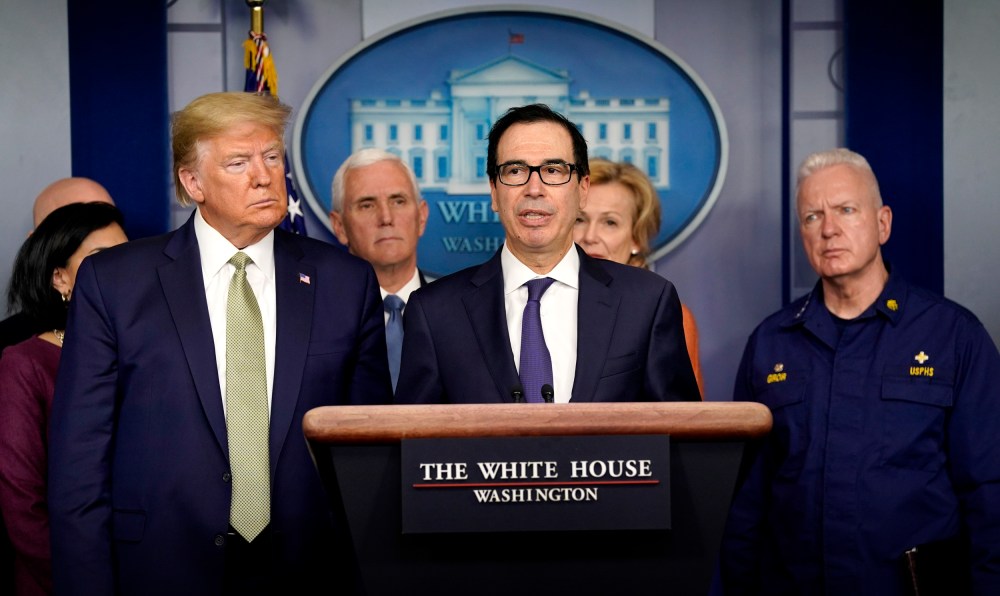
At a White House press briefing yesterday, a reporter asked the president about possible layers of accountability. Trump largely dodged the question, so the reporter followed up: “[T]he concern about the fund is about the lack of oversight for Treasury having this unilateral authority to dole out all of this money.” Trump seemed eager to offer a solution:
“Well, look, I’ll be the oversight. I’ll be the oversight.”
Ah yes, there’s a sensible solution. Donald Trump, who’s been impeached and criminally investigated, who’s paid millions in fraud settlements, who’s no longer allowed to run a charity in New York because his so-called foundation was considered flagrantly corrupt, is now volunteering to be a check on himself — just as soon as Congress gives his administration a half-trillion dollars to spread around at its own discretion.
The answer came a day after the president opened the door to directing taxpayer money to his own private-sector ventures.
What could possibly go wrong? Also yesterday, reflecting on the Schumer/Mnuchin negotiations, Trump told reporters, in reference to members of Congress, “They have to get together and just stop with the partisan politics, and I think that is happening. I got call a little while ago; I guess they are getting closer, should go quickly and it must go quickly it’s not really a choice they don’t have a choice. They have to make a deal.” I seem to recall Trump describing himself as a world-class dealmaker. Indeed, not long before launching his presidential campaign, the Republican identified this as his greatest strength. “Deals are my art form,” the Republican boasted. “Other people paint beautifully or write poetry. I like making deals, preferably big deals. That’s how I get my kicks.” It’s partly why he paid a ghost-writer to write a book called, The Art of the Deal. So why isn’t the president at the negotiating table, working something out?
Steve Benen is a producer for "The Rachel Maddow Show," the editor of MaddowBlog and an MS NOW political contributor. He's also the bestselling author of "Ministry of Truth: Democracy, Reality, and the Republicans' War on the Recent Past."
Latest Post
Recommended


