








According to the Senate Republican leadership’s plan, GOP lawmakers should be gearing up to pass a major overhaul of the nation’s health care system early next week. That plan, however, is now in shreds.
Instead of moving closer to their goal, Republicans appeared to be going backwards yesterday. Sen. John Hoeven (R) of North Dakota, for example, became the latest GOP senator to announce he can’t support the current version of his party’s plan. A far-right effort in Ohio to freeze the state’s Medicaid expansion program failed, increasing pressure on Sen. Rob Portman (R) not to vote for the broader GOP gambit. Sen. Mike Lee (R-Utah), meanwhile, made his demands clear, and in the process, narrowed the window of opportunity for Republican leaders to craft a bill that would satisfy the party’s competing factions.
It was around this time that Sen. Jerry Moran (R-Kan.), another red-state opponent of the current Republican plan, told a town-hall audience in his home state that it’s “almost impossible” to overhaul the nation’s health care system with GOP votes exclusively — which to date has been the only approach his party has been willing to try.
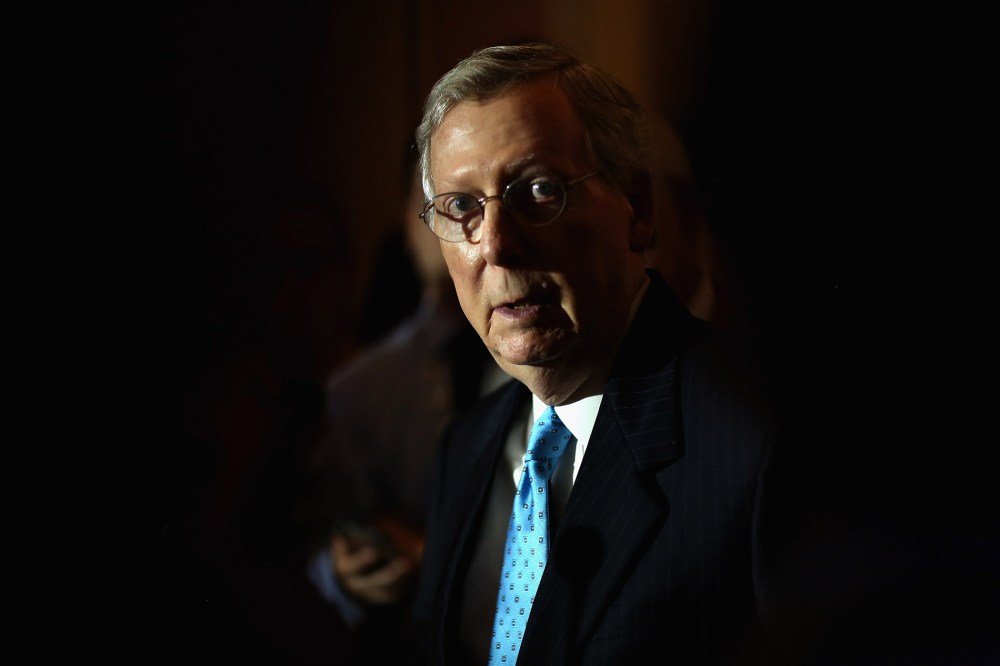
And then there was Senate Majority Leader Mitch McConnell (R), who spoke publicly about the process for the first time in a while at an event in his native Kentucky.
In his first public comments in nearly a week, Senate Majority Leader Mitch McConnell Thursday indicated that passing the GOP’s health care bill remains a daunting prospect for a Republican conference so far unable to agree on key details…. But he also said taking no action on health care is not an option for Congress.
“If Republicans are not able to agree among themselves, the crisis will still be there and we’ll have to figure out the way forward at that point,” McConnell told the crowd Thursday.
And that was an unexpectedly interesting thing for the Senate Republican leader to say.
McConnell is starting to prepare for the fact that GOP senators may simply fall short of passing their own regressive legislation. Failure, in other words, is an option. But for the Senate Majority Leader, walking away from health care policymaking altogether isn’t an option, which means McConnell is thinking about the one avenue he’s fought so hard to avoid: reaching out to Democrats to strike a bipartisan compromise.
That’s tactically significant — it suggests an entirely new phase of the debate may soon begin — but it’s also substantively important. As The New Republic‘s Brian Beutler explained:
…McConnell is giving the lie to the White House’s bogus line that Obamacare is “dead” and the country now faces an immediate choice between Trumpcare and a national single-payer system. House Speaker Paul Ryan likewise routinely describes Obamacare as collapsing, as if policymaking wasn’t a tool at his disposal to affect the functioning of government programs. McConnell is reluctantly admitting is that Obamacare is fixable, and that the law’s ongoing challenges reflect policy choices that Republicans have made in an attempt to hobble it. It’s possible, of course, that McConnell doesn’t really intend to pursue bipartisan solutions, and he’s only using this as a threat to get Republicans in line, but if that is his strategy, it’s unlikely to work. Sens. Lindsey Graham (R-S.C.) and Shelley Moore Capito (R-W.Va.) both indicated last week that a bipartisan approach would make sense, and several other senators made similar comments. It’s not an effective threat if many of McConnell’s members would welcome the consequence. For Republican officials who simply want to pass something related to health care, a bipartisan bill would probably get around 70 votes — roughly double the number of senators who are on board with McConnell’s existing legislation. Postscript: A floor vote on health care was supposed to happen next week. Senate sources confirmed yesterday that GOP leaders are now pushing that off until the week after next.
Steve Benen is a producer for "The Rachel Maddow Show," the editor of MaddowBlog and an MS NOW political contributor. He's also the bestselling author of "Ministry of Truth: Democracy, Reality, and the Republicans' War on the Recent Past." Recommended


