








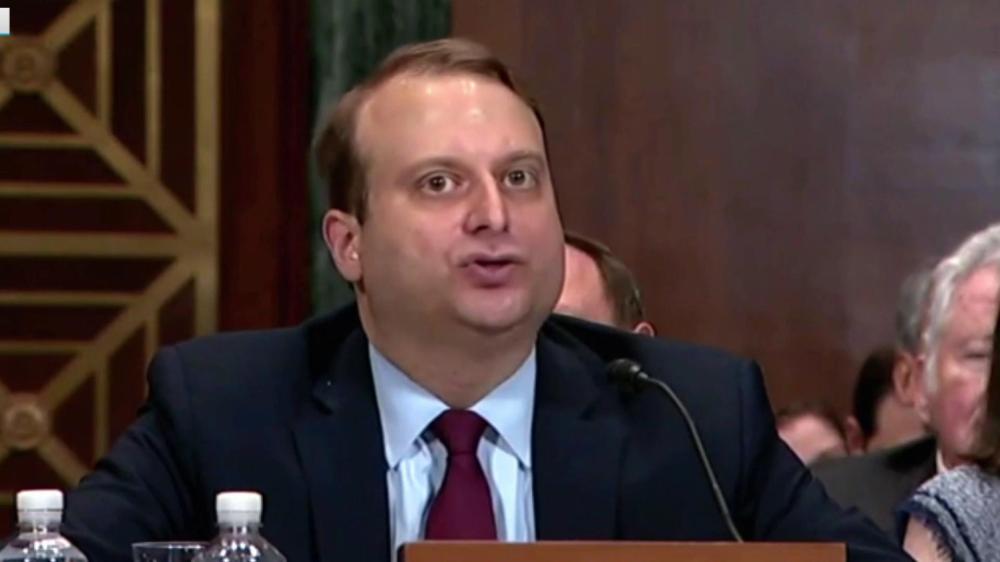
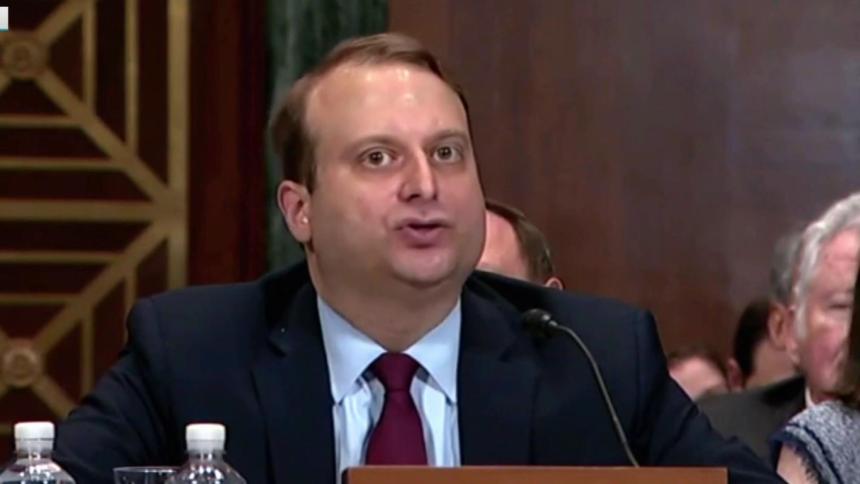
Steven Menashi, one of Donald Trump’s far-right lawyers, has become one of the year’s most controversial judicial nominees for good reason. The New York conservative, nominated for the 2nd Circuit Court of Appeals, has a tough-to-defend record of radicalism that includes an argument about democratic countries working better when everyone is of the same ethnicity. Demand Justice’s Brian Fallon described Menashi as “a perfect storm of awful.”
His confirmation hearing did not go well. Senate Judiciary Chairman Lindsey Graham (R-S.C.) chided Menashi for not being more forthcoming, as did Sen. John Kennedy (R-La.).
This morning, however, Graham, Kennedy, and every other Republican on the Senate Judiciary Committee voted to advance Menashi’s nomination to the floor, where he’ll almost certainly be confirmed.
That’s not too surprising — GOP senators nearly always serve as a rubber stamp for Trump’s far-right picks for the federal judiciary — but the vote came on the heels of this New York Times report, published yesterday, which common sense suggests should’ve at least given the Judiciary Committee pause.
A judicial nominee slated for a key Senate committee vote on Thursday helped devise an illegal Education Department effort to use private Social Security data to deny debt relief to thousands of students cheated by their for-profit colleges, according to a memo obtained by The New York Times.
The plan, outlined by Steven J. Menashi when he was acting general counsel under Education Secretary Betsy DeVos, was ruled by a federal judge to violate federal privacy laws. She ordered the department to stop the practice.
If you missed Rachel’s coverage of this last night, I’d recommend taking the time to watch the segment, because this story’s a doozy.
It starts with a chain of for-profit colleges that ran a scam operation: administrators targeted low-income and minority applicants, made a bunch of outlandish claims about what the schools could do for their career prospects, and encouraged them to get student loans from the federal government. This, naturally, generated quite a bit of money for the for-profit colleges.
It did not, however, benefit the students, who ended up with significant debts. Some of those students received worthless degrees, while others didn’t even get that because the schools closed their doors without notice before the students could graduate.
The Obama administration investigated and agreed that these students who’d been taken advantage of deserved a break. In fact, the Obama administration determined that it’d be fair to simply forgive the loan debts of the for-profit colleges’ apparent victims.
Problem solved? It was, right up until Donald Trump took office, Senate Republicans confirmed Betsy DeVos as the secretary of Education, and the Trump administration decided those victims still owed the federal government lots of money.
In fact, the Department of Education came up with a formula that set out to determine the value of the education from the scam operation, all in the hopes of wringing more money out of the students. One woman, who never got a diploma and who found that the scam for-profit college failed to give her the proper training in her field, was told by the Trump administration she had to pay back 80% of her loan total. The policy was set out in a memo written by the department’s top lawyer. His name was Steven Menashi. A federal judge determined that the policy was illegal. When DeVos’ department continued to collect money from thousands of the victims anyway, the judge fined the Education secretary $100,000. Even if Senate Republicans were unconcerned about Menashi’s ugly record on matters related to race, women, and the LGBTQ community, it seemed possible that they’d take an interest in the nominee’s role in devising an illegal scheme at the Department of Education that punished victims of scam for-profit colleges. And yet, GOP senators on the Judiciary Committee nevertheless voted to reward him with a lifetime position on one of the nation’s highest courts. It’s worth noting that Sen. Susan Collins (R-Maine) has said she intends to oppose Menashi’s nomination, but in a 53-47 chamber, Menashi’s opponents will need at least four Republicans to break ranks, and that’s a threshold that almost certainly won’t be met.
Steve Benen is a producer for "The Rachel Maddow Show," the editor of MaddowBlog and an MS NOW political contributor. He's also the bestselling author of "Ministry of Truth: Democracy, Reality, and the Republicans' War on the Recent Past." Recommended


