








Before today, there was already a long list of criminal convictions tied to Special Counsel Robert Mueller’s investigation. This afternoon, the list got a little longer.
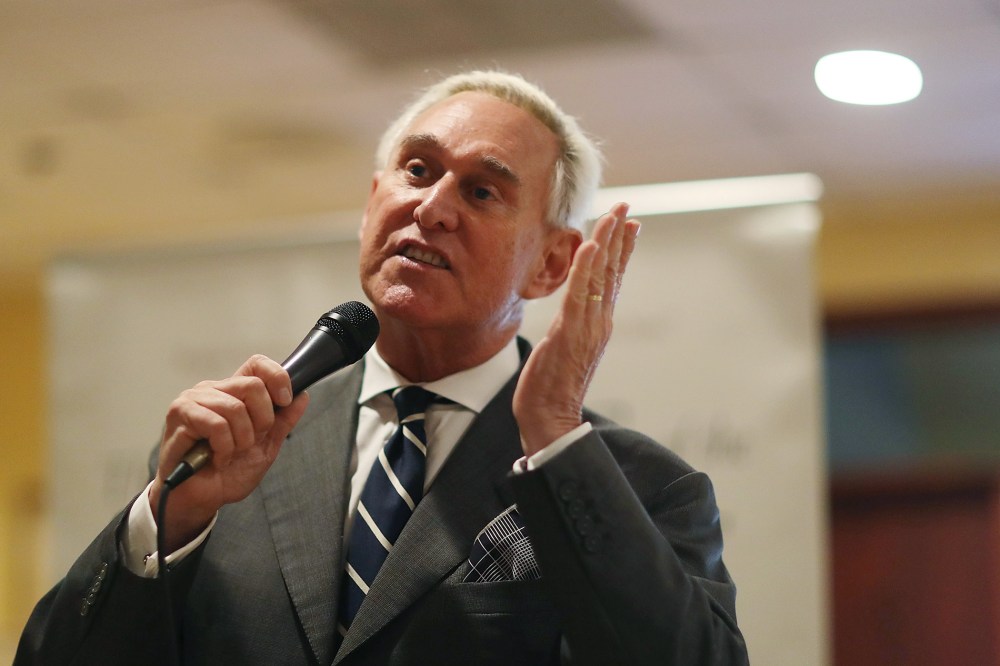
Republican operative Roger Stone was found guilty Friday of all seven counts against him, including witness tampering and making false statements.
Prosecutors portrayed Stone, 67, as a serial liar who tried to bully witnesses into not cooperating with authorities. They charged Stone, a confidant of President Donald Trump, with making false statements, obstruction and witness tampering in a case that was an offshoot of special counsel Robert Mueller’s Russia investigation.
NBC News’ report added that Stone is scheduled to be sentenced in February, and he faces up to 20 years in prison.
Though Donald Trump was obviously not on trial in this case, the president was hardly on the periphery of the proceedings. Roger Stone is a longtime Trump ally who briefly worked for the future president’s campaign operation in 2015. Indeed, much of the case centered on Trump and Stone’s interactions between WikiLeaks and the Trump campaign.
Both Steve Bannon and Rick Gates — two top officials from Trump’s political operation — testified in the trial, and prosecutor Aaron Zelinsky explicitly made the case that Stone’s crimes were motivated by his belief that “the truth looked bad for Donald Trump.”
And speaking of the Republican president, Trump responded to Stone’s conviction in a decidedly Trumpian way.
“So they now convict Roger Stone of lying and want to jail him for many years to come,” the president tweeted. “Well, what about Crooked Hillary, Comey, Strzok, Page, McCabe, Brennan, Clapper, Shifty Schiff, Ohr & Nellie, Steele & all of the others, including even Mueller himself? Didn’t they lie?”
Trump added, “A double standard like never seen before in the history of our Country?”
As regular readers know, the rhetorical tactic is known as “whataboutism.” The Merriam-Webster definition is as good as any: “It is not merely the changing of a subject (‘What about the economy?’) to deflect away from an earlier subject as a political strategy; it’s essentially a reversal of accusation, arguing that an opponent is guilty of an offense just as egregious or worse than what the original party was accused of doing, however unconnected the offenses may be.”
In a New York Times piece a couple of years ago, Masha Gessen described it as an “old Soviet propaganda tool.” And it’s one of Trump’s favorites. Told that Vladimir Putin is a killer, Trump defended his Russian ally by asking, “There are a lot of killers. We’ve got a lot of killers. What, do you think our country’s so innocent?” Asked about the white nationalists responsible for deadly violence in Charlottesville, the Republican president responded, “What about the alt-left?” When his former campaign chairman, Paul Manafort, was sentenced to several years behind bars, Trump asked, “What about Comey and Crooked Hillary and all of the others?” And today, he applied it (again) to Republican operative Roger Stone, as Trump’s perceived enemies were also caught lying to investigators, obstructing justice, and engaging in witness tampering. (They weren’t.) Looking ahead, there are a handful of angles to keep an eye on. Will Trump pardon Stone? Will Stone receive the maximum sentence? Will other witnesses in the president’s orbit — Gordon Sondland, for example — take note of today’s outcome and take great care to make sure every word of their congressional testimony is accurate? Watch this space.
Steve Benen is a producer for "The Rachel Maddow Show," the editor of MaddowBlog and an MS NOW political contributor. He's also the bestselling author of "Ministry of Truth: Democracy, Reality, and the Republicans' War on the Recent Past." Recommended


