A narrow, brick-sided alley runs between the Republican Party headquarters in Lackawanna County, Pennsylvania, and its parking lot. The building also served as Donald Trump’s 2024 campaign headquarters in the city of Scranton, and the alley is where I came across a man in his 70s, and his wife, as they were heading back to their car.
They had come out that morning, the Saturday before Election Day, to aid Trump’s election by curing ballots and “cleaning voter rolls” — one facet of the lingering “stolen 2020 election” conspiracy theories that Trump’s imminent victory would soon put to bed. When I asked why they thought Trump’s election was important, they offered a few reasons. For one, they were worried about immigration. For another, local property taxes had gone up (which is admittedly outside the president’s purview).
But, they said, it was also out of concern for someone they knew, a 24-year-old who could be at risk if the United States were sucked into a military conflict. “The potential for war has us stressed,” the man said.
You might recall that Trump’s 2016 campaign was centered on the idea that he, unlike most prominent Republicans, had opposed the invasion of Iraq before it occurred. This wasn’t true.
This was not an uncommon sentiment among Trump’s 2024 supporters. Often expressing the shorthand “no new wars,” many backers of the former and future president embraced his claims that he’d been the first president in a long time not to commit the military to armed conflict. The idea pops up regularly, from a New York Times survey asking people in April 2024 what they remembered about Trump’s first term to polling from Marquette Law conducted after Trump won in November.
“In foreign policy, we are more respected internationally,” a 60-year-old woman told the Marquette pollsters when prompted to say something she liked about Trump. “This means stopping wars and keeping enemies at bay.” She hadn’t voted in 2020 but cast a ballot for Trump last year.
The thing about the “no new wars” line, though, is that it was neither a central element of Trump’s rhetoric nor presented in the way that a lot of his followers understood it.
You might recall that Trump’s 2016 campaign was centered on the idea that he, unlike most prominent Republicans, had opposed the invasion of Iraq before it occurred. This wasn’t true: His comments generally tracked with public opinion over the course of the conflict, including initial support. But it was a useful argument: He was smart about conflict in a way that people such as George W. Bush and John McCain were not.
On the trail in 2024, Trump ran the same play. He would frequently insist that there had been no new wars during his first four years in office, a claim presented in order to attack or split his opponents. He would suggest that incumbent President Joe Biden was somehow at fault for the expanded Russian invasion of Ukraine, an event Trump said he would have somehow prevented. He elevated the conflict in Gaza because it was deeply divisive on the left.

Despite being repeated by various allies and Trump himself at the 2024 Republican National Convention, the retrospective “no new wars” claim is dubious, relying heavily on narrowly tailoring the murky definition of “war.” More important, Trump didn’t generally carry that line to its logical next step, pledging that he wouldn’t start new wars should he win reelection.
In June 2024, he all-capped “NO MORE WARS” on Truth Social as he insisted that there were “NO NEW WARS WHEN I WAS PRESIDENT.” That explicit opposition to more wars, though, was an exception. A review of Facebook’s political ad database shows that the campaign didn’t run ads claiming that there would be no new wars in a second term. Besides insisting that he would prevent a nebulously imminent World War III, during no speech in the 2024 general election did he promise that he wouldn’t start new wars. So “no new wars” caught on without much prodding from Trump — and he’s never been inclined to stop someone when they’re in the middle of saying anything positive about him.
There don’t appear to have been very many voters celebrating the “no new wars” idea, anyway. Exit polling shows that, while Trump won people whose votes prioritized foreign policy by a margin of 17 percentage points, only 4% of voters identified that as the most important issue in the campaign. A review of 735 responses to that Marquette Law poll shows that only seven people mentioned new wars; of those seven, only two voted for Trump.
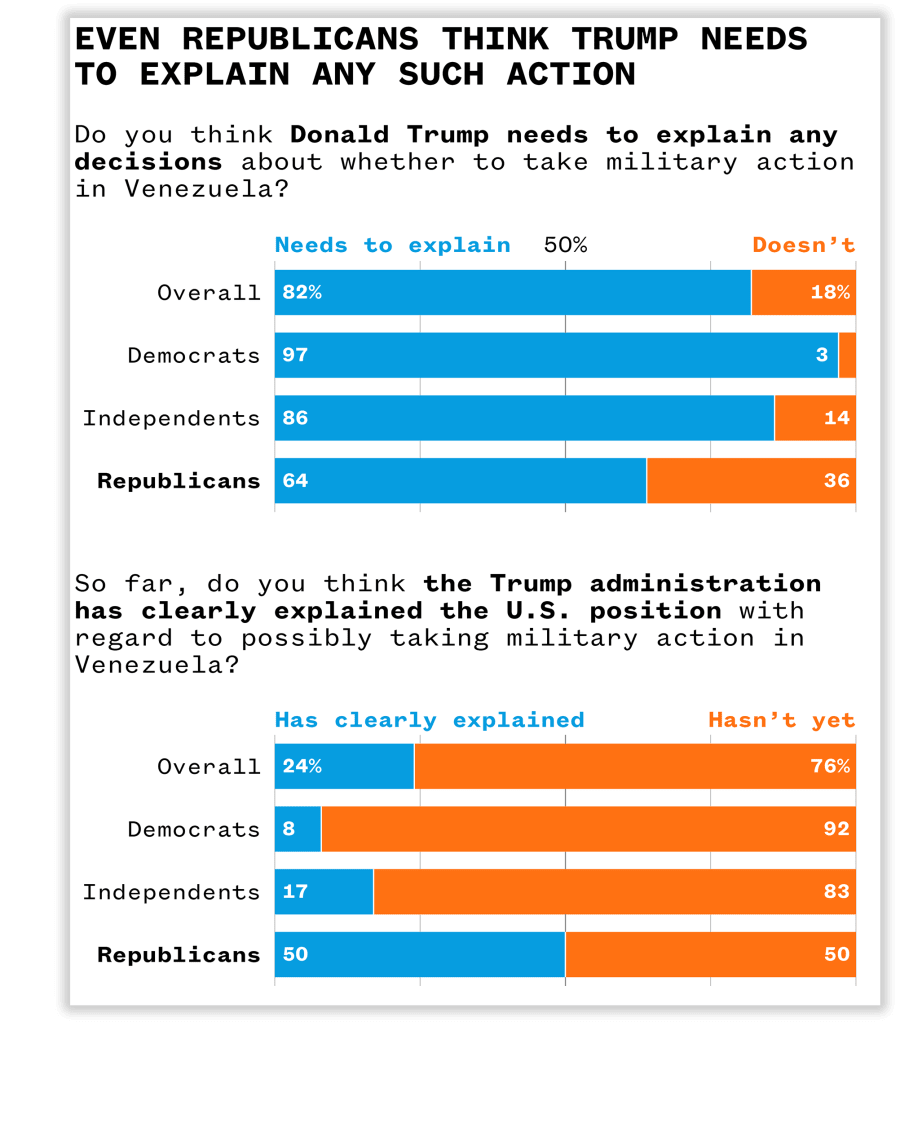
All of this context is useful when considering polling released earlier this week by CBS News. Conducted by YouGov, the poll found that most Americans oppose taking military action in Venezuela, something that the administration and its allies have moved from hinting at to talking about openly. It is the sort of conflict that a president and party that objected to new wars would presumably oppose — but it’s one for which Trump’s team is preparing and one that has the support of nearly 6 in 10 Republicans. The same poll found that Americans said that Trump needed to explain why he might engage Venezuela militarily (something he’s poised to do, given the buildup of forces in the region). Most Americans — including half of his own party — think he hasn’t yet done so. And yet! Nearly 6 in 10 Republicans still favor action. At least 1 in 10 Republicans, in other words, think Trump hasn’t explained why conflict should occur but are OK with it happening regardless. Some new wars, apparently. But hypocrisy is not the best way to understand what’s happening here. First, 40% opposition among Republicans to a proposed Trump action is high, though that skepticism would likely wither should a military conflict actually begin. Second, as detailed above, Trump never consistently committed to starting no new wars and, in fact, repeatedly suggested that he would use the threat of military action as a cudgel against foreign opponents. While he likely picked up some votes from people who believed that the line was forward-looking, most of his supporters (as is generally the case with supporters of a candidate) may have plucked that issue from the salad bar of rhetorical options reflecting positively on someone for whom they already planned to vote. Consider the gentleman with whom I spoke in that alley in Scranton the weekend before the election. Even without his stated concerns about that 24 year-old, he had plenty of other rationales ready to go.
Philip Bump is a data journalist and creator of the “How To Read This Chart” newsletter. He spent 11 years at The Washington Post and is the author of the 2023 book “The Aftermath.”