









For Donald Trump to win the White House he must find a way to attract more women voters to his candidacy. The presumptive Republican nominee faces many other demographic challenges — most notably with Latino and black voters — but his biggest hurdle is in trying to close the gender gap, according to public polling and past election results.
Women voters present a particularly difficult challenge for Trump in two ways. First, the Democratic edge with women is consistent. The party’s nominee has won women in every presidential election since 1992 – and usually by double digits. Second, women have made up more than 50 percent of the electorate in every presidential race since 1984. That’s a lot of votes.
Add in Trump’s current standing with women in polling data — and that he is likely going to be running against the first female major-party presidential candidate in history in Hillary Clinton — and the usual Republican gender gap for him looks like a gender chasm that could be very difficult to bridge.
The April NBC News/Wall Street Journal poll showed Trump actually had a 3-point lead over Hillary Clinton among men – 46 percent to 43 percent. The problem came with women, where Clinton held a 23-point edge. That’s a massive difference and if it held until November, Trump would almost certainly lose, badly.
The question is how much would Trump have to trim his gender gap to make it more manageable. The answer comes in the form of a two-step equation.
First, there is the composition of the electorate.
In 2012, 53 percent of those who voted were women, compared to 47 percent for men, according to exit polls. And that six-point gap was not extraordinary. Since 1984, women have held an edge of 4 to 6 points in every election except 2004; and in that election women held an 8-point edge among all voters.
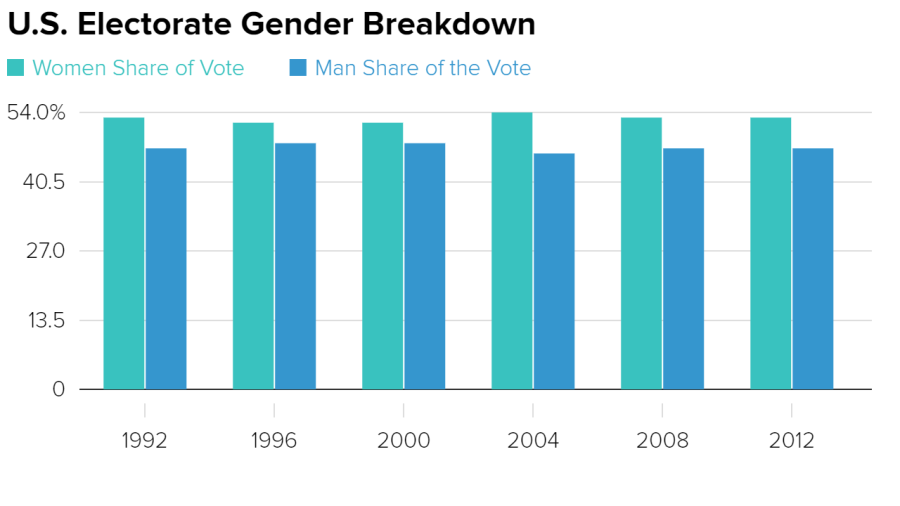
What if Trump could alter the math and turn out an army of male voters that changed the electorate to make it a more even, 2-point gap – 51 percent female to 49 percent male? Using 2012’s numbers that would require Trump to bring out somewhere around 3 million more male voters.
That not impossible, of course – only about 58 percent of eligible voters turned out in 2012 – but it’s not easy either. Remember the increases would have to come among men only and women have a 30-plus year track record of holding a large edge in the presidential electorate.
But let’s say that through a combination of personality and positions and enthusiasm, he can somehow get that difference down to 2 points. That brings us to the second part of the equation, how Trump does among men and women in the electorate.
In 2012, President Barack Obama won women by 11 points. That may sound like a big number, but it’s not historically speaking. Obama won women by 13 points in 2008. Former Vice President Al Gore won women by 10 points in 2000. Bill Clinton won them 17 points in 1996.

There is, in other words, a pretty solid Democratic tilt among women in presidential races in the past few elections. Some of that has to do with Democratic positions on issue such as abortion and some of it may be related to the candidates themselves. But there’s no reason to expect that Democratic lean to change in 2016, particularly with Trump’s atrocious numbers among women.
For the sake of argument, however, let’s say Trump finds a way to chip away at his bad number and somehow get Hillary Clinton’s advantage with women back down to 11 points, where it was for Obama in 2012. (And that’s a pretty favorable estimate for Trump considering that Clinton would be the first female nominee of a major American political party.) The presumptive Republican nominee would still need to find a way to bump up his numbers among men. The best number for Republicans among men in the last six presidential races was an 11-point edge for former President George W. Bush in 2000 and 2004. No other Republican presidential candidate got near that mark. In 2012, Mitt Romney had a 7-point edge among men. In 2008, Sen. John McCain narrowly lost men by 1 point. Even if Trump can do all of that – get his advantage with men up to Bush’s 11-point edge and get Clinton’s edge with women down to just 11 points – he still would come up short in the popular vote because of the first part of the equation: women produce more votes. It would be very close though, a margin of just less than a percentage point, maybe close enough to put the all-important Electoral College tally in play. Still, remember, just to get to this point we had to change the composition of the electorate to look like something it hasn’t in more than 30 years and give Trump good general election numbers among men and women. None of those things is impossible, but for Trump to bring them into the realm of probability he has a lot of work to do with women voters. This article first appeared on NBCNews.com.
Dante Chinni Recommended


