









For years, conservatives have accused Democrats of being socialists. And for years, liberals have accused Republicans of being fascists. It’s never been true — until maybe now, when there is an actual democratic socialist in the 2016 presidential race, along with a Republican whom many, including some in his own party, say borders on fascistic.
While Donald Trump and Bernie Sanders could not be farther apart ideologically, both have built nontraditional movements around their presidential candidacies by appealing to some of the same disaffected voters, those who appreciate blunt talk and an anti-establishment message.
RELATED: Trump, Sanders spar over similarities
Now, Sanders and his aides are making a direct attempt to woo at least some would-be Trump fans away from the dark side of populism, especially in New Hampshire, which has an open primary system that allows even a small number of independent voters to make a big impact.
“Bernie’s ability to appeal to a broad swath of voters, and not solely triple-prime Democrats, can make a crucial difference in the Live Free or Die state, where unaffiliated and independent voters play an enormous role,” said Sanders’ New Hampshire communications director Karthik Ganapathy. “Bernie’s message speaks to people who feel that frustration, but instead of channeling it towards hatred and xenophobia, offers voters a forward-looking and hopeful vision for the future.”
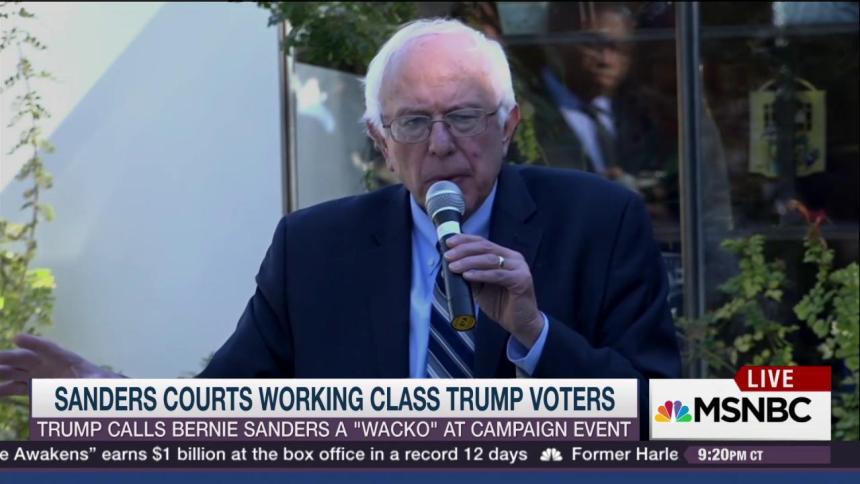
Both candidate share reliance on independents and those who have not voted before, and both have strong support among similar demographics, like middle-aged white men. Both have accused his rivals as being in the pocket of special interests, arguing for a systematic overhaul — they just disagree on what the country should look like afterward. And even operatives with rival campaigns privately say they’re surprised at how often they’ve encountered voters who say they like both Trump and Sanders.
How many Sanders-Trump voters actually exist, and whether they actually turn out to vote — let alone make a real difference — remains dubious. But Sanders will take what he can get.
He’s pulled no punches on Trump, whom he’s called racist sexist xenophobe. But he separates Trump from his supporters, whom Sanders says are primarily driven by economic anxiety.
“What Trump has done with some success is taken that anger, taken those [economic] fears which are legitimate and converted them into anger against Mexicans, anger against Muslims,” Sanders said Sunday on CBS’ “Face the Nation.” “I think for his working class and middle class supporters, I think we can make the case that if we really want to address the issues that people are concerned about … we need policies that bring us together,” he said.
Sanders has made a direct appeal to Trump voters while on the stump in Iowa. And in New Hampshire, aides said they found a larger-than-expected number of voters who say they’re deciding between the socialist and the billionaire. “We hear it a lot,” said one Sanders aide.
RELATED: The six biggest political surprises of the year
While any other Democrat would likely write off a voter who expresses a preference for Trump, Sanders canvassers are told to pitch their candidate to those voters. The campaign even prepared a script specifically for the situation.
“A lot of people feel like this country isn’t working for them — because it’s not,” Sanders canvassers are instructed to say, according to the script shared by the campaign. “[T]he solution is not to turn to someone like Trump, with a message of hate, xenophobia, and division — it’s to elect a leader with integrity like Bernie, who’s proven time and again that he won’t be held hostage by moneyed special interests. That’s the right way to address the challenges we face.”
It’s not hard to see why Sanders, the longest-serving independent in Congress, would be excited by the idea of winning non-partisan voters in New Hampshire. “Undeclared” voters vastly outnumber registered Democrats — 383,000 to 229,000, according to the secretary of state’s office — and made up 40 percent of those who voted in the 2008 Democratic primary. Sanders and his aides believe he is the Democrat best positioned to make a play for that swath in a critical state they say is a “must-win.” Experts are skeptical. “Past results show that registered Democrats are likely to make up a majority of the primary electorate. Sanders either has to convince more of these voters to support him or he has to turn out an unprecedented number of independents and brand new voters,” said Patrick Murray, director of the independent Monmouth University Polling Institute. Andy Smith, the director of the University of New Hampshire Survey Center, said that every year some candidate attempts to capitalize on the “myth of the independent voter.” “It’s just never been the case that independents have really swung an election for a candidate here,” he noted. At least two-thirds of the state’s undeclared voters are really Republicans or Democrats who vote consistently in their party’s primary, while the remaining third are largely low-propensity voters mostly detached from politics. Only about 4 percent to 5 percent of the undeclared electorate was genuinely up for grabs between the parties in most recent election when both parties had contested primaries, according to Smith. In the 2000, Democratic challenger Bill Bradley made a show of appealing to independent voters in New Hampshire and succeeded in winning the bloc — but front-runner Al Gore swamped him with registered Democrats and carried the contest. Still, in a tight election, as the Feb. 9 primary is expected to be, a few thousand voters could make a big difference. And if anyone can break the mold, Sanders thinks it’s him. His campaign is predicated on the idea of sparking a political revolution with a flood of new voters to the poll. And he’s done it in Vermont, where Sanders is the most popular senator in the country with an 83% approval rating, according to a recent Morning Consult poll. That’s 12 points higher than Vermont Democratic Sen. Patrick Leahy’s rating, presumably thanks to support from non-Democrats — no small feat in a polarized era where it’s typically impossible for a politician of one party to win voters on the other side.
Alex Seitz-Wald Recommended


