








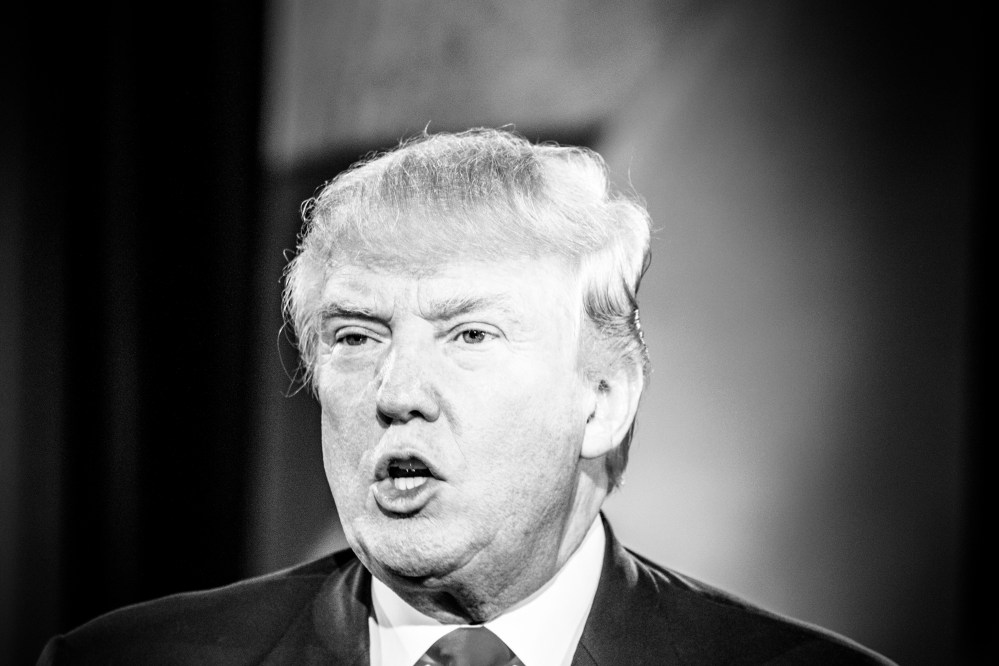
Not long ago, Democratic operatives stifled grins and tried to conceal their enthusiasm when asked about the prospect of running against Donald Trump in November. Could they possibly be so lucky?
But as Trump vanquishes his GOP challengers and climbs in the polls, defying all political gravity, the glee is turning to unease for many Democrats who worry that the general election could turn into a nasty and unpredictable house of horrors.
A Hillary Clinton vs. Donald Trump contest is no longer a passing fantasy but the most likely scenario, and Democrats are bracing for a white-knuckle ride. Electoral college math still favors Democrats in a presidential election, but the way forward is so unsettling that it’s hard for them to feel excited anymore.
Yes, Trump is incredibly divisive and has sky-high negative ratings. Yes, he could inflame turnout among exactly the demographic blocs Democrats need to get to the polls in a general election. And yes, there’s a good chance his appeal is limited to a narrow slice of Republican primary voters.
But Trump has exceeded all expectations already and is running a playbook no one has ever seen before. Anything seems possible, from a Barry Goldwater-style blowout to a Trump victory despite Democrats’ structural advantages.
“While on its face it may make sense to root for Trump to win the nomination because he seems like the easiest to defeat, variables are not your friend in a presidential campaign,” said Ben LaBolt, a former Obama campaign aide. “You need to build a model that predicts turnout on both sides. And because Trump is such an unconventional politician, it’s hard to predict who will show up for him.”
Democrats win the presidency today by identifying their voters and getting them to the polls in a hyper-partisan environment. The party has built a high performance and precisely calibrated machine to accomplish that goal. But like a sports car, it’s not necessarily reliable in off-road terrain. Trump’s unusual coalition, which pulls from Democrats, independents and all stripes of Republicans, could test its ability to handle unexpected bumps.
Some in Clinton’s orbit see bad omens: The middle-aged African-American cab driver who drove one operative and said he voted for both Clintons, but now likes Trump. The young would-be Bernie Sanders voter who likes that Trump can’t be bought because he funds his own campaign. The labor-commissioned survey that finds a surprising number of blue collar Democrats intrigued by Trump.
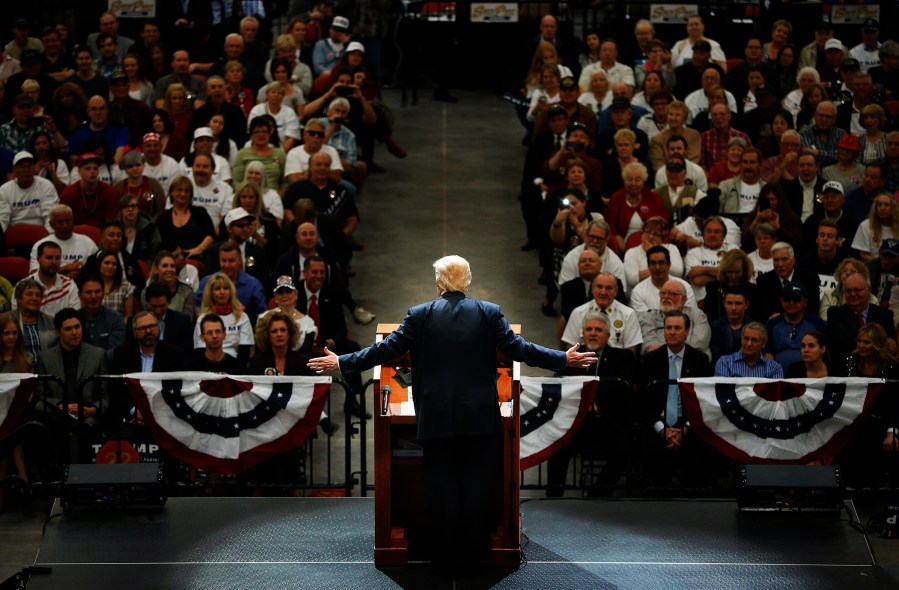
Trump’s vague platform, which has little connection to conservative orthodoxy, could give him more flexibility to retool in a general election than conventional Republicans. “I’m very capable of changing to anything I want to change to,” Trump told Fox’s Greta Van Susteren earlier this month.
In an interview with MSNBC, Ruy Teixeira, a senior fellow at the Center for American Progress specializing in demographics, argued that Trump’s path through the electoral map would be difficult, especially if minority voters upset with his bigoted rhetoric push swing states like Colorado and Florida out of contention early.
But according to Teixeira, a Trump victory would not be impossible either: If his populist message boosts turnout and margins with working class white voters high enough in the Rust Belt and Upper Midwest, he could win even while alienating black and Latino voters.
“You could see a situation where someone like Trump could carry Ohio, Iowa, Wisconsin, maybe Pennsylvania,” he said. “That starts to put a real dent in the Democratic coalition.”
While Trump’s offensive language is undoubtedly a huge liability in a general election, it’s also a dangerous weapon. He’s already accused Bill Clinton of being a sexual abuser, an attack no other candidate is likely to level at the former president and one that some observers think contributed to Hillary Clinton’s drop in polls in the beginning of the year.
The attack on Bill Clinton seemed to unsettle the former secretary of state’s campaign. After spending months blasting Trump without hesitation, Hillary Clinton suddenly had nothing to say about him. “That’s not something we’ll engage in, we’re not going to try to respond. We will just let people run their campaigns any way they want,” Clinton said at a forum in Iowa in January after Trump brought up her husband’s indiscretions.
People familiar with the Clinton campaign’s thinking say they’re confident she can beat Trump — but that the race would likely to be much uglier and potentially more damaging than against another nominee. People are “insane” if they think this will be a walkover, one pro-Clinton operative said.
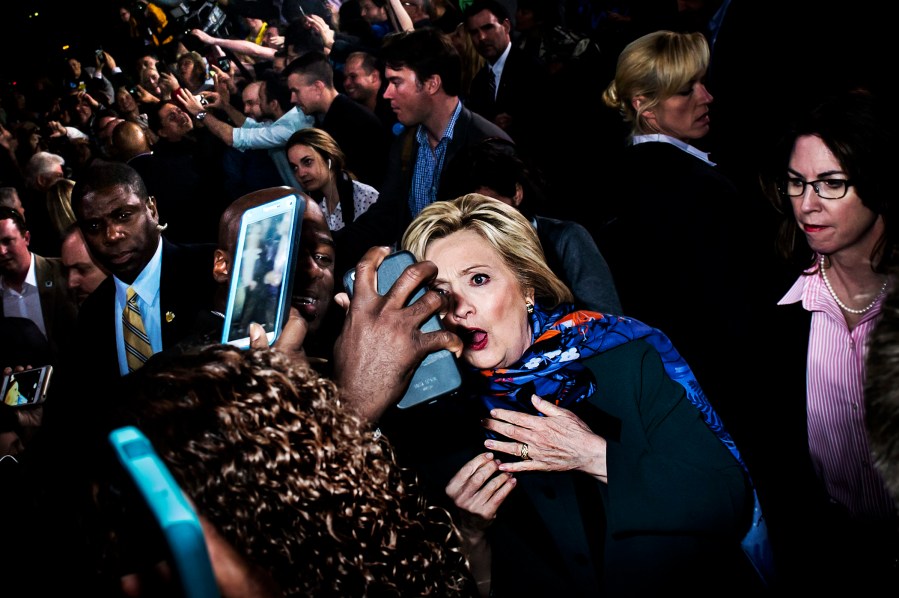
“It’s very hard to counter someone who is in every single news cycle and who is always on offense in every single news cycle. Especially when they have no respect for boundaries that other candidates typically respect,” said David Brock, who is at the nexus of several pro-Clinton super PACs, and who has been warning Democrats about Trump while traveling the country on a book tour.
“I haven’t even started with her,” Trump warned in Thursday night’s Republican debate.
The opening salvo against Trump is likely to come quickly and it will not be subtle. Democratic outside groups are ready to declare total war the moment Trump locks in his path the nomination and won’t let up until November 8.
American Bridge, one of the groups Brock founded, began culling through all of Trump’s 816 businesses this summer to collect legal records, lawsuits, news clippings and more.
Democrats also see an opportunity to hack Trump’s aggression by engaging him in a constant succession of street fights so that he never has time to actually present a positive narrative for himself. Republicans who are not supporting Trump are just as unsure of his general election prospects. Some are openly predicting a historic disaster in line with 1964 or 2008. “We’ll get slaughtered,” South Carolina Sen. Lindsey Graham told reporters this week. A number of prominent conservative commentators, including RedState’s Erick Erickson, have pledged not to vote for Trump under any circumstances, raising the prospect of a third party siphoning Republican support and clearing the way for Democrats further. But others are less willing to assume electoral doom for the same reason Democrats are unwilling to write off Trump: He’d run a campaign like no other. One unaligned Republican strategist predicted ads featuring Juanita Broaddrick or baseless speculation about Hillary Clinton’s physical health, a popular topic on the Drudge Report. “In the end, while I’d bet against Trump, I think he stands at least a 30-40 percent chance of pulling it off because he’d do things that are simply not on the table,” the strategist said. In a sign of things to come, Trump supporter and former longtime political adviser Roger Stone recently promoted a GoFundMe page to make mortgage payments for Kathleen Willey, another 90s-era Bill Clinton accuser. Stone, who once started an anti-Hillary Clinton group with an unprintable misogynist acronym, recently co-authored a book with a longtime Clinton conspiracy theorist who has accused the family of murder and drug smuggling. Republican consultant Curt Anderson predicted the election would be among the most grotesque in modern memory. For both Clinton and Trump, the path to victory would likely require a scorched-earth campaign targeting a large swath of voters who dislike them both. “Such a race would represent the death of subtlety in America,” Anderson said. “It would be a blunt force trauma race with a mind numbing series of attacks and counterattacks.” Not all Democrats agree, and some still see Trump as an ideal challenger. “Boy I wish I could run as easily as against somebody named Donald Trump,” said Virginia Rep. Gerry Connolly at an event with Bill Clinton this week. His colleague, Democratic Rep. Don Beyer added, “Hillary is going to kill him.” Paul Begala, the long-time Clinton strategist now involved with pro-Clinton super PAC Priorities USA, said his party is prepared. “Democrats have never (as Dubya would say) misunderestimated Trump. He is the front-runner of the GOP because they love his racist, misogynistic, Islamaphobic message. That and the GOP establishment is too pusillanimous to take him on. We are not,” he said. Democrats are likely to reprise the line of attack used against Mitt Romney in 2012, to paint Trump as ruthless businessman who doesn’t care about the little-guy voters he claims to champion. It could be harder to define Trump than Romney, Democrats acknowledge, thanks to the fact that most Americans have already formed opinions of him. Hillary Clinton herself, in a fundraising email Thursday night told supporters: “I’ve said for a long time that Trump isn’t a joke, and now, he’s looking more and more likely to be the Republican nominee.” There is also an endless supply of outrageous quotes from Trump bashing Latinos, women, Muslims, African-Americans Democrats will resurface to keep him from moving to the center. “I spend every day wishing for a Trump victory,” one veteran Democratic operative said. “Many beds in [Washington] will be wet on a regular basis, but the upside potential for Democrats up and down the ballot is basically limitless.”
Benjy Sarlin
Alex Seitz-Wald Recommended


